
Archaia Olympia and the sanctuary where the Olympic Games began
Published on 08/30/2026 at 10:21 | Editorial responsibility: Rafael Müller, Editor-in-Chief AD HOC NEWS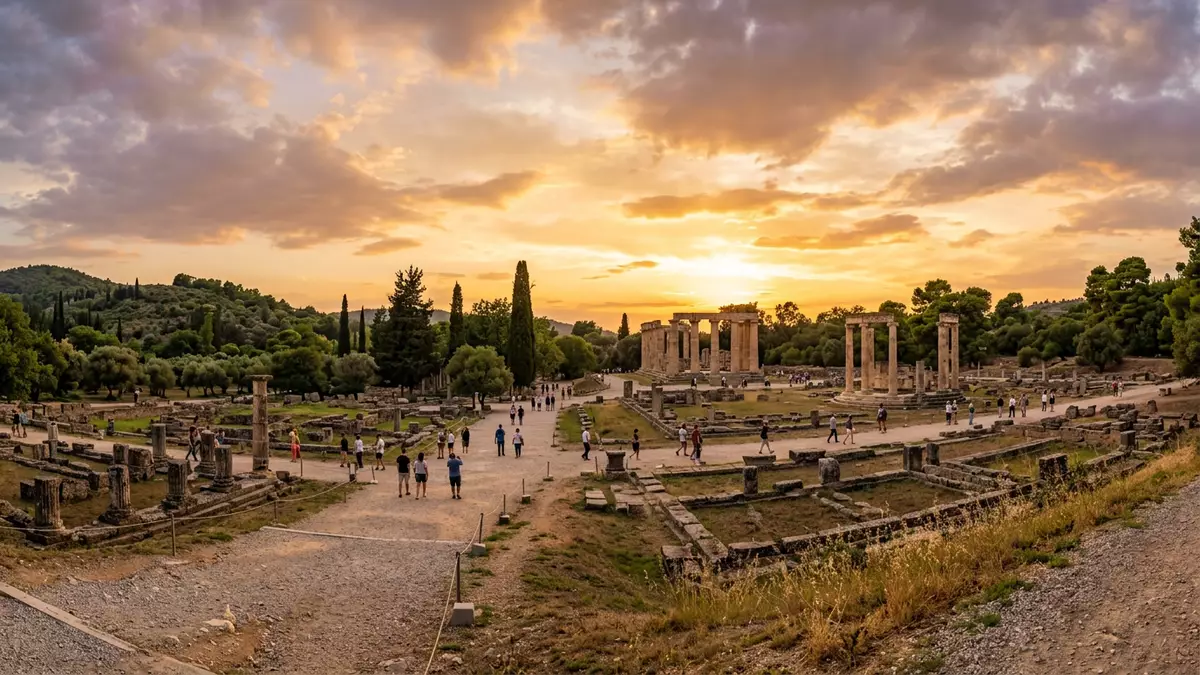
Archaia Olympia in Olympia, Greece, is both a small town in Elis and the gateway to the archaeological site where the Olympic Games began in antiquity. In a river valley in the north-western Peloponnese, the modern settlement stands beside the sanctuary of Zeus and the stadium that carried the games for many centuries, anchoring everyday life to one of the most resonant places in the ancient Greek world.
Sanctuary of Zeus in a river valley
The archaeological site associated with Archaia Olympia lies in a fertile valley shaped by the meeting of the Alpheios and Kladeos rivers, a landscape of low hills and alluvial ground that framed the ancient sanctuary.The sanctuary of Olympia in the Peloponnese grew here as a religious centre dedicated to Zeus, with its core in the sacred enclosure known as the Altis. Within this precinct, temples, treasuries and cult buildings stood among groves and altars, forming a dense concentration of classical architecture and votive monuments in stone and bronze.
Life in the Altis began in prehistoric times, and by the tenth century BC Olympia had become a recognised centre for the worship of Zeus.The sanctuary developed as a focus of Zeus worship and gradually gathered both religious and athletic structures over many generations. The Heraion, dedicated to Hera, and other temples rose alongside stoas, treasuries from different Greek cities and numerous dedications, shaping a place where political, artistic and spiritual life intersected in visible form.
Birthplace of the ancient Olympic Games
Archaia Olympia is closely tied to the stadium and sports grounds where the ancient Olympic Games were held, making the valley not only a seat of worship but also a centre of athletic competition. The Olympic Games are recorded as beginning in 776 BC, with contests repeated every four years in honour of Zeus and drawing athletes from across the Greek world.Olympia functioned as a Panhellenic sanctuary in which the games formed part of a wider festival.
The stadium remains one of the most striking features on the site, with a long running track laid out on packed earth and flanked by simple earthen banks that once held large crowds of spectators.Athletic premises such as the stadium, gymnasion and palaestra stood close to the sacred Altis. Training grounds, starting mechanisms for races and buildings for judges and officials formed a coherent ensemble, showing how athletic discipline and religious ritual shared the same ground rather than belonging to separate quarters.
Archaia Olympia as town and World Heritage site
Modern Archaia Olympia is a town in the regional unit of Elis on the Peloponnese peninsula, recognised officially under that name and known for its proximity to the ruins that carry the formal title Archaeological Site of Olympia.Archaia Olympia is the official name of the settlement, and the town and site together form a single point of reference for visitors interested in ancient Greece. The archaeological zone has been inscribed on the UNESCO World Heritage List since 1989 under the name Archaeological Site of Olympia, recognising its outstanding testimony to classical civilisation.The site entered UNESCO’s list in 1989, securing international protection for both the ruins and their surrounding landscape.
Within the site, some structures have been partially restored, including the Heraion and the palaestra, helping visitors read the ground plan and imagine the volumes that once rose above the foundations.The municipality highlights the Heraion, palaestra and the Crypt leading into the stadium among the visible elements. Elsewhere, fallen columns, scattered drums and low walls mark the outlines of buildings that have not been re-erected, leaving an open archaeological landscape in which stone and earth carry the lines of the ancient sanctuary more than towering structures.
Visiting Archaia Olympia: what travellers from Western Europe should know
- Archaia Olympia lies in the regional unit of Elis in western Greece, in the north-western Peloponnese, reached by road connections from nearby towns such as Pyrgos and from the port of Katakolon.
- The archaeological site occupies gently sloping ground in a river valley; paths run across earth and stone surfaces among ruins, and movement between the stadium, Altis and surrounding structures involves extended walking on uneven terrain.
- The official language is Greek and the currency is the euro.
- Entry requirements depend on your nationality; UK travellers can check the FCDO travel advice at gov.uk/foreign-travel-advice, Irish travellers the Department of Foreign Affairs at ireland.ie.
Searching for Archaia Olympia on social platforms
These links open searches for Archaia Olympia on each platform.
Frequently asked questions about Archaia Olympia
Where is Archaia Olympia located?
Archaia Olympia is a town in Elis in western Greece, on the Peloponnese peninsula, beside the archaeological site known as the Archaeological Site of Olympia.
What should visitors expect at the archaeological site?
Visitors encounter an open landscape of ruins including the Altis sanctuary, temples, treasuries, athletic grounds such as the stadium and palaestra, and partly restored structures like the Heraion.
What makes Archaia Olympia distinctive among ancient sites?
Archaia Olympia combines a major sanctuary of Zeus with the stadium and sports facilities where the ancient Olympic Games were held, linking religious architecture and athletic infrastructure in a single valley.


