
Arches National Park and the stone arches of Moab
Published on 09/17/2026 at 18:29 | Editorial responsibility: Rafael Müller, Editor-in-Chief AD HOC NEWS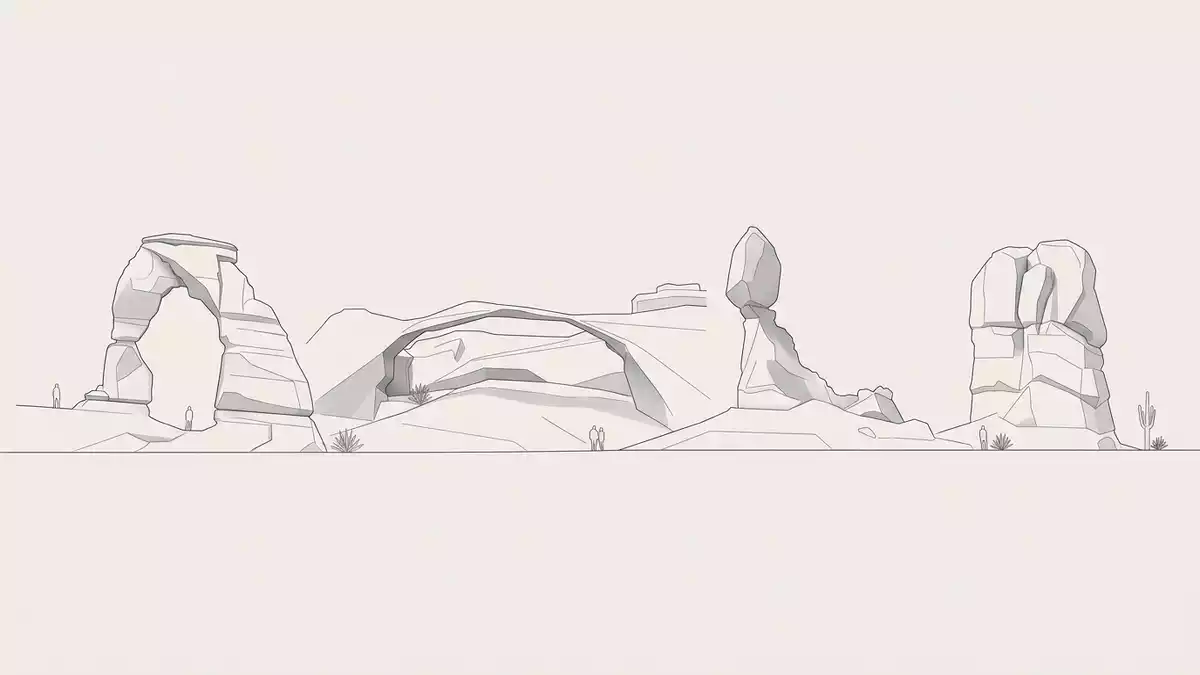
Arches National Park near Moab in Utah is a desert landscape where red sandstone arches, fins and towers define almost every horizon. Set on the Colorado Plateau in the south-east of the state, the park preserves a dense concentration of natural stone arches within a relatively compact area of high desert terrain.
Sandstone arches in a concentrated desert landscape
Arches National Park lies in Grand County in eastern Utah, on a section of the Colorado Plateau that carries thick layers of exposed sandstone shaped into cliffs, domes and narrow ridges. Within the park boundaries, more than 2,000 natural sandstone arches have been documented, ranging from fine slits in the rock to wide spans that connect two massive walls of stone.over 2,000 documented arches This density of arches is a defining feature: the rock forms appear across the park, in large groups and solitary outcrops, rather than as isolated curiosities.
The park sits above an underground salt bed in the Paradox Basin, a thick sequence of evaporite deposits laid down hundreds of millions of years ago.underground evaporite layer or salt bed Movement and dissolution of these deeper salt layers produced anticlines and other structures in the overlying rocks, creating zones of fracturing and uplift. On the surface, the visible result is a landscape dominated by red sandstone formations such as arches, fins, balanced rocks, mesas and narrow canyons, with bare rock and sand covering much of the ground.landscape dominated by red sandstone formations
Geology: Entrada Sandstone and the Paradox salt
The arches at Arches National Park are largely carved from Entrada Sandstone, a salmon-coloured rock unit formed from ancient desert dunes in the Jurassic period.blocks of Entrada Sandstone In places, arches also form in related units such as the Moab Member of the Curtis Formation and the Dewey Bridge Member of the Carmel Formation.three named geologic units These sandstones are relatively hard but cut by vertical fractures, providing the raw geometry for erosion to exploit.
Beneath these sandstones lies the Paradox Formation, a salt-rich unit deposited when a shallow sea covered this part of the Colorado Plateau during the Pennsylvanian period.underground salt bed called the Paradox Formation As salt moved and dissolved, the overlying rock buckled and cracked, creating elongated domes and valleys such as Salt Valley and Cache Valley. Around these collapsed salt anticlines, Entrada and Navajo Sandstones crop out in thick, vertical walls, with closely spaced parallel fractures. Over time, weathering along these fractures turned solid blocks into slender fins; further erosion then opened holes within the fins, enlarging them into arches.
From national monument to national park
The protected status of Arches dates to the early twentieth century, when the United States government moved to safeguard the area’s distinct stone formations. On 12 April 1929, President Herbert Hoover signed a proclamation establishing Arches National Monument.Presidential Proclamation No. 1875 Later legislation expanded and reclassified the site, and in the early 1970s Arches gained its present designation as a national park under federal law.changing Arches from a National Monument to a National Park
As a national park, Arches forms part of a wider network of protected landscapes across the American West. Together with other parks and monuments on the Colorado Plateau, it preserves examples of sedimentary geology spanning from the Pennsylvanian Paradox Formation to younger units such as the Cretaceous Mancos Shale.ten major sedimentary formations Within this sequence, the park’s sandstone cliffs and natural arches offer a concise cross-section of desert geomorphology shaped by water, wind and temperature changes over long spans of time.
Visiting Arches National Park: what travellers from Western Europe should know
- Arches National Park lies north of Moab in eastern Utah, reached by road that branches from U.S. highway routes serving the town and the wider canyon country of the Colorado Plateau.
- Much of the park’s terrain consists of bare sandstone, uneven slickrock and sandy washes, with established paths and viewpoints involving short walks over rock steps and gentle slopes.
- The high-desert setting means wide, open views across sandstone fins and distant mesas, with limited shade away from cliffs and rock overhangs.
- The official language is English and the currency is the United States dollar.
- Entry requirements depend on your nationality; UK travellers can check the FCDO travel advice at gov.uk/foreign-travel-advice, Irish travellers the Department of Foreign Affairs at ireland.ie.
Searching for Arches National Park on social platforms
These links open searches for Arches National Park on each platform.Frequently asked questions about Arches National Park
Where is Arches National Park?
Arches National Park is in Grand County in eastern Utah, north of the town of Moab on the Colorado Plateau in the south-west of the United States.
What can visitors expect on a visit?
Visitors encounter extensive red sandstone formations including natural arches, fins and balanced rocks, with viewpoints and short walks across slickrock and sandy terrain.
What makes Arches National Park distinctive?
Arches National Park is distinctive for its high concentration of natural sandstone arches, many carved in Jurassic-age Entrada Sandstone above the salt structures of the Paradox Formation.


