
Arena di Verona, the Roman amphitheatre at the heart of Verona
Published on 09/19/2026 at 09:14 | Editorial responsibility: Rafael Müller, Editor-in-Chief AD HOC NEWS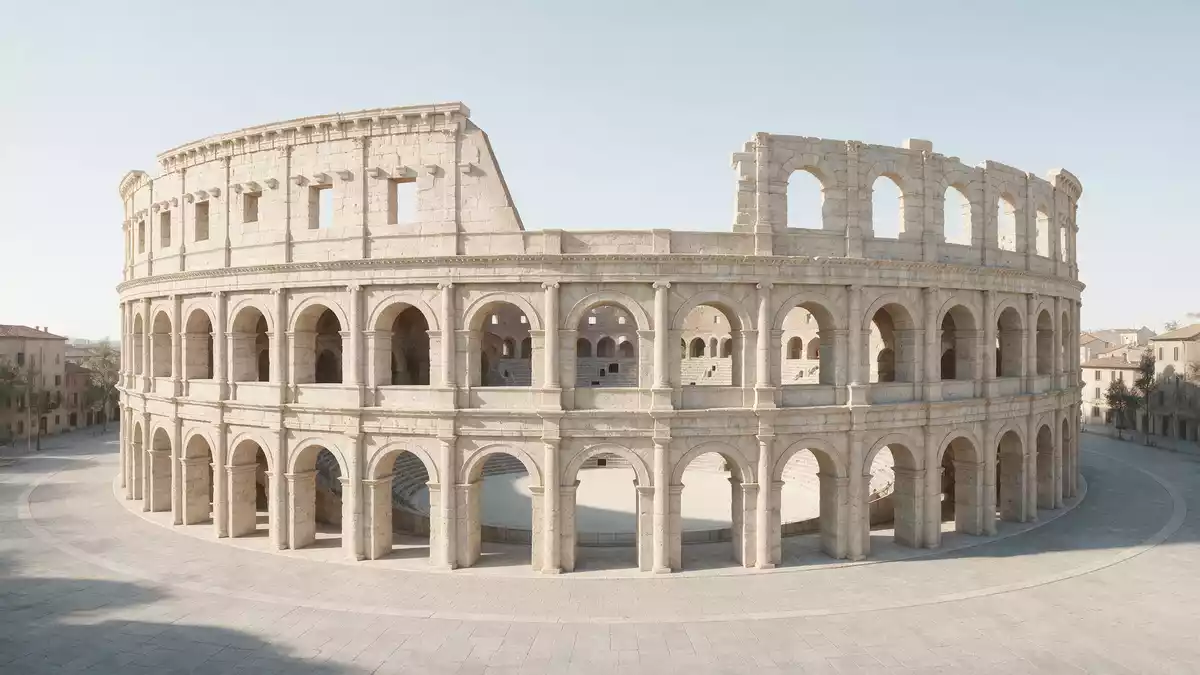
Arena di Verona is a Roman amphitheatre of stone tiers and arcades embedded in the historic centre of Verona, where an ancient performance space still frames large-scale shows in the open air. Built in the first century AD, it has carried the city’s name through nearly two millennia of spectacle and reuse, from gladiatorial contests to modern staging on the same rising steps.
A Roman amphitheatre shaped for spectacle
Arena di Verona is one of the large Roman amphitheatres that survive substantially intact, and it stands in Verona as a closed oval of masonry with rising seating around a central arena floor.Roman amphitheatre in Verona The building was constructed during the early imperial period, with most studies placing its completion in the first century AD, probably around AD 30, at a time when Verona was a Roman colony integrated into northern Italian trade routes.built around 30 AD Its form follows the standard amphitheatre layout: an enclosed arena encircled by concentric rings of seating, supported by a network of substructures and corridors.
The overall footprint is large enough to rank among the major amphitheatres in Italy, with a long axis of about 152 m (499 ft) and a shorter axis of about 123 m (404 ft), giving the exterior its imposing elongated oval.dimensions of the Arena In Roman times the cavea, the stepped seating built on the sloping substructure, accommodated in the region of 30,000 spectators, a scale that makes Arena di Verona one of the largest surviving amphitheatres of the Roman world.capacity of about 30,000 The monument’s substantial height, which reaches well over 20 m (65 ft) at the preserved outer wall, adds to the sense of enclosure when one stands at arena level and looks up towards the highest tiers.
Stone, arches and a layered history
The amphitheatre is built largely from local limestone, including pink and light-coloured stone from the hills north of Verona, which gives the exterior a two-tone appearance where the materials meet.pink-and-white limestone of Valpolicella From the outside, Arena di Verona is read in stacked horizontal bands: an outer ring of arches for access at ground level, higher walls with arcaded openings, and above them the line of the seating steps. Inside, the cavea rises in successive tiers, originally divided into sectors and levels that reflected Roman social ordering, all focused on the sand-covered arena at the centre.
In its earliest centuries the amphitheatre hosted public spectacles characteristic of Roman civic life, including gladiatorial combats and animal hunts staged in the enclosed arena.venue for public spectacles Over the medieval period its use changed repeatedly: sections of the structure were adapted for fortification, dwellings and tournaments, and its masonry suffered from seismic events, notably an earthquake in 1117 that destroyed much of an original outer façade which had enclosed the building in an additional ring of arches.earthquake of 1117 What visitors see now is the inner body of the amphitheatre: the main structure with its arcades and seating largely preserved, while only a fragment of the grand outer ring survives as a freestanding segment on one side.
From gladiatorial arena to open-air performance venue
The most striking aspect of Arena di Verona for many visitors is that the amphitheatre is not a ruin frozen in a single era but a working venue adapted to the scale of its Roman envelope. The stone steps of the cavea are used as terraces for seating, while modern staging and temporary structures occupy part of the arena floor and some of the lower tiers during performance seasons.amphitheatre used for large-scale shows This reuse has become a defining feature of the monument’s identity: ancient masonry carries lighting, scenery and sound equipment, yet the fundamental spatial relationship between audience and central performance space remains recognisably Roman.
Opera has been the principal performance form associated with Arena di Verona for more than a century, with large productions staged on the broad arena floor and spectators arrayed on the stone terraces that rise around it.opera and theatre season Beyond opera, the amphitheatre hosts a range of concerts and events, all making use of the deep perspective from the lower seating to the topmost rows and the open sky above the elliptical enclosure. For visitors, the contrast between walking the high outer steps by day, reading the stonework and arches in full light, and seeing the same space lit for a performance on an evening visit underlines how Arena di Verona holds both archaeological monument and living venue in a single structure.
Visiting Arena di Verona: what travellers from Western Europe should know
- Arena di Verona stands on Piazza Bra in Verona’s historic centre, a short walk from Verona Porta Nuova railway station along streets that lead directly towards the amphitheatre.
- The monument consists of stone steps, internal corridors and sloping passages; reaching the upper tiers involves climbing stairways with significant height gain.
- The amphitheatre lies within Verona, in north-eastern Italy, where the official language is Italian and the currency is the euro.
- Entry requirements depend on your nationality; UK travellers can check the FCDO travel advice at gov.uk/foreign-travel-advice, Irish travellers the Department of Foreign Affairs at ireland.ie.
Searching for Arena di Verona on social platforms
These links open searches for Arena di Verona on each platform.
Frequently asked questions about Arena di Verona
Where is Arena di Verona located in the city?
Arena di Verona stands on Piazza Bra at the edge of Verona’s historic centre, close to major streets and within walking distance of Verona Porta Nuova station.
What can visitors expect when entering the amphitheatre?
Visitors move through stone corridors and stairways before emerging onto the cavea, where rising tiers of seating encircle the central arena floor beneath an open sky.
What makes Arena di Verona distinctive among Roman amphitheatres?
Its combination of large Roman oval, pink-and-white limestone construction and continued use as a performance venue gives Arena di Verona a distinctive presence in Verona.


