
Aso-san: a volcanic world within a vast caldera
Published on 09/23/2026 at 16:16 | Editorial responsibility: Rafael Müller, Editor-in-Chief AD HOC NEWS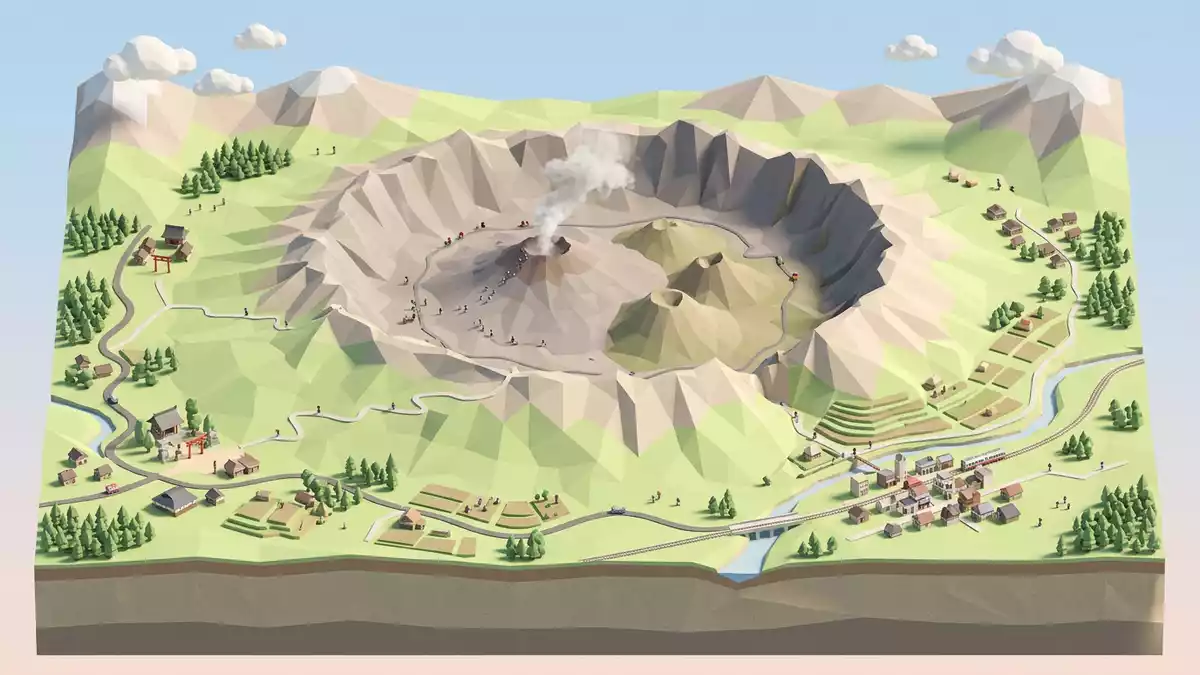
Aso-san is a volcanic landscape rather than a single isolated peak. In central Kyushu, Japan, its central cones rise inside a caldera measuring about 25 km (16 miles) from north to south and 18 km (11 miles) from east to west. The scale of that basin is the defining view: villages, farmland, roads and volcanic summits occupy the same immense depression.
The landscape remains active. Nakadake, the central cone associated with Aso-san, has a steaming crater, while the surrounding caldera holds grasslands, hot springs and the city of Aso. The visible scene combines deep geological time with a lived-in rural region.
Aso-san and the shape of a collapsed volcano
A caldera is a broad volcanic depression formed when the ground collapses after major eruptions. Aso’s present landform records four immense pyroclastic-flow eruptions between about 270,000 and 90,000 years ago. The largest event in this sequence formed much of the caldera seen today.
The depression has an inner area of roughly 350 square kilometres. Its outer rim reaches around the central cones, while the caldera floor contains the Asodani and Nangodani valleys. The contrast between steep walls, open pasture and dark volcanic peaks gives Aso-san its distinctive spatial character.
The Aso Caldera dimensions are recorded as approximately 18 km east to west and 25 km north to south.
Nakadake, the active centre of Aso-san
Nakadake is the active volcanic centre within the caldera. It belongs to a group of central peaks known as Aso Gogaku, alongside Takadake, Nekodake, Kijimadake and Eboshidake. Their ridges form the elevated core of the wider Aso volcanic system.
The highest summit in the group is Takadake, reaching 1,592 m (5,223 ft). Nakadake is the cone most closely associated with visible volcanic activity, including fumes rising from its crater. Its presence gives the landscape a changing visual focus, from broad pasture to a stark volcanic rim.
The Nakadake crater is a representative geosite within the Aso UNESCO Global Geopark.
Aso-san is also known by the Japanese name Aso-san, while “Aso” refers both to the volcano and to the surrounding region. The distinction matters because the landscape includes a whole caldera, not merely the summit visible from one viewpoint.
Grasslands, settlements and volcanic heritage
The caldera floor is not an empty wilderness. Cultivated land, roads, railway lines, villages and the city of Aso occupy parts of the basin. Pasture extends across open slopes, creating a broad green setting around the volcanic cones.
This combination of habitation and active geology is central to the character of Aso-san. The volcano is part of a regional landscape that includes hot springs, agricultural valleys and the protected scenery of Aso-Kuju National Park, established in 1934.
Aso-san also forms part of the Aso UNESCO Global Geopark, whose designation dates from 2014. The geopark presents the caldera, volcanic rocks, valleys and human settlements as connected elements of one geological region.
The Aso Geopark landscape includes the central peaks, the caldera floor and the outer rim around them.
Views across Aso-san can therefore include several scales at once: a crater rim nearby, a cone rising across the basin and the distant wall of the caldera. The broad setting makes the volcano legible as a landform, not merely as a summit.
Visiting Aso-san: what travellers from Western Europe should know
- Aso-san lies in Kumamoto Prefecture on Kyushu. The JR Hohi Main Line crosses the caldera, with Aso Station serving the northern part of the region.
- The volcanic landscape includes steep caldera walls, exposed crater terrain and high open slopes. Conditions on the mountain change with the seasons; the local cable-car operators and alpine clubs provide information.
- Aso-Kuju National Park surrounds the central volcanic area. The caldera floor contains roads, railway lines, pasture and settled valleys rather than a single enclosed attraction.
- The official language is Japanese and the currency is the Japanese yen.
- Entry requirements depend on your nationality; UK travellers can check the FCDO travel advice at gov.uk/foreign-travel-advice, Irish travellers the Department of Foreign Affairs at ireland.ie.
Searching for Aso-san on social platforms
These links open searches for Aso-san on each platform.
Frequently asked questions about Aso-san
Where is Aso-san?
Aso-san is in central Kyushu, within Kumamoto Prefecture, Japan. The volcano and its caldera surround the city and region of Aso.
What does a visit to Aso-san involve?
A visit can include views across the caldera, volcanic peaks, grasslands, crater landscapes and settlements on the basin floor. The terrain ranges from open valleys to elevated volcanic ground.
What makes Aso-san distinctive?
Its defining feature is the enormous caldera surrounding the active central cones. Nakadake, pasture, hot springs and inhabited valleys form one connected volcanic landscape.


