
At-Turaif, earthen citadel above the oasis of Diriyah
Published on 09/18/2026 at 20:53 | Editorial responsibility: Rafael Müller, Editor-in-Chief AD HOC NEWS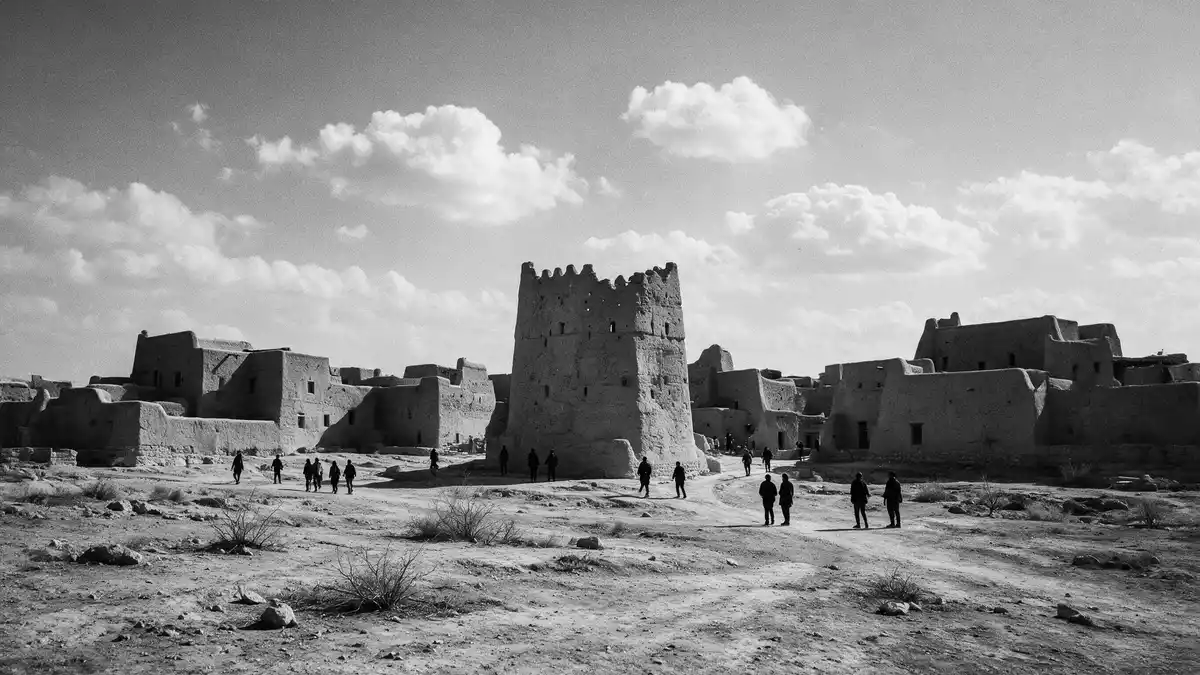
At-Turaif is a historic mudbrick district in Diriyah, on the north-western outskirts of Riyadh, rising above the palm-lined Wadi Hanifah oasis in central Saudi Arabia. Recognised as a UNESCO World Heritage Site since 2010, it preserves the Najdi earthen architecture that framed the political heart of the First Saudi State in the eighteenth century.
An earthen capital on a desert plateau
At-Turaif occupies a raised spur on the western side of Wadi Hanifah, its palaces, mosques and houses forming a dense earthen citadel above the valley landscape. The historic district lies within Diriyah in the Riyadh Region of Saudi Arabia, north-west of the contemporary capital and closely linked to the wider oasis settlement along the wadi.At-Turaif District in ad-Diriyah The inscribed area extends across a limestone plateau, where mudbrick structures stand on stone foundations and step towards the edge of the oasis.World Heritage identification and area
Diriyah emerged as a seat of power on the central Arabian plateau in the fifteenth century, and At-Turaif became the citadel that anchored this authority above the oasis. During the eighteenth and early nineteenth centuries the district served as the centre of governance for the First Saudi State, with its fortified ensemble reflecting the temporal power of the House of Saud and its close connection to religious reform.Nomination dossier for At-Turaif The historic status of the site is therefore tied both to its physical fabric and to its role in the formation of the Kingdom of Saudi Arabia.historic district of At-Turaif
Najdi mudbrick architecture in concentration
What sets At-Turaif apart is the concentration of Najdi mudbrick architecture preserved across the district. The buildings draw on local earth for thick walls, parapets and towers, often laid on limestone foundations that stabilise the ensemble on the plateau above Wadi Hanifah.earthen capital above the oasis The resulting fabric reads from the valley as a mass of earth-toned volumes, stepped rooflines and projecting elements rising above the greenery of the oasis.
Within the inscribed area lie palaces, a mosque and surrounding urban fabric that together illustrate how a traditional human settlement adapted earthen construction to a desert environment.listed property covers palaces and mosque UNESCO’s recognition under cultural criteria (iv), (v) and (vi) reflects this combination of architectural quality, settlement pattern and association with major historical events.World Heritage inscription and criteria Visitors walking through the restored quarters encounter terraces, narrow lanes and courtyards where mudbrick walls define routes and views across the plateau.
World Heritage recognition and living heritage
At-Turaif was inscribed on the UNESCO World Heritage List on 31 July 2010 as a cultural property of “outstanding universal value”.World Heritage listing for At-Turaif The nomination highlighted the citadel as an outstanding example of earthen architecture and as a traditional settlement that illustrates the relationship between landscape, natural resources and settlement on the central Arabian plateau.description of earthen architecture
Within Diriyah, At-Turaif stands above newer quarters along Wadi Hanifah, forming a historic core that anchors broader cultural and heritage programmes led by local authorities.At-Turaif Historic District asset details The district’s preserved palaces, mosques and residential quarters act as a kind of open museum of Najdi architecture, where earthen construction and urban form can be read directly in the standing fabric.Najdi mudbrick citadel
Visiting At-Turaif: what travellers from Western Europe should know
- At-Turaif lies in Diriyah on the north-western outskirts of Riyadh in central Saudi Arabia, above the western side of Wadi Hanifah; it is reached by road from Riyadh.
- The historic district occupies a raised plateau with terraces, lanes and courtyards, and exploring it involves walking on uneven earthen and stone surfaces with changes in level.
- At-Turaif is part of a wider oasis landscape; the palm-lined Wadi Hanifah runs below the citadel, and other areas of Diriyah extend along the valley.
- The official language is Arabic and the currency is the Saudi riyal.
- Entry requirements depend on your nationality; UK travellers can check the FCDO travel advice at gov.uk/foreign-travel-advice, Irish travellers the Department of Foreign Affairs at ireland.ie.
Searching for At-Turaif on social platforms
These links open searches for At-Turaif on each platform.
Frequently asked questions about At-Turaif
Where is At-Turaif?
At-Turaif is a historic district in Diriyah in the Riyadh Region of Saudi Arabia, on the north-western outskirts of Riyadh above the Wadi Hanifah oasis.
What should visitors expect on a visit to At-Turaif?
Visitors encounter a preserved earthen citadel with mudbrick palaces, mosques and residential quarters arranged on terraces, lanes and courtyards overlooking the oasis landscape.
What makes At-Turaif distinctive among historic sites?
At-Turaif combines Najdi mudbrick architecture, a compact citadel above an oasis and an eighteenth-century role as the centre of the First Saudi State, recognised through its UNESCO World Heritage inscription.


