
Ayeyarwady River beside the temple plain of Bagan
Published on 09/17/2026 at 10:25 | Editorial responsibility: Rafael Müller, Editor-in-Chief AD HOC NEWS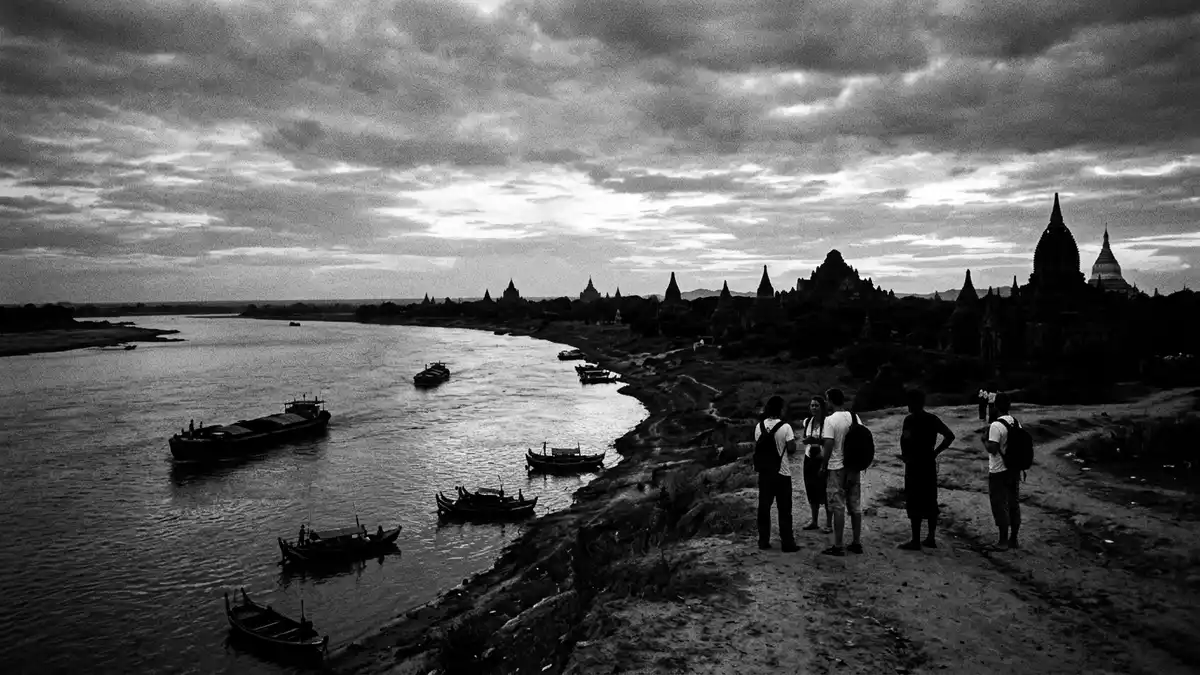
Ayeyarwady River, long known in English as the Irrawaddy River, is the principal waterway of Myanmar and makes a broad bend beside the temple plain of Bagan in the country’s central dry zone. At this point the river and the expanse of Buddhist monuments share a single landscape, with Bagan spread across slightly raised ground along the eastern bank.
A river running the length of Myanmar
Ayeyarwady River runs through the centre of Myanmar, forming a north–south axis that links the country’s uplands with the Andaman Sea. It begins in Kachin State in the far north, where the N’mai and Mali rivers meet, and then flows south across successive climatic regions towards a wide delta on the coast.N’mai and Mali rivers Along its course Ayeyarwady River passes major towns and historic centres including Myitkyina, Bhamo, Mandalay and Bagan before dispersing into numerous distributary channels and wetlands near the Andaman Sea.principal river of Myanmar
Measured over its full course, Ayeyarwady River extends for about 2,170 km (1,350 mi), making it the longest river entirely within Myanmar and the country’s most important inland waterway.2,170 km length The river carries water from the eastern fringes of the Himalayas to the Indian Ocean and has served for centuries as a transport corridor, a source of irrigation and a defining feature of many Burmese capitals, among them Bagan on its eastern bank.ancient capitals along Ayeyarwady
Ayeyarwady River and Bagan’s temple plain
Bagan lies in central Myanmar on the eastern bank of Ayeyarwady River, where the high, dry plain drops towards the water in terraces and low bluffs. The Bagan Archaeological Zone occupies a large area of low ground along this margin, with Old Bagan close to the embankment and the built?up areas of Nyaung U and New Bagan extending inland.eastern bank of Ayeyarwady River From among the brick and stucco monuments on the plain, Ayeyarwady River is visible as a wide, pale channel forming a clear western edge to the temple landscape.
The temple area at Bagan contains a very dense concentration of Buddhist monuments from the eleventh and twelfth centuries, spread across an alluvial plain beside the river.eleventh and twelfth centuries This landscape is recognised as a cultural World Heritage site, with the description emphasising how the temple plain occupies a curve of the river’s left bank in the central dry zone.World Heritage description of Bagan Travellers moving between pagodas frequently encounter earthen tracks and simple descents towards the river, where boats tie up against the natural slope of the bank.
River landscapes and boat travel at Bagan
At Bagan, Ayeyarwady River forms a sweeping bend that frames the temple plain and creates broad river views from sites close to the edge of the terrace. From embankment pagodas such as Bupaya, the river appears wide and gently curving, with sandbanks and low islands breaking the channel at lower water levels.view over the river The contrast between the open expanse of brick stupas on slightly raised ground and the broad, shimmering waterway below is one of the characteristic scenes of central Myanmar.contrast between river and pagodas
River travel along Ayeyarwady between Mandalay and Bagan follows the main channel and brings passengers past stretches of rural riverbank and occasional clusters of temples visible from the water.boat travel between Mandalay and Bagan At Bagan itself, simple boat landings are reached by earthen paths or flights of steps descending from Old Bagan’s higher ground, and many landings are little more than compacted soil above the waterline.earthen tracks and steps to boat landings From these points, short trips on the river offer a different view of the temple plain, with the pagodas rising in tiers above the bank.
Visiting Ayeyarwady River: what travellers from Western Europe should know
- Ayeyarwady River runs through central Myanmar and Bagan stands on its eastern bank, with the Bagan Archaeological Zone spread along this river reach and Old Bagan closest to the water.
- Access to the river at Bagan is typically via earthen tracks or simple stairways descending from the higher temple plain to boat landings, where surfaces and gradients can be uneven.
- Bagan is reached by domestic transport connections from cities such as Mandalay and Yangon, with local roads linking Nyaung U, Old Bagan and New Bagan along the river margin.
- The official language is Burmese and the currency is the kyat.
- Entry requirements depend on your nationality; UK travellers can check the FCDO travel advice at gov.uk/foreign-travel-advice, Irish travellers the Department of Foreign Affairs at ireland.ie.
Searching for Ayeyarwady River on social platforms
These links open searches for Ayeyarwady River on each platform.
Frequently asked questions about Ayeyarwady River
Where is Ayeyarwady River in relation to Bagan?
Ayeyarwady River passes beside Bagan in central Myanmar, with the ancient city and its temple plain occupying the slightly raised eastern bank along a broad bend in the river.
What should visitors expect when approaching the river from the temple area?
From the temple plain the ground drops towards Ayeyarwady River in terraces and slopes, with earthen paths or simple stairways leading to boat landings on the lower bank.
What makes the Ayeyarwady River reach at Bagan distinctive?
At Bagan the river forms a pronounced curve beside a dense concentration of eleventh? and twelfth?century Buddhist monuments, creating a wide river landscape set against hundreds of pagodas.


