
Ayutthaya Historical Park and its brick temple landscape
Published on 09/23/2026 at 11:55 | Editorial responsibility: Rafael Müller, Editor-in-Chief AD HOC NEWS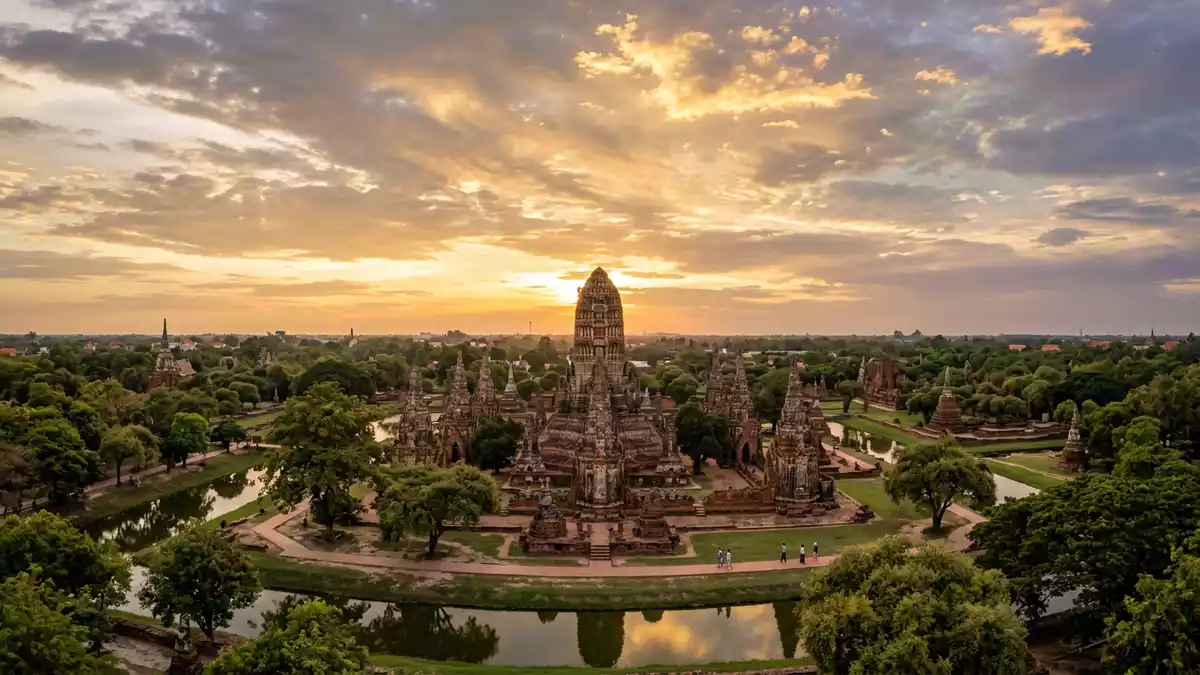
Ayutthaya Historical Park spreads across the historic centre of Ayutthaya, where brick temples, prangs, monasteries and royal buildings mark the former capital of the Ayutthaya Kingdom. The ruins are arranged across an island shaped by the Chao Phraya, Pa Sak and Lopburi rivers, creating a landscape in which water and architecture remain closely connected.
Ayutthaya Historical Park: a city of brick and water
King Ramathibodi I founded Ayutthaya in 1351. The city became the centre of a powerful kingdom whose political, religious and commercial connections extended across mainland Southeast Asia. Its historic core contains monasteries, halls, towers, defensive remains and traces of urban spaces built across several centuries.
The surviving structures are dominated by fired brick, laterite and stucco. Their surfaces carry the marks of weather, vegetation, conflict and conservation. A historic city of Ayutthaya was inscribed as a World Heritage Site in 1991, recognising the archaeological remains as a cultural landscape rather than a single monument.
Temples, prangs and royal foundations
Wat Phra Si Sanphet occupies a central place in the park’s royal history. Its three large stupas form a recognisable group among the ruins and once belonged to the royal temple within the palace precinct. Nearby, Wihan Phra Mongkhon Bophit contains a large image of the Buddha and remains part of the religious landscape.
Wat Mahathat is associated with a prang, monastic buildings and the Buddha head enclosed by tree roots. Wat Ratchaburana contains a central prang and surviving decorative traces. These sites belong to different moments in Ayutthaya’s architectural development, so the park presents variation rather than a single uniform style.
Wat Chaiwatthanaram stands beside the Chao Phraya outside the island’s central cluster. Its central prang is surrounded by galleries and subsidiary structures linked with the religious symbolism of Mount Meru. Wat Phutthaisawan, founded in 1353 by Ramathibodi I, preserves another important prang-centred arrangement. Wat Phutthaisawan and Wat Chaiwatthanaram show how temple layouts and decorative details changed across the Ayutthaya era.
From capital city to archaeological landscape
Ayutthaya was attacked and destroyed by Burmese forces in 1767. The capital was not rebuilt as the kingdom’s political centre, while Bangkok became the seat of the later Chakri dynasty. The ruins that remained across the island and surrounding areas gradually became a record of the earlier kingdom.
The Fine Arts Department registered historic sites in Ayutthaya in 1935. The Ayutthaya Historical Park project was established in 1976, followed by systematic work on ancient monuments from 1977. The protected landscape includes temples, palace remains, monastic compounds and archaeological ground plans.
The park’s importance lies in the relationship between separate remains. A prang can stand beside a gallery, a chedi can rise behind a broken wall, and a former royal precinct can sit within the same urban setting as a neighbourhood temple. The fragments do not form a reconstructed city, but they preserve its scale, materials and religious architecture.
Visiting Ayutthaya Historical Park: what travellers from Western Europe should know
- Ayutthaya Historical Park is in Ayutthaya, north of Bangkok. The railway station stands east of the Pa Sak River, with the historic park reached by crossing towards the island.
- The park is spread across several archaeological areas. Walking between monuments involves exposed paths, uneven ground, steps and substantial outdoor sections.
- Bicycles, tuk-tuks, cars and boats are used around Ayutthaya, while the river crossings and island roads connect separate temple groups.
- The official language is Thai and the currency is the Thai baht.
- Entry requirements depend on your nationality; UK travellers can check the FCDO travel advice at gov.uk/foreign-travel-advice, Irish travellers the Department of Foreign Affairs at ireland.ie.
Searching for Ayutthaya Historical Park on social platforms
These links open searches for Ayutthaya Historical Park on each platform.Frequently asked questions about Ayutthaya Historical Park
Where is Ayutthaya Historical Park?
Ayutthaya Historical Park is in Ayutthaya, Thailand, within and around the historic island formed by the Chao Phraya, Pa Sak and Lopburi rivers.
What can visitors see there?
The park contains ruined temples, prangs, stupas, palace remains, Buddha images, galleries and archaeological traces from the Ayutthaya Kingdom.
What makes the park distinctive?
Its brick temple landscape preserves the remains of a former capital across several connected archaeological areas, including Wat Phra Si Sanphet, Wat Mahathat and Wat Chaiwatthanaram.


