
Ayutthaya Historical Park and the brick skeleton of Siam’s lost capital
Published on 08/31/2026 at 20:45 | Editorial responsibility: Rafael Müller, Editor-in-Chief AD HOC NEWS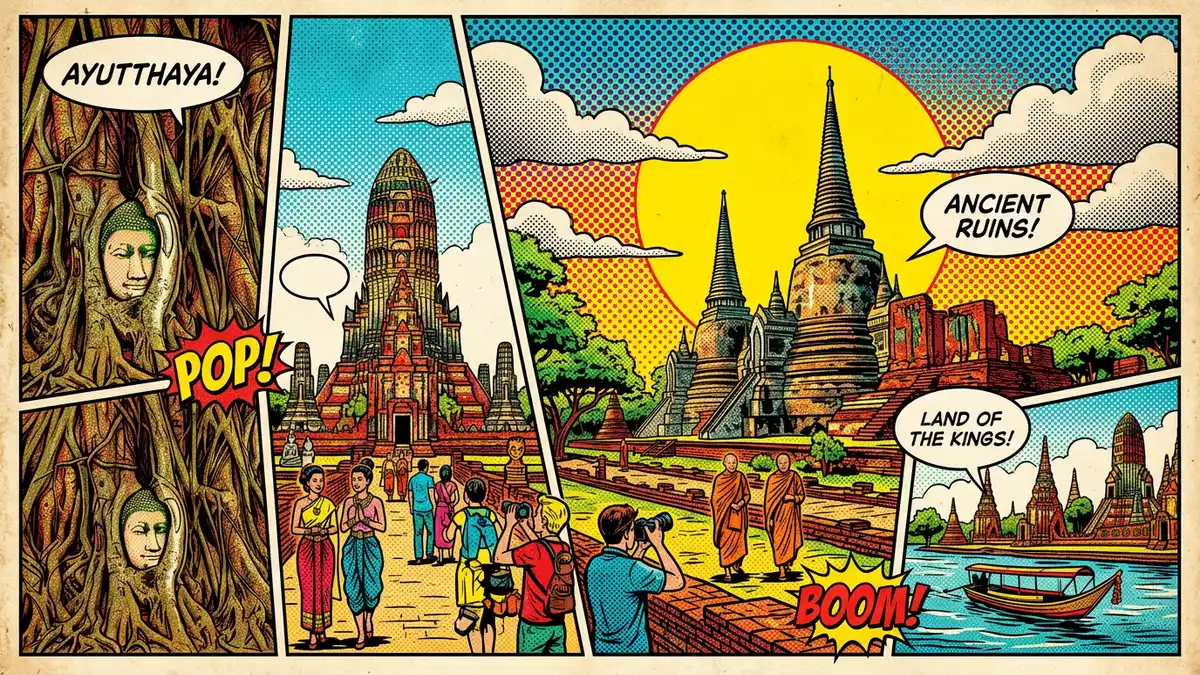
Ayutthaya Historical Park in Ayutthaya, Thailand, preserves the ruins of a former royal capital whose brick and stucco structures still shape the landscape of the Chao Phraya plain. The park covers the core of the old city, including palace foundations, monasteries and towering temple forms associated with the Ayutthaya Kingdom in the centuries between its founding in 1351 and its destruction in 1767.
A city of water and brick
Ayutthaya grew as a planned island city at the confluence of major rivers, enclosed by waterways that once acted as natural defences and trade routes for the Siamese Kingdom. Within Ayutthaya Historical Park, these waterways frame a grid of streets and temple compounds whose surviving brick walls and bases mark out the organisation of the old capital as it stood under kings such as Ramathibodi I, also known as U Thong, who established Ayutthaya in the fourteenth century.Ayutthaya Historical Park At the heart of the park lie the traces of the Royal Palace and ceremonial grounds, among them the area around Wat Phra Si Sanphet where palace platforms and religious structures formed a single ensemble.Historic City of Ayutthaya
Temple complexes punctuate the park with vertical forms that recall Ayutthaya’s role as both a political and religious centre. Brick prasats and chedis clad in stucco rise above courtyards lined with rows of Buddha images, some still seated, others reduced to fragments through the city’s fall and the centuries of exposure that followed.Ayutthaya Historical Park is the UNESCO World Heritage site that preserves the ruins of the former capital The arrangement of these structures around central terraces or cloistered walks allows a visitor to read the hierarchy of spaces, from outer courts to inner sanctuaries, even where roofs and much of the upper decoration have gone.
World Heritage ruins of the Ayutthaya Kingdom
Part of Ayutthaya Historical Park forms the World Heritage property known as the Historic City of Ayutthaya, inscribed on UNESCO’s list in 1991 for its cultural significance as the capital of a powerful Siamese kingdom.Historic City of Ayutthaya The inscribed area covers a sizeable section of the island city where palace compounds and major monasteries stand on raised ground, reflecting the deliberate planning of a court that controlled regional trade and diplomacy over several centuries.Geschichtspark Ayutthaya
Among the best-known temple sites within Ayutthaya Historical Park are Wat Mahathat, Wat Phra Si Sanphet, Wat Ratchaburana and Wat Phra Ram, each representing a different aspect of Ayutthaya religious architecture.monuments located within the inscribed core zone Wat Chaiwatthanaram, on the bank of the river outside the central island, forms part of the wider historic landscape linked to the park, with a symmetrical layout centred on a high prang and surrounding smaller towers that echo Khmer-influenced architectural forms. These named sites sit alongside less-complete ruins and active temples, together illustrating how royal patronage shaped Ayutthaya’s skyline with monasteries and stupas marking victories, alliances and devotional acts.
Reading the layers of a fallen capital
Ayutthaya’s fall to Burmese forces in 1767 left the city burned and largely abandoned, and Ayutthaya Historical Park preserves that rupture through toppled prangs, headless Buddha statues and collapsed cloisters that reveal brick cores once hidden under smooth stucco.Ayutthaya was established in 1350 and destroyed in 1767 In places, conservation has stabilised leaning structures and cleared vegetation from platforms, while still leaving surfaces weathered and scarred so that the park reads as an archaeological landscape rather than a reconstructed city.Ayutthaya Historical Park was pronounced a UNESCO World Heritage site
For visitors, the scale of Ayutthaya Historical Park makes it possible to move between temple compounds, palace remains and quieter corners where remnants of walls or gateways stand beside modern streets. Monuments such as the Ayutthaya Historical Study Centre, Japanese village and Baan Hollanda (the Dutch village) in and around the park highlight Ayutthaya’s former connections to foreign merchants and diplomats, adding another layer to the experience of walking through the old capital’s footprint.Ayutthaya Historical Study Centre, Japanese village and Baan Hollanda The combination of standing religious structures, foundation lines and interpreted sites invites a longer visit that traces how the city expanded, accumulated monuments and then collapsed, leaving the brick skeleton that defines the park today.
Visiting Ayutthaya Historical Park: what travellers from Western Europe should know
- Ayutthaya Historical Park occupies much of the island section of Ayutthaya city in central Thailand, reached by rail services from Bangkok to Ayutthaya station and by road connections that cross the surrounding rivers.
- The terrain inside the park alternates between level ground and raised temple platforms, with masonry steps and uneven brick surfaces in and around prangs, chedis and cloisters that require care on foot.
- Major historic temples and palace remains lie close to one another on the island, while sites such as Wat Chaiwatthanaram and Wat Phu Khao Thong stand across the water but remain visually and historically connected to the core park area.
- The official language is Thai and the currency is the baht.
- Entry requirements depend on your nationality; UK travellers can check the FCDO travel advice at gov.uk/foreign-travel-advice, Irish travellers the Department of Foreign Affairs at ireland.ie.
Searching for Ayutthaya Historical Park on social platforms
These links open searches for Ayutthaya Historical Park on each platform.
Frequently asked questions about Ayutthaya Historical Park
Where is Ayutthaya Historical Park located?
Ayutthaya Historical Park is in Ayutthaya city in central Thailand, on and around an island bounded by rivers north of Bangkok.
What should visitors expect inside the park?
Visitors encounter extensive temple ruins, palace foundations and some active monasteries, with brick platforms, statues and towering religious structures spread across a broad landscape.
What makes Ayutthaya Historical Park distinctive among historic sites?
The park combines the large-scale footprint of a former royal capital with a dense concentration of temple architecture and palace remains recognised as a UNESCO World Heritage cultural site.


