
Ayutthaya Historical Park and the river island capital of old Siam
Published on 09/01/2026 at 10:45 | Editorial responsibility: Rafael Müller, Editor-in-Chief AD HOC NEWS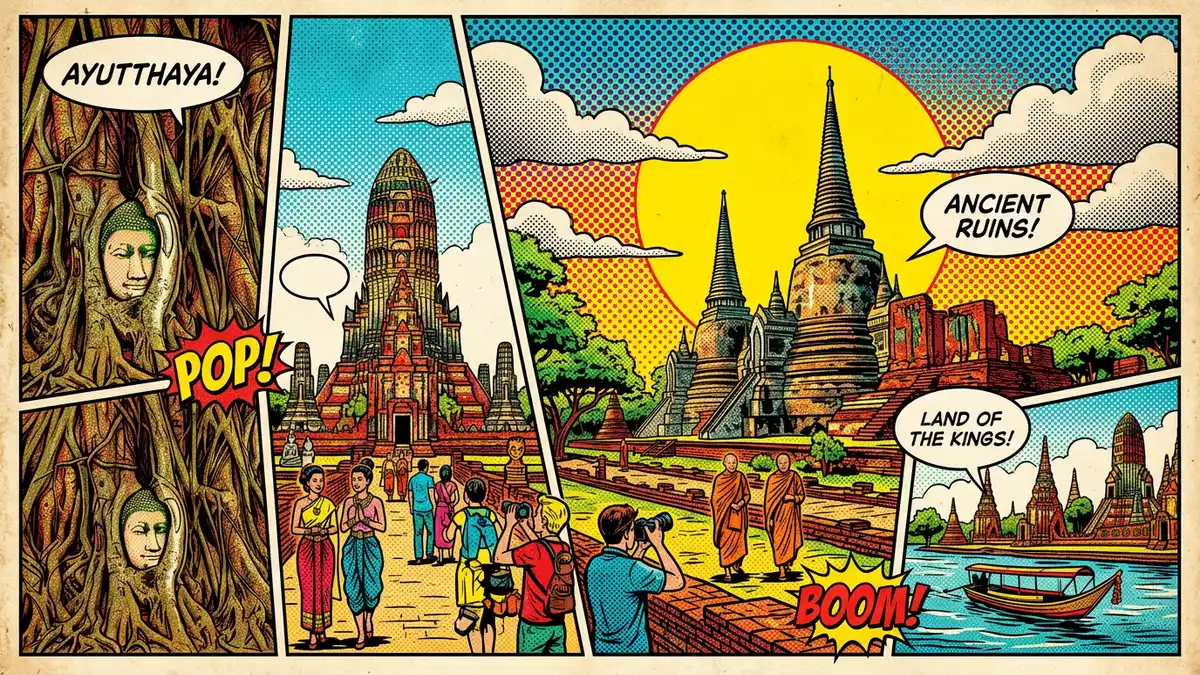
Ayutthaya Historical Park in Ayutthaya preserves the ruins of a former royal capital whose brick sanctuaries, towering prangs and broad processional spaces still occupy a river island north of Bangkok. The site grew from a city founded in 1350 by King Ramathibodi I, known as U Thong, and part of the historic city is inscribed as a UNESCO World Heritage Site for its cultural significance.
From island capital to ruined city of temples
The old city of Ayutthaya was established in the mid-fourteenth century on an island formed by the confluence of three rivers, including the Chao Phraya, creating a natural moat around the emerging capital of Siam.river island capital This position helped shape Ayutthaya as a major trading centre linking overland routes with maritime connections across the Gulf of Thailand and further afield in Asia.historic city of Ayutthaya
Within a few centuries of its foundation by Ramathibodi I, Ayutthaya developed into the heart of a regional empire whose power was expressed through dense clusters of Buddhist monasteries and royal complexes. The historical park covers much of this inner area, where brick platforms, collapsed halls and standing chedis mark the outlines of ceremonial axes leading towards palace precincts and major wats such as Wat Phra Si Sanphet. The surviving structures illustrate several phases of Ayutthaya-period architecture, with Khmer-influenced prangs, bell-shaped stupas and elongated assembly halls sharing the same orthogonal street grid.
Wat Mahathat, Wat Ratchaburana and the central temple zone
Many visitors concentrate on the central zone of Ayutthaya Historical Park, where Wat Mahathat and Wat Ratchaburana stand close to one another on the island. Wat Mahathat, whose name refers to the “Monastery of the Great Relic”, was developed in the fourteenth century and became an important religious centre tied to the royal court.Wat Mahathat Ayutthaya Brick bases and laterite cores still define the outlines of its ordination hall and ancillary structures, while the main prang rises over surrounding chedis and chapels, reflecting the influence of Khmer tower forms on Ayutthaya builders.Khmer-style prang
Immediately to the north of Wat Mahathat lies Wat Ratchaburana, a royal temple founded in 1424 during the reign of King Borommaracha II, recognisable by its tall central prang and flanking structures within a walled compound.Wat Ratchaburana temple The crypt beneath the prang once contained mural paintings with scenes from the Jataka tales, and the tower itself retains stucco ornament that hints at the richness of Ayutthaya’s temple decoration. Around these two temples, further notable sites such as Wat Phra Ram, Wat Phra Si Sanphet, Wiharn Phra Mongkhon Bophit and Wat Lokaya Sutha create a continuous landscape of ruins across the central island.central temple cluster
World Heritage recognition and the scale of the ruins
Ayutthaya’s historic core has been recognised internationally since 1991, when the “Historic City of Ayutthaya” was inscribed on the World Heritage List as a cultural site under criterion (iii).UNESCO inscription 1991 The designated property covers an area of 289 ha (710 acres), encompassing principal temple complexes, palace remains and segments of the old defensive system, including sections of walls and moats. Within this area, the ground plane alternates between open lawns, low platforms and clusters of restored bases that give a sense of the density of the former city.
Walking through Ayutthaya Historical Park today reveals how much of the old capital’s structure can still be traced through its surviving brickwork and alignments. Processional routes lead along straight roads to compounds defined by walls and gateways, while waterways and former canals mark boundaries between districts. Even where buildings have lost their upper portions, the arrangement of plinths, staircases and sanctuaries conveys the hierarchy between royal spaces and monastic precincts, and the distribution of prangs and chedis indicates how sacred landmarks punctuated the skyline of the river island capital.
Visiting Ayutthaya Historical Park: what travellers from Western Europe should know
- Ayutthaya Historical Park lies in the city of Ayutthaya in central Thailand, north of Bangkok, and is reached by rail or road services from the capital terminating near the river island.
- The terrain within the park includes extensive grassy areas, brick platforms and temple compounds with steps and uneven surfaces, so visiting the main wats involves walking across open ground and climbing stairways.
- The Chao Phraya and other rivers encircle the historic core, and bridges link the island district containing the principal ruins to surrounding neighbourhoods where further monasteries and later urban development stand.
- The official language is Thai and the currency is the baht.
- Entry requirements depend on your nationality; UK travellers can check the FCDO travel advice at gov.uk/foreign-travel-advice, Irish travellers the Department of Foreign Affairs at ireland.ie.
Searching for Ayutthaya Historical Park on social platforms
These links open searches for Ayutthaya Historical Park on each platform.Frequently asked questions about Ayutthaya Historical Park
Where is Ayutthaya Historical Park located?
Ayutthaya Historical Park lies in Ayutthaya in central Thailand, on a river island formed by waterways including the Chao Phraya north of Bangkok.
What can visitors expect to see inside the park?
Visitors encounter brick and laterite ruins of royal temples, palace remains, prangs, chedis and processional routes that outline the former Siamese capital’s ceremonial spaces.
What makes Ayutthaya Historical Park distinctive among temple sites?
The combination of an island setting, large-scale clusters of Ayutthaya-period monasteries and its recognition as a UNESCO World Heritage Site gives the park a distinct character.


