
Babylon in Hillah, Iraq as a city of brick and legend
Published on 09/19/2026 at 09:21 | Editorial responsibility: Rafael Müller, Editor-in-Chief AD HOC NEWS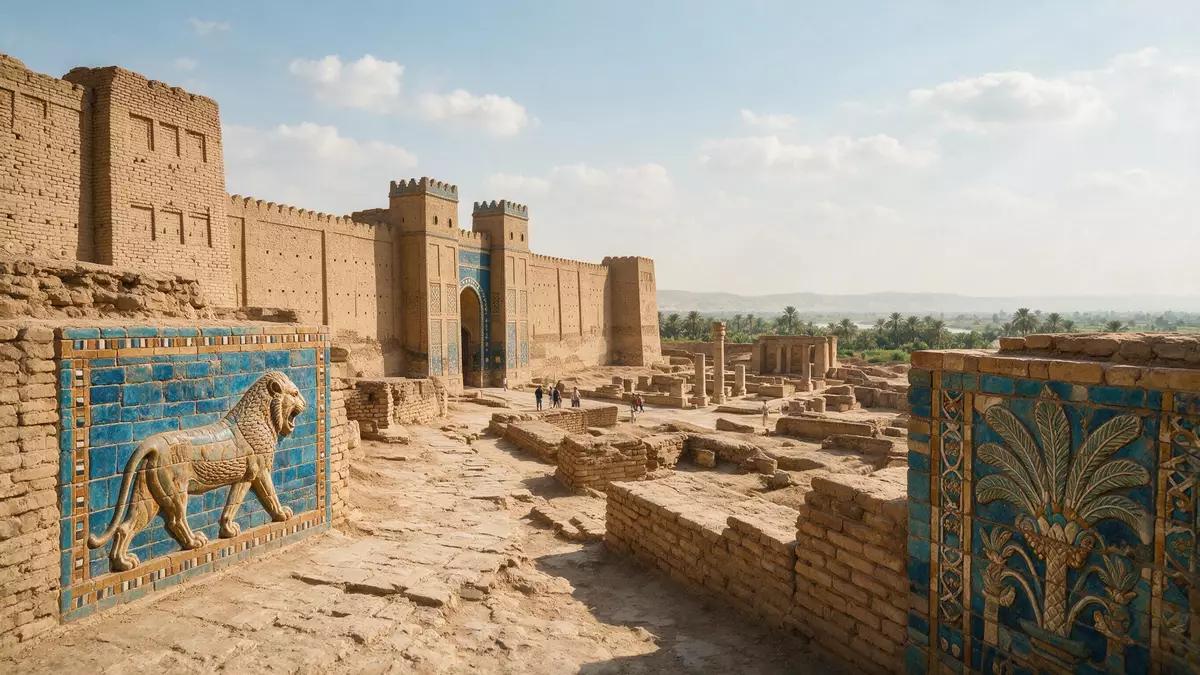
Babylon near Hillah in Iraq is an ancient city of mud-brick walls and layered legends, spread across the flat Mesopotamian plain along the lower Euphrates River. The ruins mark the heart of Mesopotamia’s Neo-Babylonian Empire in the sixth century BC under Nebuchadnezzar II and carry a UNESCO World Heritage Site inscription dating from 2019.
Brick, scale and layout on the Mesopotamian plain
Babylon occupies a broad tract of land in the Babil Governorate, within the orbit of modern Hillah and about 85 km (53 miles) south of Baghdad along the Euphrates River. The archaeological property covers a large area of former city fabric where baked mud-brick structures rise from low mounds, preserving fragments of fortifications, foundations and ceremonial routes across the plain.about 85 km south of Baghdad In plan, the site extends across several square kilometres, with traces of outer and inner defences defining a once-walled metropolis at the centre of southern Mesopotamia.capital of the Neo-Babylonian Empire
The city’s ruins include long stretches of brick wall and gateways laid out along an axial processional route that once linked the northern approach with the temple quarter and royal residences. Within this fabric, visitors walk past reconstructed sectors and original archaeological layers that reveal the dense urban scale of the Neo-Babylonian capital. The surviving brickwork, whether ancient or later reconstruction, gives Babylon a strong material character: baked clay blocks laid in massive courses, weathered yet still defining streets, courtyards and ceremonial spaces.
Neo-Babylonian power: Nebuchadnezzar II and the city of gods
Babylon’s most celebrated phase belongs to the Neo-Babylonian Empire between 626 and 539 BCE, when the city served as its capital and reached a peak under King Nebuchadnezzar II.between 626 and 539 BCE During his reign in the sixth century BC, extensive building campaigns reshaped the city with monumental palaces, defensive walls, religious complexes and processional avenues, and it is this era that most strongly defines the archaeological site experienced near Hillah today.Nebuchadnezzar II
The Processional Way and the celebrated Ishtar Gate belong to this Neo-Babylonian cityscape, forming a ceremonial approach lined with walls and decorated elements honouring deities such as Marduk and Adad.Ishtar Gate and Processional Way On site, visitors encounter a modern replica of the Ishtar Gate built in the twentieth century, while the original glazed brick structure stands in the Pergamon Museum in Berlin. Within the ruins, foundations of large palace complexes associated with Nebuchadnezzar II survive as platforms, walls and rooms, indicating the scale of royal architecture that once dominated this Mesopotamian city.
Myths, wonders and the UNESCO World Heritage inscription
Babylon is entwined with stories that travelled far beyond Mesopotamia, from the Biblical Tower of Babel to the legendary Hanging Gardens. The city was referenced with striking detail by ancient Greek writers, and the supposed gardens entered the later canon of the Seven Wonders of the Ancient World. Archaeology at Hillah has not confirmed definite remains of such terraced gardens, hydraulic systems or associated structures, so the Hanging Gardens remain an open question in scholarship rather than an identified feature on the ground.Hanging Gardens of Babylon
The modern significance of Babylon is formalised through its status as a UNESCO World Heritage Site, recognising the city’s outstanding value for understanding ancient Mesopotamian civilisation.UNESCO World Heritage Site in 2019 Inscription on the World Heritage List in 2019 followed long-running efforts to document, conserve and present the ruins within their wider landscape. For visitors walking through the site, this global recognition sits alongside local symbolism, including monuments such as the Lion of Babylon and named sectors like the South Palace and religious precincts, which together frame Babylon as both an archaeological park and a cultural landmark of Iraq.
Visiting Babylon: what travellers from Western Europe should know
- Babylon lies a short distance north of Hillah in central Iraq, on the lower Euphrates River, with road links connecting the archaeological site to Hillah and the wider region.
- The site extends across uneven ground with archaeological mounds, brick ruins and open areas, so walking between the main features involves unpaved surfaces, steps and changes in level.
- The ruins sit within the Babil Governorate of Iraq, where the official language is Arabic and the currency is the Iraqi dinar.
- Entry requirements depend on your nationality; UK travellers can check the FCDO travel advice at gov.uk/foreign-travel-advice, Irish travellers the Department of Foreign Affairs at ireland.ie.
Searching for Babylon on social platforms
These links open searches for Babylon on each platform.Frequently asked questions about Babylon
Where is Babylon in relation to Hillah and Baghdad?
Babylon stands near Hillah in the Babil Governorate of Iraq, about 85 km south of Baghdad along the Euphrates River in southern Mesopotamia.
What does a visit to Babylon involve?
A visit involves walking across an extensive archaeological landscape of mud-brick walls, gateways, palace foundations and ceremonial routes, with both original remains and reconstructed sections.
What makes Babylon distinctive among ancient cities?
Babylon is distinctive for its role as the Neo-Babylonian capital under Nebuchadnezzar II, its association with myths such as the Hanging Gardens and its UNESCO World Heritage Site status.


