
Babylon near Hillah as an ancient city of brick and empire
Published on 09/21/2026 at 17:40 | Editorial responsibility: Rafael Müller, Editor-in-Chief AD HOC NEWS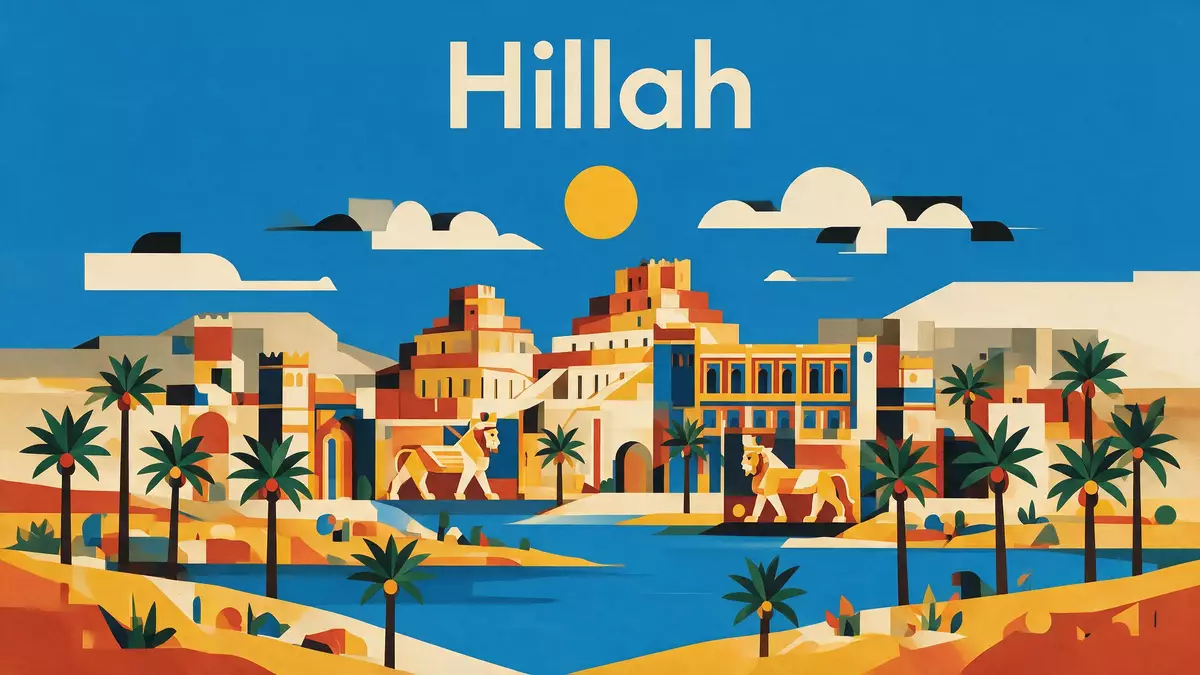
South of Hillah in central Iraq, Babylon stretches across the Mesopotamian plain as an archaeological city where baked brick, earth mounds and fragmentary walls still outline an imperial plan from the sixth century BC. Within this broad tract of land beside the Euphrates River, visitors walk through traces of the Neo-Babylonian capital associated with King Nebuchadnezzar II, reading its surviving gates, avenues and foundations as the remains of a once monumental city.
Babylon on the Euphrates: setting and scale
Babylon occupies ground on the lower course of the Euphrates River in southern Mesopotamia, within Babil Governorate and close to the modern town of Hillah in Iraq. Historical and archaeological descriptions place the ruins roughly south of Baghdad, forming a large enclosed area where fortification lines and inner walls once defined the city’s extent.Babylon in Babil Governorate The recognised archaeological property covers several square kilometres, combining the core of the ancient city with surrounding land that still carries its imprint.the roughly 1,050 hectare property
From the visitor’s perspective, this scale translates into long walls of sun-baked brick running across the plain, interrupted by gates, palace platforms and the outlines of courtyards. The city’s position beside a major river underlines its role within Mesopotamia, linking the ancient capital physically to fertile land and to wider trading routes. Standing on the earth mounds within the former inner city, it is possible to see how the urban area related to the surrounding fields and waterways, even though much of the brickwork now appears as low alignments emerging from the soil.
Neo-Babylonian power in brick and processional routes
Babylon reached its height in the Neo-Babylonian period, when the city served as the centre of an empire between 626 and 539 BC, and major building projects reshaped its appearance.centre of the Neo-Babylonian Empire Under Nebuchadnezzar II, who ruled from 605 to 562 BCE, vast palaces, temples and city walls were constructed or rebuilt, giving the capital a monumental brick architecture that still defines the site’s character.Nebuchadnezzar II rebuilt much of the city
One of the most striking elements of this programme was the northern entry to the inner city, known as the Ishtar Gate, approached by a long Processional Way that cut across the urban fabric. The gate itself, constructed in 575 BCE, used glazed brick with rows of relief animals, combining structural brickwork with vivid colour and imagery.Ishtar Gate constructed in 575 BCE Archaeological excavations uncovered its remains at Babylon, while a reconstruction using original bricks stands in Berlin’s Pergamon Museum, linking the site in Iraq to museum collections abroad.reconstructed Ishtar Gate in Berlin On the ground at Babylon, visitors follow the line of the Processional Way between surviving walls, imagining the route once used in religious ceremonies as a straight brick corridor leading towards temple and palace complexes.
Ruins, World Heritage and the Hanging Gardens tradition
The visible remains at Babylon include segments of outer and inner city walls, archaeological gates, palace foundations and large areas of unexcavated mounds that still shelter ancient structures below. These elements collectively earned Babylon inscription on the UNESCO World Heritage List, recognising its outstanding testimony to Mesopotamian civilisation and its association with rulers such as Hammurabi and Nebuchadnezzar II.UNESCO World Heritage Site in 2019associated with Hammurabi and Nebuchadnezzar II Walking across the site, the contrast between reconstructed sections and eroded mounds highlights both the fragility of the ruins and the scale of what remains beneath the surface.
Babylon is also bound up with one of the most debated traditions of ancient architecture: the Hanging Gardens. Classical writers described terraced planting and water features attributed to Nebuchadnezzar II, and the gardens became one of the Seven Wonders of the Ancient World. Yet systematic excavations at Babylon have not identified definitive remains of such a structure, leaving their exact location and physical form unconfirmed.no trace of the legendary gardensno confirmed archaeological evidence For visitors, this tension between physical brick ruins and celebrated but elusive gardens adds a layer of myth to the experience of walking through the archaeological city.
Visiting Babylon: what travellers from Western Europe should know
- Babylon lies a short distance north of Hillah in central Iraq, south of Baghdad along the Euphrates River, and is reached by road connections that link the archaeological site with Hillah and the wider region.
- The terrain at the ruins consists of low earth mounds, brick walls and uneven ground, with sections of the former Processional Way and palace areas requiring walking over packed soil and occasional steps.
- Hillah stands adjacent to the archaeological zone, on a branch of the Euphrates, and acts as the nearest urban centre for reaching Babylon and for seeing related sites such as Borsippa and Kish in the wider landscape.
- The official language is Arabic and the currency is the Iraqi dinar.
- Entry requirements depend on your nationality; UK travellers can check the FCDO travel advice at gov.uk/foreign-travel-advice, Irish travellers the Department of Foreign Affairs at ireland.ie.
Searching for Babylon on social platforms
These links open searches for Babylon on each platform.
Frequently asked questions about Babylon
Where is Babylon in relation to Hillah and Baghdad?
Babylon stands near the modern town of Hillah in Babil Governorate on the lower Euphrates River, roughly south of Baghdad within central Iraq.
What should travellers expect when visiting the ruins?
Travellers encounter extensive earth mounds, surviving brick walls, gates and palace foundations spread across a large archaeological area, with uneven terrain and open exposure to sun.
What makes Babylon distinctive among ancient Mesopotamian sites?
Babylon is distinctive for its role as the Neo-Babylonian imperial capital, its association with Nebuchadnezzar II and the Ishtar Gate, and its enduring link to the Hanging Gardens tradition.


