
Babylon’s reconstructed cityscape on the Euphrates
Published on 09/18/2026 at 08:11 | Editorial responsibility: Rafael Müller, Editor-in-Chief AD HOC NEWS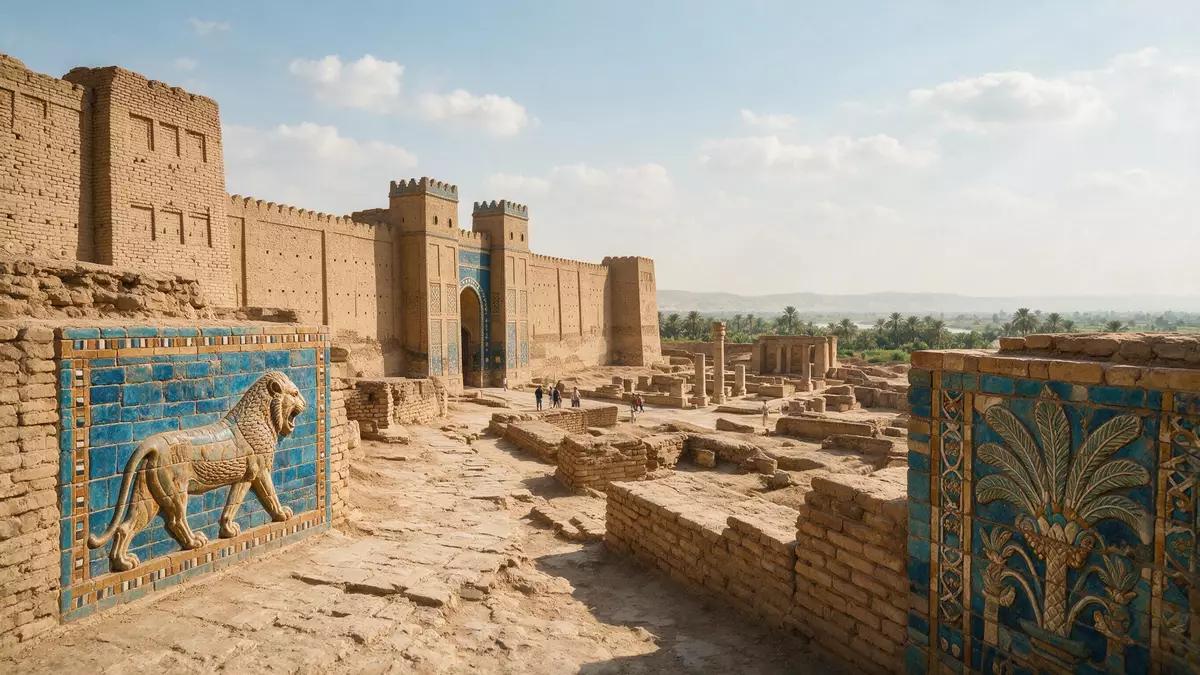
Babylon near Hillah in Iraq is an archaeological cityscape where ancient foundations and modern reconstructions together outline the former capital of the Neo-Babylonian Empire along the Euphrates River. The site lies south of Baghdad in Babil Governorate, with the ruins spread across low ground near the river and the modern town of Hillah.
The Neo-Babylonian capital in the Mesopotamian plain
The ruins of Babylon occupy part of the alluvial plain of southern Mesopotamia, on the lower reaches of the Euphrates where the river bends through farmland and settlements. The ancient city lay within what is now Babil Governorate, and its remains stand near the modern town of Hillah.ruins near Hillah The broader site extends towards the course of the river, and the relationship between water, flat terrain and urban planning is still legible in the way major structures align.
Babylon’s most powerful phase as a city belongs to the Neo-Babylonian period, between 626 and 539 BCE, when it served as the capital of an empire that controlled large parts of the Near East.capital between 626 and 539 BCE During this era, rulers such as Nabopolassar and his son Nebuchadnezzar II reshaped Babylon with palaces, temples, defensive walls and monumental gates, leaving ground plans and foundations that remain traceable.
Walls, gates and the reconstructed Ishtar Gate
One of the most striking features at Babylon is the interplay between original brickwork and twentieth-century reconstruction, especially around the Ishtar Gate and the Processional Way. Nebuchadnezzar II, who ruled in the early sixth century BCE, rebuilt the city’s fortifications and ceremonial approaches, creating the famous northern gateway whose glazed-brick decoration with bulls and muš?uššu dragons is known from both the site and museum reconstructions.Nebuchadnezzar II and the Ishtar Gate At Babylon itself, visitors encounter large-scale modern brick structures that follow ancient footprints, marking the approximate position and height of the gate and nearby palace walls.
Beyond the Ishtar Gate zone, long stretches of inner and outer city walls frame the archaeological area, with foundations and partial rises of brick masonry outlining former quarters and defended lines.outer and inner-city walls Within these lines, palace complexes and temple platforms, including the ziggurat known as Etemenanki, are represented by low brick cores, earth-covered mounds and occasional higher reconstructed volumes. The result is a readable urban pattern in which gates, main streets and large buildings can be followed on foot as a sequence of open spaces, ramps and chambers.
UNESCO recognition and the archaeological landscape
Babylon is inscribed on the UNESCO World Heritage List as a cultural site, recognised for its testimony to one of the most influential empires of the ancient world.UNESCO inscription decision The listing emphasises the ensemble of ruins, from fortifications and city gates to palaces, temples and associated agricultural land, rather than a single monument. Standing within the site, this breadth is visible in the mix of excavated areas, reconstructed buildings and unexcavated mounds that stretch across the plain.
The city’s location south of Baghdad, within reach of Hillah, places the archaeological zone within a living landscape where villages, fields and modern roads surround ancient bricks.ruins in modern Iraq For travellers, this means that views from palace platforms take in both the outlines of the old city and the wider Mesopotamian plain, giving a sense of how the Neo-Babylonian capital once sat within its region.
Visiting Babylon: what travellers from Western Europe should know
- Babylon lies in Babil Governorate in Iraq, south of Baghdad and near Hillah, and is reached by road from the capital and other cities.
- The archaeological terrain consists of uneven ground, brick structures, earth mounds and ramps, so sturdy footwear is advisable for exploring the ruins.
- The Euphrates flows near the site, and some viewpoints within Babylon look out over the river and the surrounding agricultural land.
- The official language is Arabic and the currency is the Iraqi dinar.
- Entry requirements depend on your nationality; UK travellers can check the FCDO travel advice at gov.uk/foreign-travel-advice, Irish travellers the Department of Foreign Affairs at ireland.ie.
Searching for Babylon on social platforms
These links open searches for Babylon on each platform.
Frequently asked questions about Babylon
Where is Babylon and what kind of place is it?
Babylon is an archaeological site in Babil Governorate in Iraq, near Hillah, on the lower Euphrates River, preserving the remains of an ancient Mesopotamian city.
What can visitors expect when walking through Babylon?
Visitors encounter reconstructed brick structures, foundations of palaces and temples, long lines of city walls and broad open areas that mark former streets and courtyards.
What makes Babylon distinctive among ancient sites?
Babylon combines the ground plan of a Neo-Babylonian imperial capital, monumental gates associated with Nebuchadnezzar II and recognition as a UNESCO World Heritage Site.


