

Babylon’s ruined avenues on the Euphrates at Hillah
Published on 09/14/2026 at 07:53 | Editorial responsibility: Rafael Müller, Editor-in-Chief AD HOC NEWS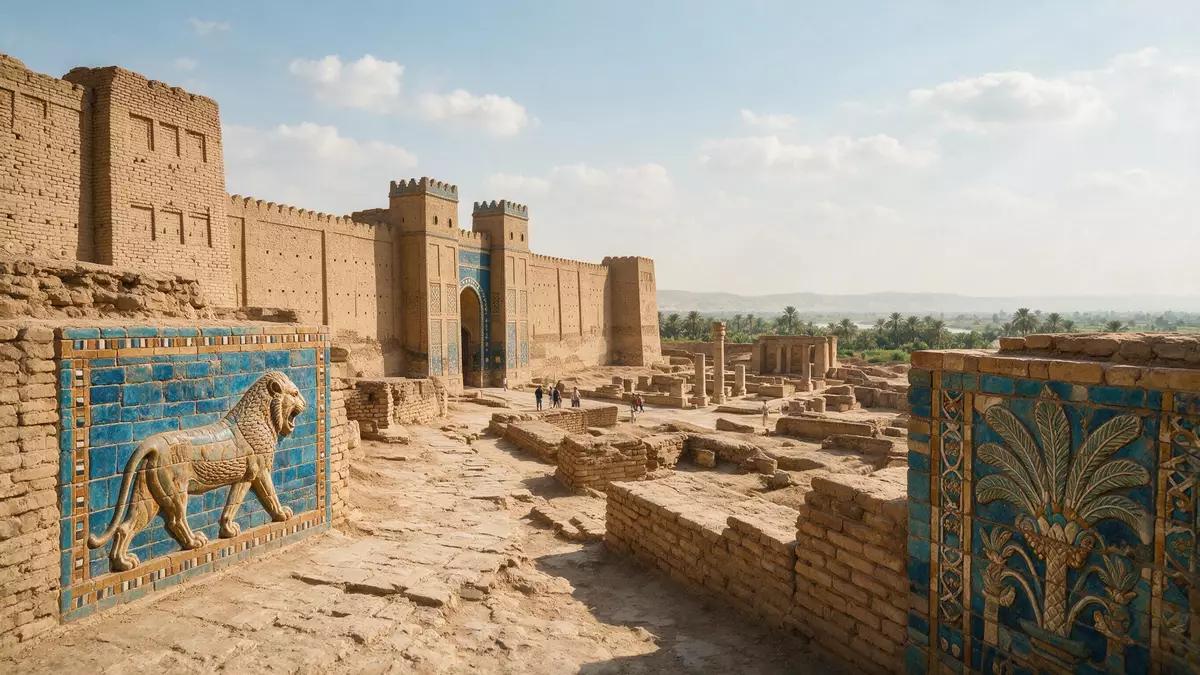
South of Hillah in central Iraq, Babylon stretches across the plain as a low maze of walls, gateways and earthworks beside a branch of the Euphrates. The archaeological site preserves the footprint of the ancient city that dominated the Neo-Babylonian Empire in the late seventh and sixth centuries BC, a place linked with rulers such as Hammurabi and Nebuchadnezzar II and inscribed on the UNESCO World Heritage List in 2019.
Babylon as an imperial city on the Euphrates
Babylon occupies ground near the modern town of Hillah in Babil Governorate, south of Baghdad and close to the Euphrates River, whose channels once flowed through and around the ancient city. Extensive ruins lie in this landscape, where long stretches of mud-brick fortification and foundations mark the outline of an urban centre that served as capital of the Neo-Babylonian Empire between 626 and 539 BC.extensive ruins The surviving remains include sections of outer and inner-city walls, ruined palaces and temple platforms, and the traces of major ceremonial routes that once cut through the city fabric.outer and inner-city walls
Archaeological work identified Babylon as a major centre of Mesopotamian civilisation, occupied from the late third millennium BC and rising to prominence as a royal city under Hammurabi in the eighteenth century BC and later under the Neo-Babylonian dynasty.Mesopotamian civilisation In this period the city expanded to cover a wide area on both banks of the river, with monumental architecture arranged along broad axial routes. The site’s modern name, Babylon, reflects the Akkadian form Babilu, often glossed as “Gate of God”, echoing the association between the city and the cult of the god Marduk.Akkadian form Babilu
Walls, gates and the processional route
One of the most striking surviving features at Babylon is the system of fortification that once enclosed the inner city. Archaeological recording and ancient texts describe multiple lines of mud-brick walls, rebuilt in baked brick under Nebuchadnezzar II, forming a layered defensive ring around the core of the settlement.multiple lines of mud-brick walls Within this system stood a series of major gates, of which the Ishtar Gate on the northern side is best documented. Although the famous glazed-brick reconstruction known from Berlin belongs elsewhere, the archaeological remains at Babylon mark the position of the original gateway complex.
The Ishtar Gate formed part of a broad ceremonial way running from the northern outskirts into the inner city, a route remembered as the Street of Procession. Under Nebuchadnezzar II, who reigned from 604 to 562 BC, this approach was rebuilt with decorated brickwork featuring lions, bulls and composite creatures associated with gods such as Ishtar, Adad and Marduk.decorated brickwork The path of the processional street can still be traced on the ground, lined by wall bases and occasional standing sections of brick, giving a sense of the axial planning that structured movement into the city’s ceremonial core.Street of Procession
Palaces, temples and later rediscovery
Inside the ring of fortifications, Babylon contained a dense concentration of royal and religious buildings whose foundations and lower walls remain visible across the site. Nebuchadnezzar II undertook major building campaigns here, enlarging the palace complex and restoring important temples dedicated to Marduk and other deities, so that the city developed into a vast ceremonial and administrative centre.building campaigns Over time Babylon passed to new imperial powers, including Cyrus II of Persia in 539 BC and Alexander the Great in 331 BC, and served as a capital or major urban centre for successive empires before its gradual decline and abandonment in late antiquity.Cyrus II of Persia
The ruins near Hillah were known from local tradition and historical texts, but systematic excavation in the nineteenth and twentieth centuries revealed the extent of the ancient city, its layout and the character of its architecture.systematic excavation Large-scale reconstruction of some walls and gateways took place in the late twentieth century, using modern brickwork to raise certain features to a visible height, while leaving significant areas as low ruins. In 2019 Babylon was inscribed as a cultural World Heritage Site, recognising its importance as the centre of the Neo-Babylonian Empire and as a lasting record of ancient urban design in Mesopotamia.cultural World Heritage Site
Visiting Babylon: what travellers from Western Europe should know
- Babylon lies near Hillah in central Iraq, south of Baghdad and close to branches of the Euphrates River, reached by road routes that connect the town with the wider region.
- The archaeological area consists largely of low ruins and rebuilt brick walls on an open plain, with stretches of uneven ground and sections of masonry that require careful footing when walking.
- The official language is Arabic and the currency is the Iraqi dinar.
- Entry requirements depend on your nationality; UK travellers can check the FCDO travel advice at gov.uk/foreign-travel-advice, Irish travellers the Department of Foreign Affairs at ireland.ie.
Searching for Babylon on social platforms
These links open searches for Babylon on each platform.
Frequently asked questions about Babylon
Where is Babylon in relation to Hillah and the wider region?
Babylon’s ruins stand near the town of Hillah in Babil Governorate in central Iraq, south of Baghdad and close to branches of the Euphrates River.
What should a visitor expect when walking through the site?
The site consists of open ground with low ruins, reconstructed brick walls and broad traces of avenues, so a visit involves walking across uneven surfaces among standing and collapsed masonry.
What makes Babylon distinctive among ancient Near Eastern sites?
Babylon is closely associated with the Neo-Babylonian Empire, the reign of Nebuchadnezzar II and monumental features such as the Ishtar Gate and processional way, preserved as ruins beside the Euphrates.


