
Bagan and the plains of temples along the Ayeyarwady
Published on 09/07/2026 at 18:11 | Editorial responsibility: Rafael Müller, Editor-in-Chief AD HOC NEWS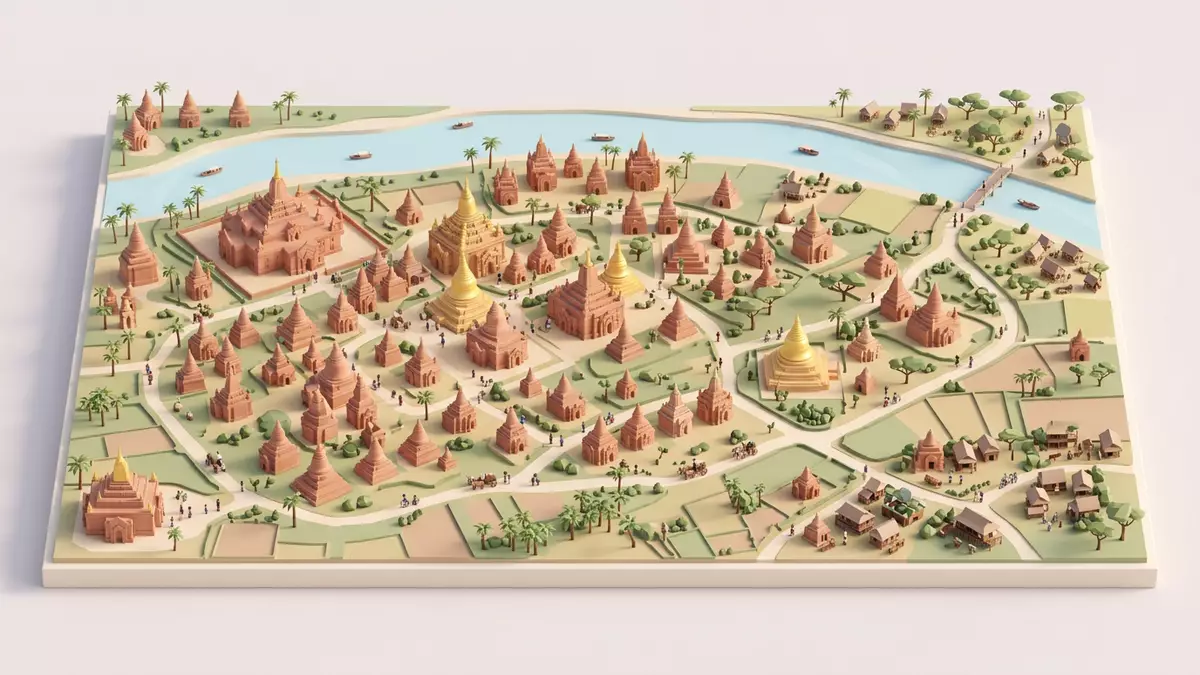
Bagan in central Myanmar is an ancient city and archaeological zone where Buddhist temples and pagodas rise across a wide plain beside the Ayeyarwady River. The landscape is defined by religious architecture dating largely to the Pagan Kingdom between the eleventh and thirteenth centuries, when Bagan served as the royal capital and spiritual centre of Myanmar.
A royal capital on the Ayeyarwady plain
Bagan lies on a bend of the Ayeyarwady River in the Mandalay Region, in the dry zone of central Myanmar, where the flat plain leaves religious monuments clearly visible against low scrub and cultivated fields.a bend of the Ayeyarwady River The city emerged as the centre of the Pagan Kingdom, which from the ninth to the thirteenth century unified territories that later formed Myanmar.capital of the Pagan Kingdom In this period Bagan’s rulers commissioned large numbers of Buddhist structures that turned the surrounding plain into a sacred landscape.
Historical records describe Bagan as the capital and political, economic and cultural hub of the Pagan Empire between 1044 and 1287, with the royal court and religious establishments concentrated around the city and its plains.political and cultural centre between 1044 and 1287 During the height of the kingdom in the eleventh to thirteenth centuries, more than 10,000 Buddhist temples, pagodas and monasteries were constructed on the Bagan plain, a density that made the area one of the most intense concentrations of religious architecture in the Buddhist world.over 10,000 Buddhist structures
Temples, stupas and the Bagan Archaeological Zone
The surviving monuments spread across what is known as the Bagan Archaeological Zone, a protected area covering parts of Old Bagan, Nyaung-U and the surrounding countryside. Within this zone, thousands of structures remain in various states of preservation, forming continuous clusters of temples and brick stupas.protected archaeological zone Modern inventories by heritage bodies record several thousand religious structures, including temples, stupas, monasteries and other buildings for Buddhist practice.3,595 recorded monuments
Many of Bagan’s major temples date from the twelfth and early thirteenth centuries and are associated with named kings of the Pagan period. Ananda Temple, for example, is recorded as completed in 1105 under King Kyansittha and stands as one of Bagan’s best known temples.Ananda Temple completed in 1105 Thatbyinnyu Temple, built in the twelfth century and attributed to King Alaungsithu, is noted for its height and multi-level structure, rising prominently above nearby buildings.Thatbyinnyu Temple built by King Alaungsithu Other documented temples from this era include Htilominlo, Gawdawpalin, Sulamani and several large pagodas, each with its own recorded construction date and patron kings.
UNESCO World Heritage and the sacred landscape
Bagan is recognised as a UNESCO World Heritage Site, inscribed in 2019 as a serial cultural property made up of several components that together present a sacred Buddhist landscape.UNESCO World Heritage Site inscribed in 2019 The inscription emphasises Bagan’s exceptional array of Buddhist art and architecture, including temples, stupas, monasteries and places of pilgrimage, as well as extensive archaeological remains such as frescoes, murals, sculptures and inscriptions.
The UNESCO documentation describes eight components containing thousands of monuments and highlights how Bagan demonstrates centuries of Theravada Buddhist practice associated with merit making.serial property of eight components As a heritage site, the area combines standing religious structures with excavated remains, creating a landscape where historical architecture, religious activity and conservation work intersect along the river and across the plain.
Visiting Bagan: what travellers from Western Europe should know
- Bagan lies in the Mandalay Region of central Myanmar on the east bank of the Ayeyarwady River and is reached overland or by domestic flights linking regional centres.
- The archaeological zone extends across a broad plain with unshaded stretches and earthen tracks, and visiting major temples involves walking on uneven ground and climbing interior stairways.
- The official language is Burmese and the currency is the Myanmar kyat.
- Entry requirements depend on your nationality; UK travellers can check the FCDO travel advice at gov.uk/foreign-travel-advice, Irish travellers the Department of Foreign Affairs at ireland.ie.
Searching for Bagan on social platforms
These links open searches for Bagan on each platform.Frequently asked questions about Bagan
Where is Bagan and what kind of place is it?
Bagan is an ancient city and archaeological zone in the Mandalay Region of central Myanmar, on the Ayeyarwady River, known for its dense concentration of Buddhist temples.
What can travellers expect when visiting the Bagan plains?
Travellers encounter a wide river plain dotted with historic temples, brick stupas and monasteries, with many structures standing in open fields connected by tracks and local roads.
What makes Bagan distinctive among historic sites?
Bagan is distinctive for the sheer number of surviving Buddhist structures from the Pagan Kingdom period and for its recognition as a UNESCO World Heritage Site forming a vast sacred landscape.


