
Bagh-e Fin and the geometry of a Persian garden
Published on 09/18/2026 at 15:25 | Editorial responsibility: Rafael Müller, Editor-in-Chief AD HOC NEWS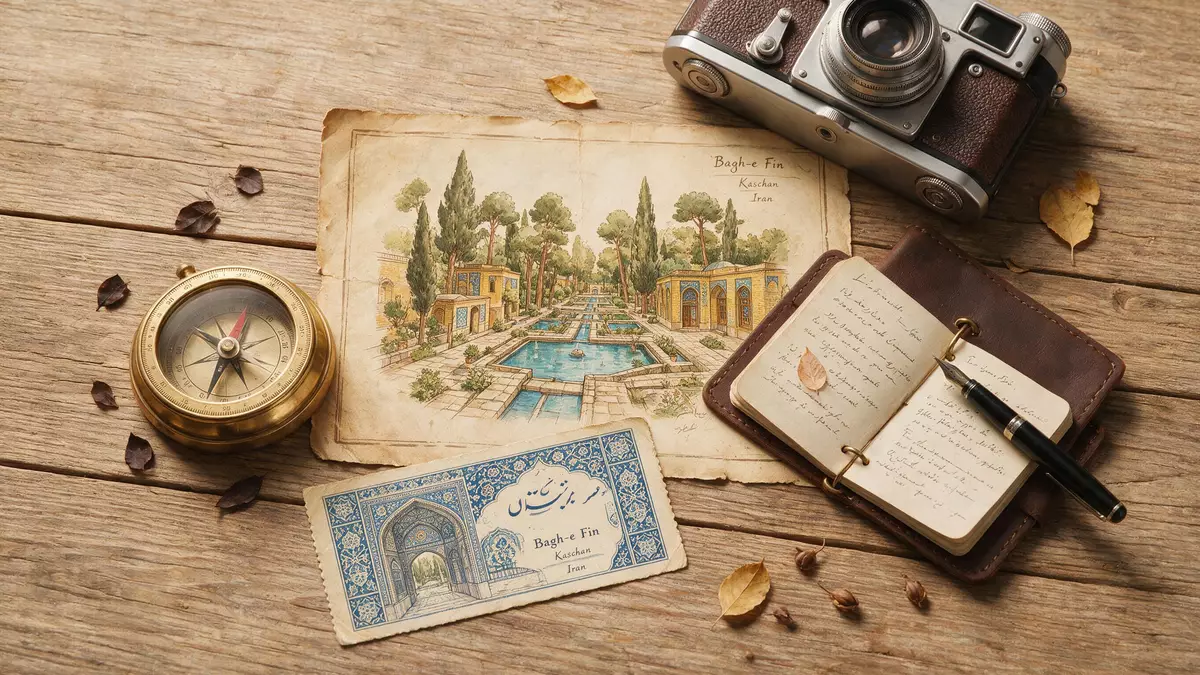
Bagh-e Fin in Kaschan is a Persian garden of walls, water and brick pavilions. It belongs to the Safavid period and forms part of the UNESCO-listed Persian Garden.
Bagh-e Fin’s enclosed landscape
The garden is laid out as a formal enclosed composition, with straight paths, channels and planted sections organised inside high boundary walls. Its name is tied to the Fin district near Kaschan, in central Iran.
The setting is the strongest first impression: clipped lines, tiled watercourses and planted geometry sit within a compact plan. The garden is associated with the court culture of Shah Abbas I, and its present form reflects that Safavid world.
Completed in 1590 gives the garden a secure historical anchor, and the site is also linked with the long Persian tradition of chahar bagh planning. The formal order remains visible in the arrangement of paths, water and planted beds.
Safavid planning and later layers
Bagh-e Fin is not a single-period relic. It has Safavid foundations and later additions, so the garden reads as a sequence of architectural and historical layers rather than a frozen tableau.
Within the enclosure, brick structures, tiled surfaces and water channels create a restrained palette. The overall effect is architectural as much as horticultural, with the garden treated as a built composition.
Safavid dynasty and serial World Heritage property are the two most useful labels for understanding its place in Iranian cultural history. A garden of this type depends on enclosure, measured lines and the disciplined use of water.
Water, memory and the garden’s social history
Bagh-e Fin also carries strong historical associations through its buildings and courtyard spaces. The garden contains later layers connected with Qajar history, including the Fin Bath.
That connection gives the place a second register beyond formal garden design. Visitors encounter a landscape that is both decorative and historically charged, where architecture and memory sit in the same enclosure.
Amir Kabir and The Persian Garden help place Bagh-e Fin within broader Iranian history and heritage. The garden’s significance lies in that blend of formal order, recorded history and surviving built fabric.
Visiting Bagh-e Fin: what travellers from Western Europe should know
- The garden lies in Kaschan, in Iran, and is reached from the city by road. It sits on the south-western edge of the urban area.
- The terrain is level and enclosed, with paved paths, channels and built surfaces. The garden is arranged for walking rather than climbing.
- The official language is Persian and the currency is the Iranian rial.
- Entry requirements depend on your nationality; UK travellers can check the FCDO travel advice at gov.uk/foreign-travel-advice, Irish travellers the Department of Foreign Affairs at ireland.ie.
Searching for Bagh-e Fin on social platforms
These links open searches for Bagh-e Fin on each platform.
Frequently asked questions about Bagh-e Fin
Where is Bagh-e Fin?
Bagh-e Fin is in Kaschan, in central Iran. It lies on the city’s south-western edge.
What does a visit involve?
The garden is a sequence of walls, water channels, paths and pavilions. It is a place for moving through a designed landscape rather than a single monument.
What makes it distinctive?
Its combination of Safavid planning, later historical layers and formal garden geometry gives it a clear identity. The surviving composition makes the garden’s structure easy to read.


