
Bagh-e Fin, Kaschan’s walled Persian garden of water and geometry
Published on 09/19/2026 at 07:33 | Editorial responsibility: Rafael Müller, Editor-in-Chief AD HOC NEWS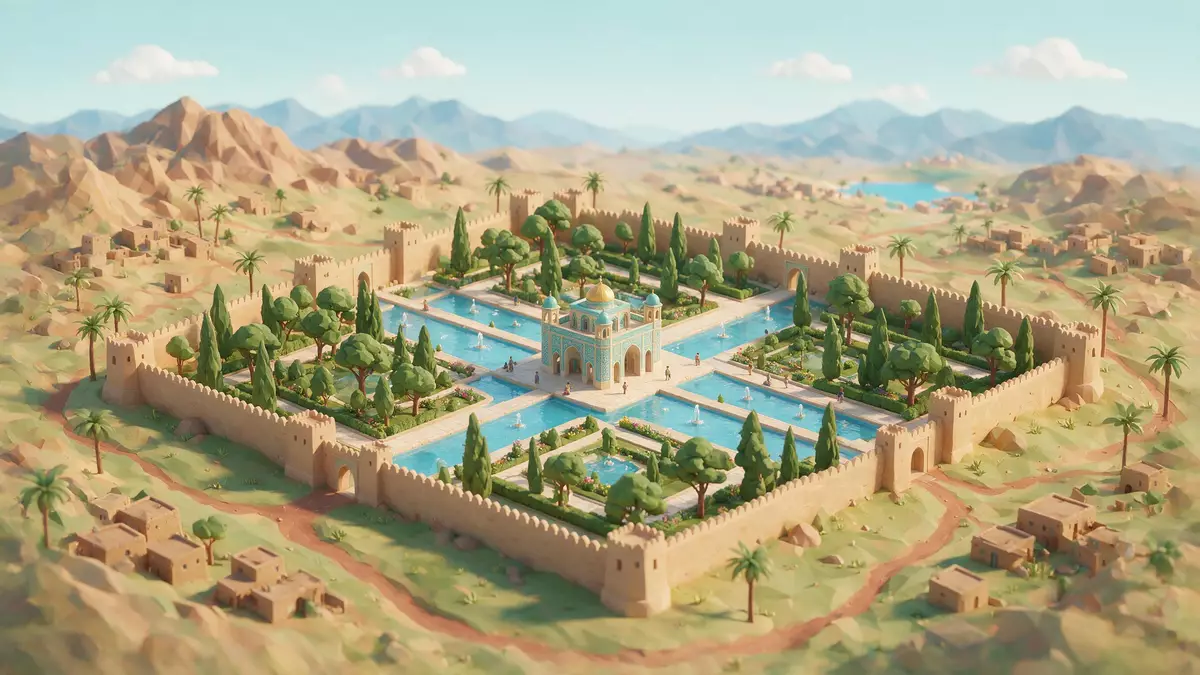
Bagh-e Fin on the south-western outskirts of Kaschan in central Iran is a walled Persian garden where spring water, brick pavilions and tall trees are organised within a precise geometric layout. Completed as a royal garden in 1590 and later reshaped under Shah Abbas I of the Safavid dynasty, it brings together Safavid and Qajar structures, running water and planted plots in a single enclosed rectangle.
A Persian garden held inside walls
Bagh-e Fin stands near the Fin suburb outside Kaschan, at the point where the Soleimaniyeh spring emerges from the desert hills and feeds a network of channels and basins laid out inside the garden’s walls.captures the Soleimaniyeh spring The enclosure covers several hectares and follows a chahar bagh layout, the four-part garden pattern that became a hallmark of Persian design.historic Persian garden
A high perimeter wall defines Bagh-e Fin towards the desert, with towers marking its corners and a monumental entrance portal on the city-facing side.protected by a perimeter wall Inside, straight watercourses run between rows of trees and planted squares, crossing at right angles and feeding basins set before small pavilions. The contrast between the ordered grid of water and the dense planting gives the garden a composed character that is still legible centuries after its Safavid beginnings.
Safavid design, Qajar history
The garden in its present form is associated with Shah Abbas I, the fifth Safavid ruler, whose reign from 1588 to 1629 left a dense legacy of architecture across Iran.dates back to the time of Shah Abbas I Safavid builders gave Bagh-e Fin its enclosing wall, the main entrance and the central pavilion aligned with the garden’s axes.Safavid constructions include the exterior wall and central pavilion Later, during the Qajar period in the nineteenth century, additional structures joined this core, including a larger bathhouse and a library on the western side.
One small Safavid-era bathhouse inside the garden gained a heavy historical association in 1852, when Amir Kabir, the influential Qajar-era chancellor, was assassinated there on the orders of Naser al-Din Shah.Amir Kabir was assassinated in 1852 The presence of this bathhouse and its later Qajar counterpart ties the pleasure garden to a more sombre layer of political history, visible in the juxtaposition of ornamental pools with the compact, domed rooms of the bathing complex.
Water, trees and geometry as a single composition
Across Bagh-e Fin the geometry of the plan is expressed through water. Channels take spring water from north to south and east to west, creating a grid that aligns with the central pavilion and the garden’s main paths.geometric layout of watercourses and pools Basins interrupt the lines of flow and stand before pavilions, marking spaces for rest in the shade. The sound and movement of water are therefore tied directly to the garden’s structure rather than added decoration.
Mature trees flank the channels and frame the paths, marking the axes while softening the brick and stone of the buildings.old trees beside pools and fountains Within the grid, smaller plots host planting that changes with the seasons, set against the fixed lines of water and architecture. The garden’s scale, around several hectares in area, allows these elements to repeat without feeling cramped, so that the plan and the individual spaces can both be understood on a single walk.
Visiting Bagh-e Fin: what travellers from Western Europe should know
- Bagh-e Fin lies south-west of central Kaschan near the Fin suburb, reached by road along Amir Kabir Road from the city’s main squares and historic bazaars.
- The garden is enclosed by high walls, and moving through it involves walking along level paths between channels, with some steps leading into pavilions and bathhouse rooms.
- Bagh-e Fin stands at the margin of the central Iranian desert, so exposure to sun can be strong in the open parts of the garden while the trees and buildings provide shaded sections.
- The official language is Persian and the currency is the Iranian rial.
- Entry requirements depend on your nationality; UK travellers can check the FCDO travel advice at gov.uk/foreign-travel-advice, Irish travellers the Department of Foreign Affairs at ireland.ie.
Searching for Bagh-e Fin on social platforms
These links open searches for Bagh-e Fin on each platform.
Frequently asked questions about Bagh-e Fin
Where is Bagh-e Fin located?
Bagh-e Fin is a historic walled garden near the Fin suburb south-west of Kaschan in central Iran, at the edge of the desert terrain.
What should visitors expect inside the garden?
Visitors encounter straight channels carrying spring water, basins set before brick pavilions, mature trees lining paths and enclosed bathhouse buildings within the garden’s geometric plan.
What makes Bagh-e Fin distinctive among Persian gardens?
Bagh-e Fin combines a Safavid-era walled layout, Qajar-period structures and a strong connection to the Soleimaniyeh spring, tying architecture, water and planted plots into one composition.


