
Bagh-e Fin, Kashan’s classical Persian garden of water and geometry
Published on 08/17/2026 at 13:14 | Editorial responsibility: Rafael Müller, Editor-in-Chief AD HOC NEWS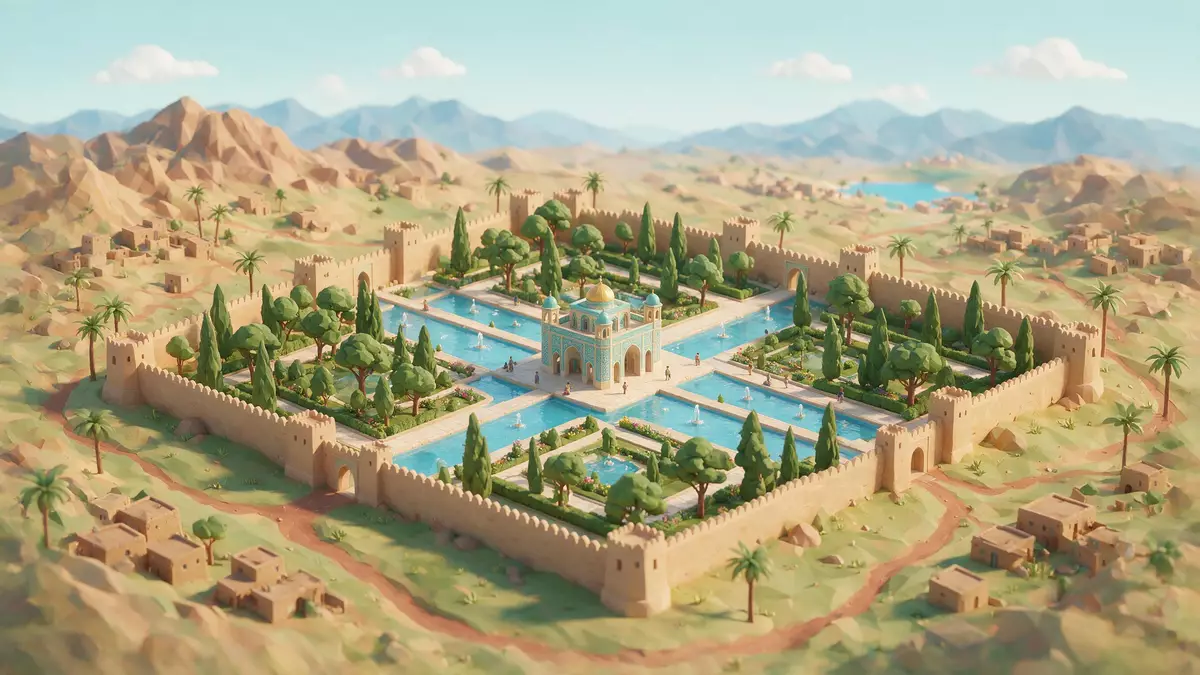
Bagh-e Fin on the outskirts of Kaschan is a classical walled Persian garden where spring water, Safavid-era architecture and Qajar-period history are held together in a single geometric plan. Built in its present form under Shah Abbas I in the late sixteenth century, it later became the setting for the assassination of the reforming prime minister Amir Kabir in 1852, a story that still clings to the garden’s central bathhouse. Within its enclosure, stone channels, tiled basins, cypress lines and brick pavilions create a dense composition that has earned Bagh-e Fin a place among Iran’s UNESCO-listed Persian gardens.
Water drawn into a formal Persian garden
Bagh-e Fin lies to the south-west of central Kaschan, at the foot of the desert hills where the Soleimaniyeh spring emerges and feeds the garden’s network of channels and basins.the Soleimaniyeh spring The enclosure covers several hectares and follows the layout typical of a chahar bagh, the quartered garden plan used across Safavid Iran, with long straight watercourses intersecting at right angles and defining rectangular plots of planting.chahar bagh Stone-edged channels carry clear water along these axes, spilling into pools and basins that sit directly in front of key buildings and under the shade of mature cypress trees.
The standing garden, as visitors experience it, belongs to the Safavid and Qajar periods, even though the site itself is thought to date from much earlier.Safavid and Qajar periods Shah Abbas I, who ruled from 1588 to 1629, ordered the creation of the present plan, which placed a central pavilion at the heart of the enclosure and framed it with axial water channels.designed for Shah Abbas I Later Safavid rulers, including Shah Safi and Shah Abbas II, expanded and embellished the structures, while Qajar-era interventions under Fath Ali Shah added new buildings and reinforced the garden’s role as a royal setting.Qajar-era interventions
Safavid pavilions, Qajar bathhouses and a royal enclosure
The enclosure wall of Bagh-e Fin rises as a solid brick boundary around the garden, punctuated by an entrance portal that leads into a forecourt and then to the main axial path.exterior wall and entrance portal Inside, the central pavilion stands above a water basin, its brick structure carrying painted interiors, wooden ceilings and openings towards the garden plots on each side. Smaller buildings sit at key points along the axes, including pavilions used historically for receptions and resting places for the Safavid and Qajar courts. The trees, largely cypress but with other species mixed in, line the channels and frame views towards the central structures.
Fin Bathhouse, within the garden complex, is the most charged of these buildings. A smaller bath belongs to the Safavid period, while a larger one is attributed to Qajar construction.small and large bathhouses In 1852, Amir Kabir, the powerful Qajar premier whose full name was Mirza Taghi Khan, was murdered in this bathhouse on the orders of Naser al-Din Shah, an episode that gives the building a place in national history as well as in garden design.Amir Kabir’s murder The combination of royal pavilions, service buildings and bathhouses, all tied together by water and planting, shows how Bagh-e Fin functioned as a complete palace garden rather than a simple park.
A Persian garden on the UNESCO World Heritage list
Bagh-e Fin forms part of the serial World Heritage property known as “The Persian Garden”, a group of nine sites across Iran that together represent the evolution of this garden type.nine Persian gardens on the UNESCO list The inscription emphasises the way water management, axial planning, enclosure walls and pavilion architecture come together to express the concept of a garden as a controlled microcosm. At Fin, the capture of the Soleimaniyeh spring and its channelling through stone-lined courses is central to this idea, as is the strict geometry that divides the space into plots and walks.
The garden’s influence has travelled beyond Kaschan and beyond Iran. Descriptions of Bagh-e Fin from Safavid times helped shape understandings of Persian garden design among travellers and architects, and the type of quartered, water-centred garden seen here appears in later royal complexes from Isfahan to distant sites in India and Spain.influence on gardens abroad Within Iran, the garden is recognised as one of the oldest surviving formal gardens in the country, with the Safavid period providing the framework and the Qajar era leaving many of the visible buildings.oldest extant garden
Visiting Bagh-e Fin: what travellers from Western Europe should know
- Bagh-e Fin stands southwest of central Kaschan, close to the Fin suburb and reached most directly along Amir Kabir Road from the city’s main squares.
- The terrain inside the garden is largely level, with long straight paths, stone-edged water channels and staircases leading up into pavilions above ground-level basins.
- Within the enclosure, the main features lie close together: central pavilion, bathhouse complex, entrance portal and spring platform all connected by axial walks and shaded tree lines.
- Kaschan lies in Iran, where the official language is Persian and the national currency is the Iranian rial.
- Entry requirements depend on your nationality; UK travellers can check the FCDO travel advice at gov.uk/foreign-travel-advice, Irish travellers the Department of Foreign Affairs at ireland.ie.
Searching for Bagh-e Fin on social platforms
These links open searches for Bagh-e Fin on each platform.
Frequently asked questions about Bagh-e Fin
Where is Bagh-e Fin located?
Bagh-e Fin is located near the Fin suburb south-west of Kaschan, in central Iran, at the point where the Soleimaniyeh spring emerges and feeds the garden.
What can visitors expect inside the garden?
Visitors find a walled Persian garden laid out on geometric axes, with stone channels, basins, cypress-lined paths, Safavid and Qajar pavilions and the historic Fin Bathhouse.
What makes Bagh-e Fin distinctive among Persian gardens?
Bagh-e Fin combines an early Safavid axial plan, Qajar-period buildings, the Soleimaniyeh spring and the historical episode of Amir Kabir’s assassination within a single, enclosed royal garden.


