
Banff National Park’s turquoise lakes and towering peaks
Published on 09/03/2026 at 18:51 | Editorial responsibility: Rafael Müller, Editor-in-Chief AD HOC NEWS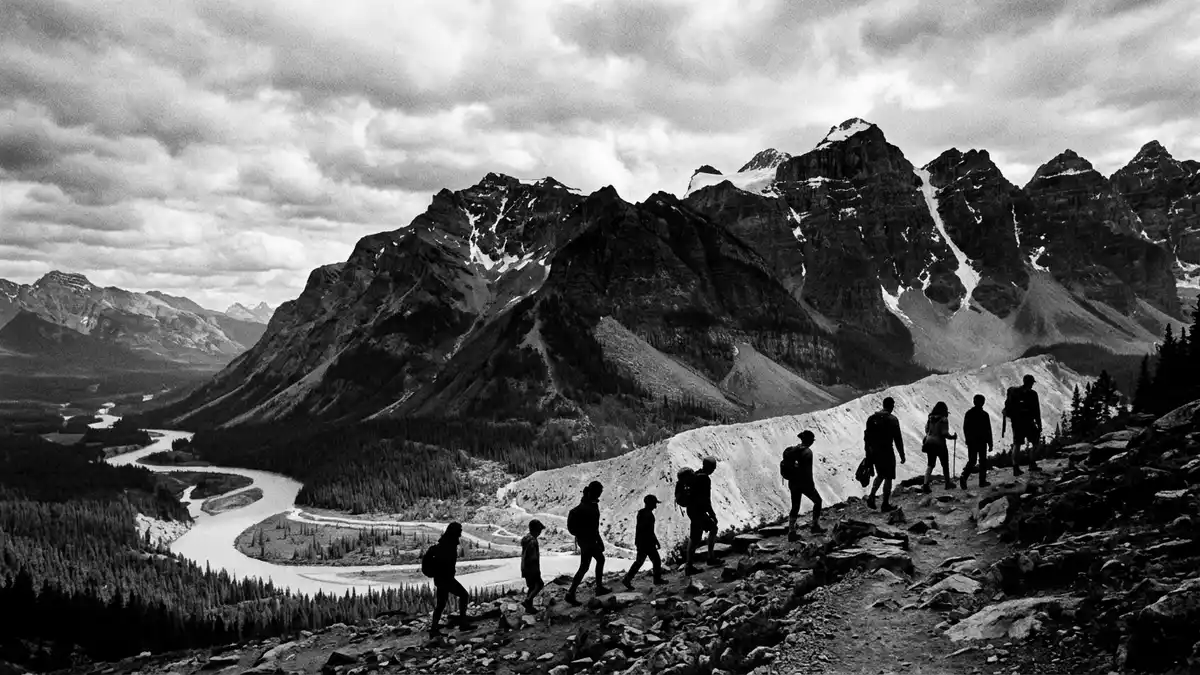
Banff National Park in western Canada sets deep turquoise lakes against steep Rocky Mountain peaks, creating a landscape where ice, forest and stone dominate every view. Established in the nineteenth century as Canada’s first national park, it stretches around the town of Banff and anchors a vast protected section of the Canadian Rockies.
Canada’s first national park in the Rockies
Banff National Park lies in the province of Alberta, within the main ranges of the Canadian Rockies west of Calgary. The protected area covers 6,641 square kilometres (2,564 square miles) of mountains, valleys and high plateaus under federal management as a national park.6,641 square kilometres This scale becomes obvious on the approach, as ridgelines stack behind one another in grey and blue bands.
The park was created in the 1880s after the discovery of hot springs near what is now the Banff townsite. It was officially established on 25 November 1885 under the name Rocky Mountains Park, making it Canada’s first national park and one of the earliest national parks worldwide.established on 25 November 1885 In 1984, Banff was included in the Canadian Rocky Mountain Parks ensemble inscribed as a UNESCO World Heritage Site for its mountain landscapes and active geological processes.Canadian Rocky Mountain Parks UNESCO World Heritage
Turquoise lakes, glaciers and alpine valleys
Much of Banff National Park’s character comes from glacial landforms. Broad U-shaped valleys carve through the ranges, with steep rock walls and hanging side valleys that speak to the power of past ice. Light-coloured rock flour from still-active glaciers suspends in meltwater and gives several lakes their distinctive turquoise colour, especially when sunlight catches the surface at a low angle.
Forests of coniferous trees cover many lower slopes and valley floors, creating dark green bands beneath pale grey summits. Above the treeline, alpine meadows and bare rock alternate in patches, and permanent ice persists on sheltered faces and on high plateau ice fields. The contrast between still lakes, dense forest and broken cliff faces is particularly marked around features such as the mountain-ringed Lake Louise, which sits within the northern part of the park and is one of its best-known glacial basins.Lake Louise
A railway town turned mountain hub
The town of Banff stands on the Bow River, within the southern part of Banff National Park, and serves as the main service centre for visitors. Banff developed in the 1880s along the Canadian Pacific Railway line, initially under the working name “Siding 29”, before taking its permanent name from Banffshire in Scotland.railway town named for Banffshire Park headquarters stand in the town, and the settlement’s streets are laid out under the shadow of surrounding peaks.
The link between railway infrastructure and protected landscape helped shape Banff’s early character as a mountain resort. Hotel buildings and service structures rose near the line, taking advantage of views to nearby summits and hot springs. Over the twentieth century, road access expanded with routes such as the Trans-Canada Highway crossing the park, and Banff’s role as a gateway centre solidified, with museums and cultural institutions joining outdoor-focused facilities.Trans-Canada Highway through the park
Visiting Banff National Park: what travellers from Western Europe should know
- Banff National Park sits in western Canada’s province of Alberta, with the town of Banff on the Bow River inside the park and Calgary to the east as the main urban gateway.
- Terrain within the park is mountainous, with steep slopes, high-altitude passes and valley floors at elevations well above sea level, so approaches on foot often involve noticeable gradients.
- The Trans-Canada Highway crosses Banff National Park, linking Banff with Lake Louise inside the park and with other communities in Alberta and neighbouring British Columbia.
- Lake Louise village lies within the northern part of the park and functions as an additional base for exploring surrounding glacial valleys and high mountain scenery.
- The official languages of Canada are English and French, and the currency is the Canadian dollar. Entry requirements depend on your nationality; UK travellers can check the FCDO travel advice at gov.uk/foreign-travel-advice, Irish travellers the Department of Foreign Affairs at ireland.ie.
Searching for Banff National Park on social platforms
These links open searches for Banff National Park on each platform.
Frequently asked questions about Banff National Park
Where is Banff National Park?
Banff National Park is in Alberta in western Canada, in the Canadian Rockies west of Calgary, with the town of Banff inside its southern section.
What kind of landscape does the park offer?
The park combines high Rocky Mountain peaks, glaciers, turquoise glacial lakes, coniferous forests and alpine valleys shaped by ice and water over long periods.
Why is Banff National Park significant?
Banff National Park is Canada’s first national park, created in 1885, and forms part of the Canadian Rocky Mountain Parks UNESCO World Heritage Site for its mountain scenery and geology.


