
Basilica de Guadalupe in Mexiko-Stadt and its twin churches
Published on 09/17/2026 at 12:23 | Editorial responsibility: Rafael Müller, Editor-in-Chief AD HOC NEWS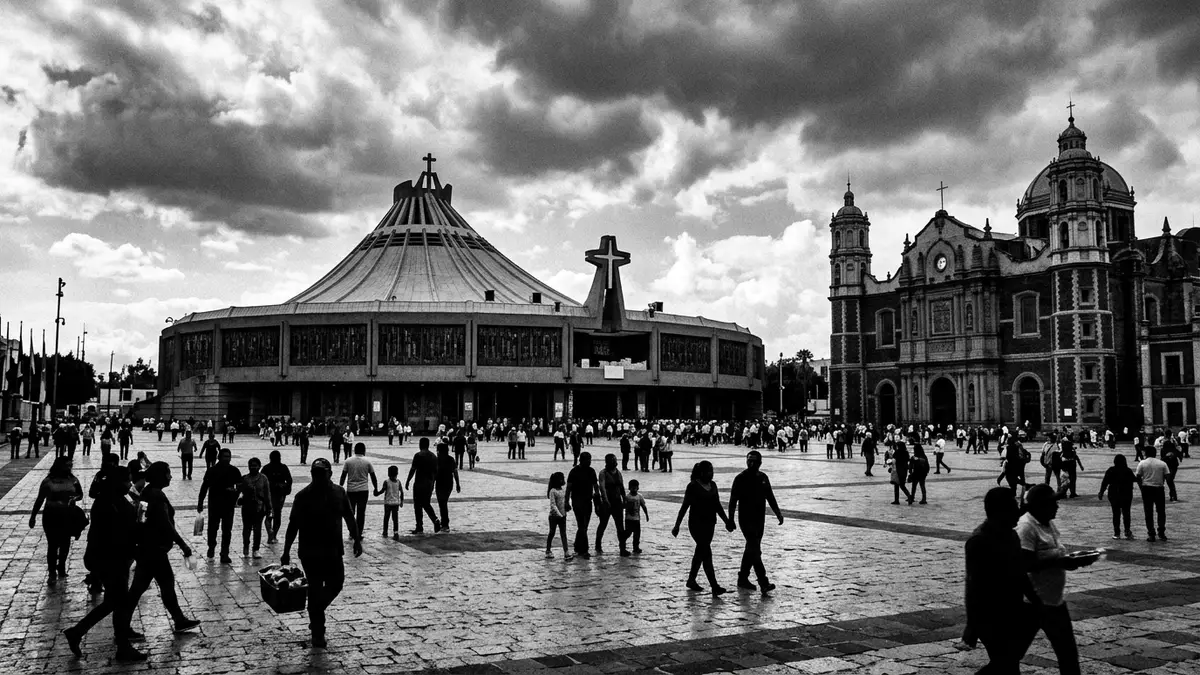
On the northern edge of Mexiko-Stadt, the Basilica de Guadalupe forms a large Catholic sanctuary where an ornate Baroque church and a striking modern basilica stand side by side at the foot of Tepeyac Hill. The complex centres on the veneration of the Virgin of Guadalupe and the tilma associated with Saint Juan Diego in the sixteenth century, giving this corner of the city a layered religious and architectural character anchored in both colonial and twentieth-century Mexico.
From Tepeyac apparitions to a growing shrine
The origins of the Basilica de Guadalupe complex are rooted in accounts of apparitions of the Virgin Mary to the Indigenous convert Juan Diego Cuauhtlatoatzin on Tepeyac Hill in December 1531, which made this site a focus of devotion from an early stage in New Spain.apparitions on Tepeyac Hill A small hermitage was ordered by Bishop Juan de Zumárraga in the sixteenth century, forming the nucleus of what would become a much larger pilgrimage destination as numbers of worshippers increased.small hermitage in 1531
As devotion expanded, Tepeyac evolved into Villa de Guadalupe Hidalgo, a settlement integrated into Mexiko-Stadt, with church buildings and supporting structures spreading across the slope and the plain below.shrine near Mexico City Over the centuries, the image of Guadalupe became a powerful symbol in Mexican religious and civic life, associated with New Spain, independence movements and national identity, and the basilica precinct reflected this status through repeated building campaigns and architectural embellishment.
The Old Basilica: Baroque foundations of the sanctuary
The church now known as the Old Basilica of Guadalupe, or Templo Expiatorio a Cristo Rey, was begun in 1695 under architect Pedro de Arrieta and inaugurated in 1709, replacing earlier sixteenth-century buildings on the same sacred ground.Pedro de Arrieta in 1695 Its design belongs to the Spanish colonial Baroque tradition, with an elaborate facade, sculpted ornament and a plan that reflects the Catholic liturgical needs of the period.
Inside, the Old Basilica carries traces of Baroque and later neoclassical interventions, including work associated with architect Manuel Tolsá in the early nineteenth century.interior rebuilt in neoclassical style Like many heavy masonry buildings in Mexiko-Stadt, it has faced structural settlement on soft ground, leading to reinforcement and stabilisation measures while keeping the historic church in use as part of the wider sanctuary ensemble.sinking foundations of the old basilica
The New Basilica: a circular modernist pilgrimage hall
Beside the Old Basilica stands the New Basilica of Guadalupe, a high modernist concrete structure completed in 1976 and designed by Mexican architect Pedro Ramírez Vázquez with collaborators including José Luis Benlliure and Fray Gabriel Chávez de la Mora.New Basilica consecrated in 1976 Its circular floorplan is a defining feature, arranged so that the revered image of the Virgin of Guadalupe, transferred here from the Old Basilica, can be seen from any point within the main worship space.circular floorplan of the new basilica
The New Basilica’s wide, column-free interior and radial seating reflect twentieth-century structural engineering, contrasting strongly with the narrower volumes and ornamental surfaces of the Baroque church next to it.contrast between Baroque and modernism Together they form a complex where visitors can walk between different architectural eras within a single plaza, with Tepeyac Hill rising behind the sanctuary and smaller chapels and devotional sites extending up its slopes.new basilica and old basilica on the same plaza
Visiting Basilica de Guadalupe: what travellers from Western Europe should know
- The Basilica de Guadalupe complex stands in the Villa de Guadalupe Hidalgo neighbourhood on the northern side of Mexiko-Stadt, at the foot of Tepeyac Hill and along Plaza de las Américas.
- Approaching the sanctuary involves broad paved plazas and interior floors, while the ascent on Tepeyac Hill reaches chapels and viewpoints through stepped paths and inclined walkways.
- The official language is Spanish and the currency is the Mexican peso.
- Entry requirements depend on your nationality; UK travellers can check the FCDO travel advice at gov.uk/foreign-travel-advice, Irish travellers the Department of Foreign Affairs at ireland.ie.
Searching for Basilica de Guadalupe on social platforms
These links open searches for Basilica de Guadalupe on each platform.
Frequently asked questions about Basilica de Guadalupe
Where is Basilica de Guadalupe located in Mexiko-Stadt?
Basilica de Guadalupe stands in the Villa de Guadalupe Hidalgo area on the northern side of Mexiko-Stadt, at the foot of Tepeyac Hill within the Gustavo A. Madero borough.
What should visitors expect when entering the sanctuary complex?
Visitors encounter a broad plaza with the Baroque Old Basilica beside the circular New Basilica, leading into large interior worship spaces and, further up Tepeyac Hill, chapels and viewpoints.
What makes Basilica de Guadalupe distinctive among church complexes?
The sanctuary is distinctive for combining a seventeenth-century Baroque basilica by Pedro de Arrieta with a twentieth-century circular modernist basilica by Pedro Ramírez Vázquez, all focused on the venerated image of the Virgin of Guadalupe.


