
Basilica di San Marco and its five gilded domes
Published on 09/22/2026 at 22:43 | Editorial responsibility: Rafael Müller, Editor-in-Chief AD HOC NEWS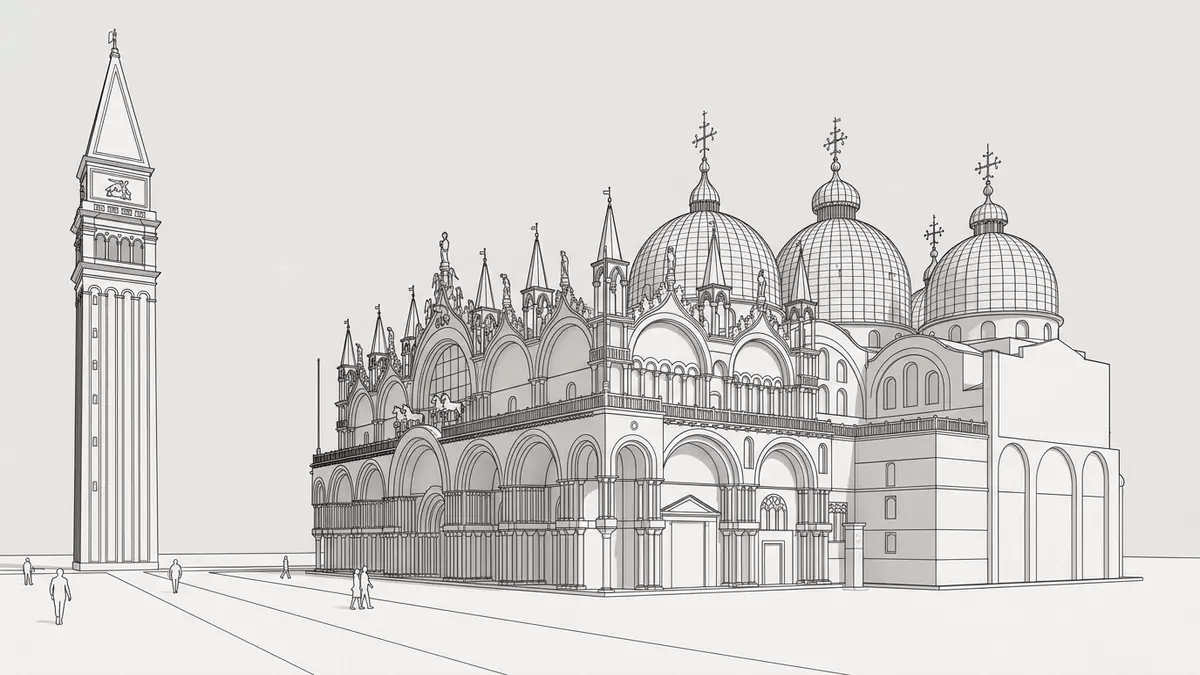
Basilica di San Marco rises beside the Doge’s Palace in Venedig as a church of five domes, marble surfaces and gold-ground mosaics. Its Byzantine design gives the building a strong visual identity, while its history connects Saint Mark, Venetian government and the civic life of the lagoon city.
Five domes above a Greek-cross plan
The basilica follows a Greek-cross plan, with the building’s arms arranged around a central space and covered by five large domes. This form belongs to a Byzantine architectural tradition, expressed through broad volumes, marble cladding and an interior whose surfaces carry colour across walls, vaults and ceilings.
The present church began in 1063 under Doge Domenico Contarini. It was consecrated in 1094, after the basilica had developed from earlier churches associated with Saint Mark’s relics. The surviving building combines the central plan with later additions, sculpture and ceremonial features. Its five Byzantine domes remain its clearest external signature.
Gold mosaics, marble and the story of Saint Mark
The interior is covered with mosaics set against gold backgrounds. Biblical scenes, saints and angels occupy the domes and walls, while varieties of marble appear across the architecture and floor. The result is not a single decorative campaign, but a surface assembled across centuries of Venetian religious and artistic life.
Saint Mark gives the basilica its name and its central historical association. In 829, the body of Saint Mark was transported from Alexandria to Venice under Doge Giustiniano Partecipazio. The first church was consecrated in 832. The basilica’s recorded historical chronology also marks the fire of 976–978, the reconstruction begun in 1063 and the consecration of the church in 1094.
From doge’s chapel to cathedral
Basilica di San Marco stood beside the Palazzo Ducale and served as the doge’s chapel during the Venetian Republic. Its religious role and political setting were closely connected, placing worship beside the spaces where the republic’s government operated.
The church became the cathedral of Venice in 1807 and the seat of the Patriarch of Venice. That change gave the basilica a different institutional role, while its earlier association with the doges remained visible in its position, decoration and ceremonial history.
The facade brings together arches, marble columns, sculptures and mosaics. Gothic decoration was added during the late fourteenth and early fifteenth centuries, including cusps, aedicules and figures of angels and saints. The four bronze horses associated with the facade came to Venice from Constantinople in 1204 and form part of the basilica’s complex artistic history.
Visiting Basilica di San Marco: what travellers from Western Europe should know
- Basilica di San Marco stands on Piazza San Marco beside the Doge’s Palace, at the centre of Venice’s historic lagoon city. The piazza connects with Venice’s pedestrian streets and waterways.
- Venice is formed by islands, canals, bridges and narrow pedestrian passages. The approach to the basilica includes bridges and stone paving rather than a continuous level route.
- The basilica is a functioning cathedral, with religious architecture, sacred images and ceremonial spaces forming part of the visit.
- The official language is Italian and the currency is the euro.
Searching for Basilica di San Marco on social platforms
These links open searches for Basilica di San Marco on each platform.Frequently asked questions about Basilica di San Marco
Where is Basilica di San Marco?
Basilica di San Marco is on Piazza San Marco in Venedig, beside the Doge’s Palace and near the lagoon waterfront.
What can visitors expect inside?
The interior contains gold-ground mosaics, marble surfaces, domed spaces, religious images and sculptural decoration associated with the cathedral.
What makes Basilica di San Marco distinctive?
Its Greek-cross plan, five domes, Byzantine design and extensive gold-ground mosaics create a clearly recognisable architectural ensemble.


