
Basilica di San Pietro and its vast stone theatre of faith
Published on 09/17/2026 at 19:33 | Editorial responsibility: Rafael Müller, Editor-in-Chief AD HOC NEWS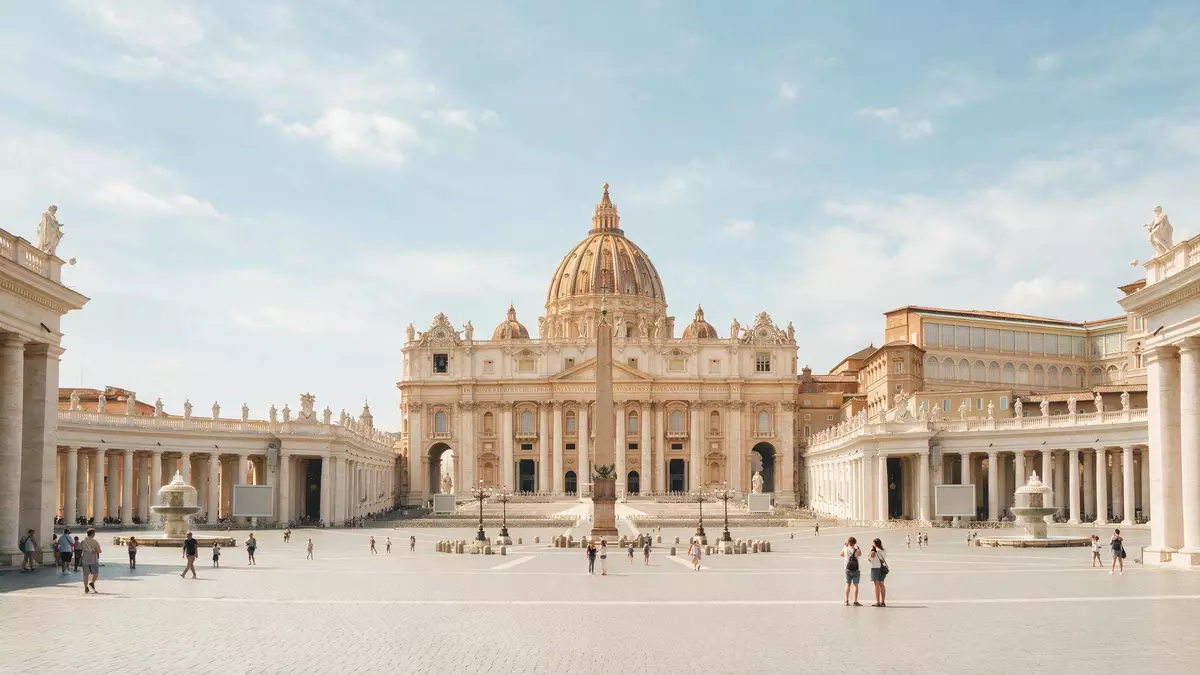
Basilica di San Pietro, known in English as St Peter’s Basilica, rises over Vatican Hill as a colossal Renaissance church at the heart of Vatikanstadt. Constructed between 1506 and 1626, it crowns the traditional burial place of the apostle Peter and anchors the broad ceremonial space of St Peter’s Square.
A Renaissance basilica built over an ancient shrine
The present Basilica di San Pietro stands where an earlier Constantinian church once marked the grave of Saint Peter, the first Bishop of Rome. In the early fourth century, Emperor Constantine sponsored a large basilica on this site above a Roman necropolis, creating the first monumental sanctuary associated with Peter’s tomb.Emperor Constantine’s basilica survived for more than a millennium before the decision was taken in the sixteenth century to replace it with a new church of unprecedented scale.
Work on the new basilica began in 1506 under Pope Julius II, who commissioned the architect Donato Bramante to design a grand central-plan church. Bramante’s scheme introduced the massive piers and Greek-cross layout that still shape the building’s core.Construction starting in 1506 Later architects, including Michelangelo Buonarroti and Carlo Maderno, reworked the plan yet retained the essential ambition: a vast stone canopy over the tomb of Peter that could serve as a principal church for Western Christianity.
The great dome and interior volume
The skyline of Vatikanstadt is dominated by the dome of Basilica di San Pietro, conceived by Michelangelo, who took over the project in 1546 when he was already in his seventies.Michelangelo’s conception of the dome He developed a powerful double-shell structure resting on a high drum, giving the basilica a vertical emphasis that balanced its enormous footprint.
After Michelangelo’s death, the architects Giacomo della Porta and Domenico Fontana oversaw the actual construction of the vaults between 1588 and 1590, raising the dome in roughly twenty-two months with hundreds of labourers.Dome completed around 1590 A gilded bronze sphere and cross were added to the lantern in 1593 by Sebastiano Torrigiani, and mosaics were later installed inside the dome under the direction of Marcello Provenzale. Beneath this structure, the nave stretches to more than 200 m (656 ft) in length, enclosed by colossal pilasters, chapels and side aisles that together form one of the largest enclosed church interiors in the world.Scale of the nave
The tomb of Saint Peter and the Baroque setting
At the heart of Basilica di San Pietro lies the high altar, beneath which the tomb of Saint Peter is located in the Vatican necropolis.Location of Saint Peter’s tomb This layered arrangement, with the shrine below and the altar above, turns the crossing of the basilica into a vertical focus of devotion.
The interior is lined with marble, stucco and gilding, enriched by altarpieces, monuments and chapels from the late Renaissance and Baroque periods. The great bronze baldachin over the high altar, designed by Gian Lorenzo Bernini in the seventeenth century, rises on twisted columns and visually marks the axis between the nave and the tomb below. The basilica also houses numerous papal tombs, drawing the history of many centuries into one continuous architectural setting.
The façade, piazza and colonnades
From outside, Basilica di San Pietro presents a broad travertine façade completed by Carlo Maderno in the early seventeenth century.Façade by Carlo Maderno The façade stretches forward to form the front wall of the basilica and frames the loggia where papal blessings are given.
In front of the church lies St Peter’s Square, a broad oval and trapezoidal space defined by Bernini’s curving colonnades and centred on an ancient Egyptian obelisk moved to the square in the sixteenth century.St Peter’s Square and obelisk The combination of basilica, façade, obelisk and embracing colonnades creates an urban ensemble in stone that functions as an open-air forecourt to the church and as a gathering place for large liturgical celebrations.
Visiting Basilica di San Pietro: what travellers from Western Europe should know
- Basilica di San Pietro stands on Vatican Hill within Vatikanstadt, immediately west of central Rome; the area is served by Rome’s urban transport and the nearby Ottaviano–San Pietro metro station.
- The basilica interior covers a long nave with broad aisles and numerous chapels, and a climb to the dome involves stairways that include narrow sections and a considerable number of steps.
- In front of the basilica, St Peter’s Square forms a large paved forecourt, enclosed by colonnades, where visitors cross open stone surfaces exposed to sun and weather on their way to the church.
- The official language is Italian and the currency is the euro.
Searching for Basilica di San Pietro on social platforms
These links open searches for Basilica di San Pietro on each platform.
Frequently asked questions about Basilica di San Pietro
Where is Basilica di San Pietro located?
Basilica di San Pietro stands in Vatikanstadt, the independent city-state enclosed within Rome, on Vatican Hill immediately west of the River Tiber.
What should visitors expect inside the basilica?
Visitors enter an immense Renaissance and Baroque church interior with a long nave, towering marble-clad piers, side chapels and the great dome rising over the central crossing.
What makes Basilica di San Pietro distinctive?
The basilica combines the tomb of Saint Peter, Michelangelo’s dome, Maderno’s façade and Bernini’s square and colonnades into a single monumental ensemble of faith and stone.


