
Basilica di San Pietro and the great dome of Vatican City
Published on 09/18/2026 at 08:17 | Editorial responsibility: Rafael Müller, Editor-in-Chief AD HOC NEWS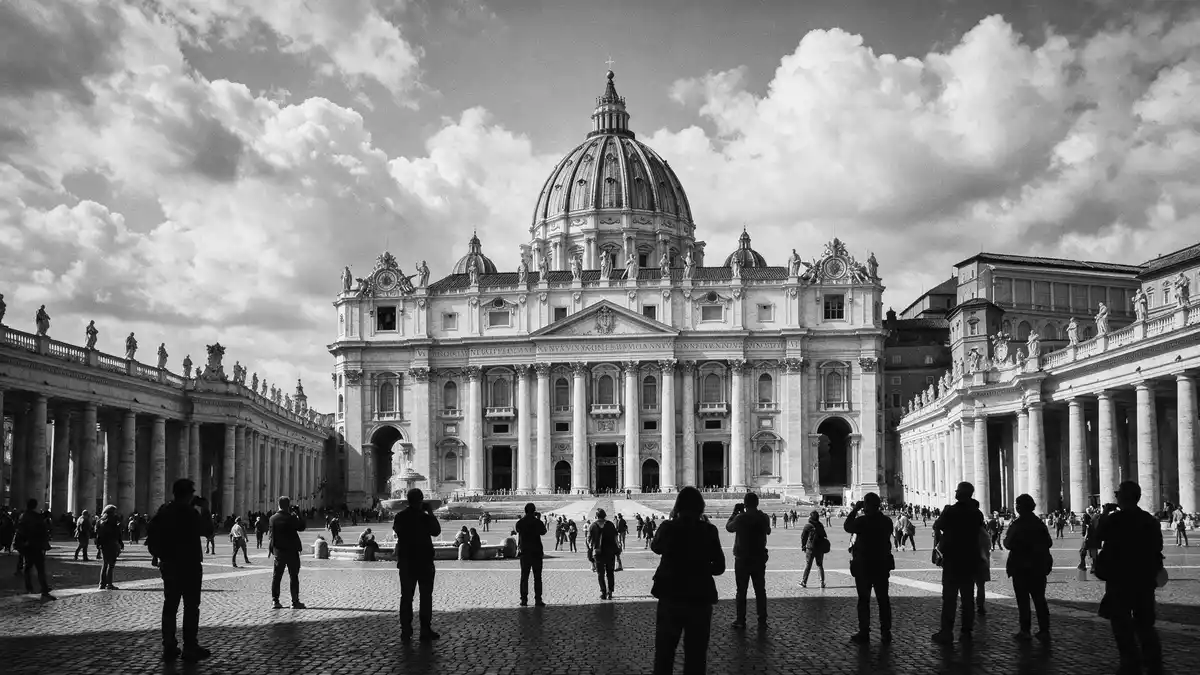
Basilica di San Pietro, better known in English as St Peter’s Basilica, dominates Piazza San Pietro in Vatikanstadt with a vast Renaissance church crowned by a mighty dome. Built between 1506 and 1626 on the site associated with the tomb of Saint Peter, it is one of the principal churches of the Catholic world and a defining monument of Vatican City.
A vast Renaissance basilica shaped over a century
The present Basilica di San Pietro is a Renaissance and Baroque church constructed over more than a century, replacing an earlier Constantinian basilica from the fourth century.Following the proclamation of the Edict of Milan in 313 AD, Emperor Constantine initiated the first great basilica above the tomb of Saint Peter, consecrated in 329. This earlier church endured until structural and artistic ambitions at the turn of the sixteenth century led Pope Julius II to commission a new basilica, whose foundation stone was laid in 1506.Work on the present basilica began under Julius II in April 1506 and continued through the reigns of many popes.
Several of the greatest architects of the Italian Renaissance contributed to Basilica di San Pietro, giving the church its layered yet coherent character.Donato Bramante’s initial centralised plan set the tone, followed by interventions from architects such as Raphael and Antonio da Sangallo the Younger. In 1546 Michelangelo Buonarroti was appointed chief architect, concentrating the design around the central crossing and developing the great drum and dome that define the basilica’s silhouette.Michelangelo’s work between 1546 and 1564 gave the exterior a colossal order and strengthened the structure. Later, Carlo Maderno extended the nave and created the monumental façade, while Gian Lorenzo Bernini shaped the piazza and furnished the interior with works such as the bronze baldacchino over the high altar.
The great dome and the spatial drama beneath it
The lead idea of Basilica di San Pietro for many visitors is the relationship between its immense stone interior and the towering dome that rises above the crossing. The dome was conceived by Michelangelo and raised after his death by Giacomo della Porta with Domenico Fontana, who completed the external structure in the late sixteenth century.They oversaw the construction of the dome between 1588 and 1590, employing hundreds of labourers and complex scaffolding to lift the masonry into place. From outside, the dome and lantern rise high above the basilica and the surrounding city, forming one of the most recognisable outlines in Europe.
Within the church, the central nave leads towards the crossing where the dome opens above the visitor, framed by colossal piers and Baroque ornament. The baldacchino by Bernini stands over the high altar and marks the vertical axis between the floor and the interior of the dome, drawing attention to the depth of the space without needing explanation.The basilica’s interior length is given as about 186 m, and the transept extends with chapels and secondary domes, but the crossing remains the visual centre. Side aisles lined with chapels, altars and tombs run parallel to the nave, each containing artworks and memorials integrated into the architecture, including Michelangelo’s marble “Pietà” in one of the first chapels on the right as visitors enter.
Piazza San Pietro and the basilica’s setting in Vatikanstadt
Basilica di San Pietro stands in Vatican City, an independent microstate enclaved within Rome on the western side of the River Tiber.The basilica forms part of the Papal Basilica of Saint Peter in the Vatican, with its façade fronting Piazza San Pietro and the broad approach from Via della Conciliazione in Rome. The square itself, designed by Bernini in the seventeenth century, is framed by curving colonnades and centred on an ancient Egyptian obelisk moved here in the sixteenth century, giving the basilica a ceremonial forecourt that can accommodate large gatherings.
The exterior of Basilica di San Pietro combines the deep nave built by Carlo Maderno with Michelangelo’s massive central volume and dome, creating a layered profile when viewed from different angles.The overall external length of the basilica is recorded as about 211 m, and the breadth of the transept as around 138 m, figures that reflect the scale of the building rather than an experience claim. Around the basilica lie other Vatican buildings, including the Apostolic Palace and the Vatican Museums further to the north, while beyond the enclosing walls the dense streets of central Rome begin within walking distance.
Visiting Basilica di San Pietro: what travellers from Western Europe should know
- Basilica di San Pietro stands in Vatikanstadt, reached on foot from central Rome and the nearby Ottaviano and San Pietro districts, with main approaches converging on Piazza San Pietro.
- The basilica interior involves extensive walking on hard stone floors, with numerous steps in side areas and a lengthy climb up narrow stairways for those ascending towards the dome.
- Vatikanstadt lies within Rome in Italy; the official language is Italian and the currency is the euro.
- St Peter’s Basilica is close to the Vatican Museums and the northern bank of the River Tiber, making it part of a wider area of religious and historical sites.
Searching for Basilica di San Pietro on social platforms
These links open searches for Basilica di San Pietro on each platform.Frequently asked questions about Basilica di San Pietro
Where is Basilica di San Pietro located?
Basilica di San Pietro stands in Vatikanstadt, the independent city-state within Rome on the western side of the River Tiber, fronting Piazza San Pietro.
What can visitors expect inside Basilica di San Pietro?
Visitors encounter a vast stone interior with a long nave, side chapels containing artworks such as Michelangelo’s “Pietà”, and the dramatic space beneath the central dome.
What makes Basilica di San Pietro distinctive among churches?
The combination of Renaissance and Baroque architecture, contributions from figures such as Bramante, Michelangelo, Maderno and Bernini, and the great dome rising over Vatican City gives the basilica its distinctive character.


