
Basilique Notre-Dame de Montreal and its blue-lit Gothic interior
Published on 09/23/2026 at 23:28 | Editorial responsibility: Rafael Müller, Editor-in-Chief AD HOC NEWS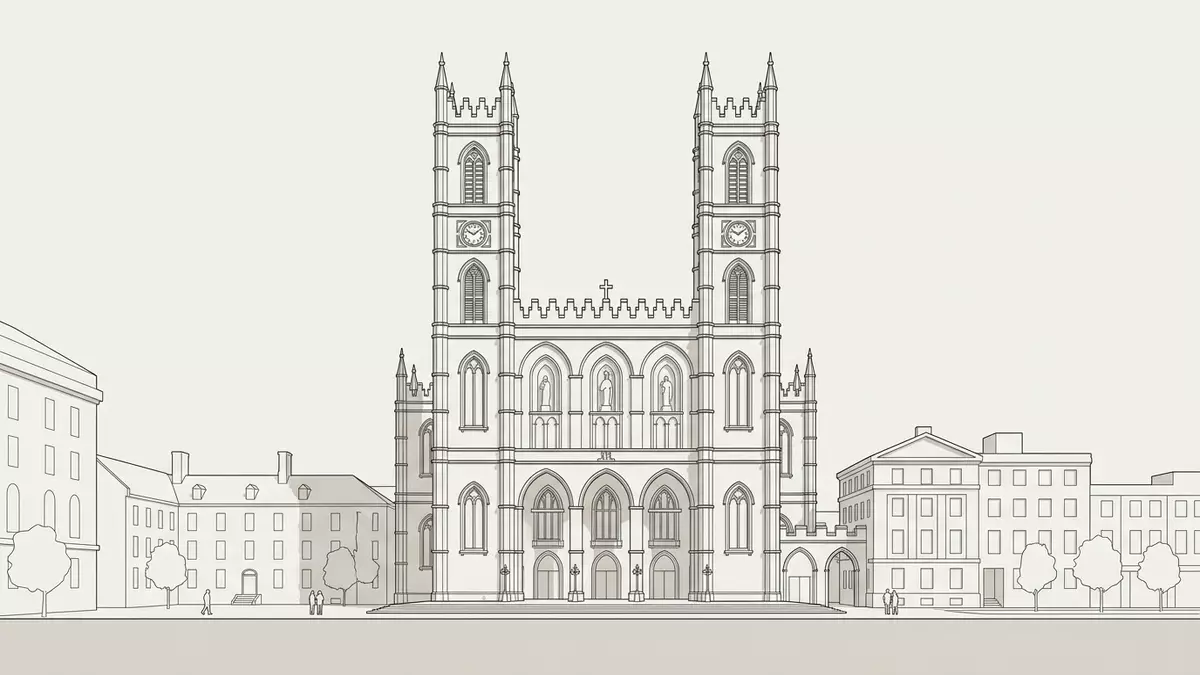
Basilique Notre-Dame de Montreal places a sober limestone exterior beside an interior filled with colour, carved wood and Gothic detail. Built between 1824 and 1829 under Irish-born architect James O’Donnell, the church occupies a prominent position in Old Montreal opposite Place d’Armes.
Limestone walls and a Gothic Revival façade
The basilica is an immense stone church in the Gothic Revival style, a nineteenth-century movement that drew on medieval architectural forms. Its exterior uses Montreal limestone and presents a symmetrical composition with pointed arches, pinnacles, battlements and two substantial towers.
James O’Donnell prepared the principal design after his appointment in 1823. Construction began in 1824, and the church was inaugurated in June 1829. The main body measures 65 metres long and 37 metres wide, giving the building a broad urban presence beside Notre-Dame Street.
The towers belong to a later phase of the building’s completion. The western tower, known as La Persévérance, was completed in 1841, while the eastern tower, La Tempérance, followed in 1843. Their names and differing bell arrangements form part of the basilica’s architectural vocabulary.
The church became a National Historic Site of Canada in 1989. It received the rank of minor basilica in 1982, during the pontificate of Pope John Paul II. These designations connect its religious role with its architectural and historical importance.
James O’Donnell’s church and Victor Bourgeau’s interior
O’Donnell’s exterior belongs to the early Gothic Revival in Canada. The design draws on European Gothic traditions and carries visual references associated with Notre-Dame de Paris and the Church of Saint-Sulpice. The formal language appears in the pointed openings, vertical accents and tower silhouettes.
The interior presents a different register. James O’Donnell began its decoration, while Montreal architect Victor Bourgeau directed a major reworking of the decorative scheme during the nineteenth century. Bourgeau’s work introduced a dense arrangement of painted surfaces, carved details and ornamental elements.
The nave contains rows of columns and a sequence of arches beneath a richly coloured ceiling. Blue, red, gold and deep wood tones define the interior, while religious scenes and decorative motifs occupy the walls and vaults. The result is more elaborate than the restrained exterior suggests.
A pulpit known as the Chaire de Vérité forms one of the interior’s notable carved features. Wood carving, sculpture and painted ornament continue through the sanctuary and side spaces, creating a visual field that rewards attention to individual details.
The basilica also contains the Notre-Dame-du-Sacré-Cœur Chapel, a separate space with its own history and decorative language. Opened in 1891, the chapel was reconstructed after a fire and reopened in 1982. Its furnishings include a large bronze altarpiece by Charles Daudelin.
A Montreal church with a civic and cultural role
Notre-Dame is Montreal’s mother church and remains a place of Catholic worship, prayer and celebration. Its position in the historic city centre also connects it with civic ceremonies, cultural programmes and major religious occasions.
The parish’s history reaches back to the seventeenth century, when the Sulpicians played a central role in Montreal’s religious administration. The present basilica belongs to a much later phase, when the growing parish required a larger church.
Music forms part of the building’s cultural life. The basilica houses a Casavant organ and has hosted concerts, choirs and performances. The generous interior, carved surfaces and vaulted spaces provide the setting for programmes that extend beyond ordinary parish use.
The building’s history also includes the conversion of James O’Donnell to Catholicism. He died in 1830, shortly after the church’s inauguration, and his crypt lies beneath the basilica.
Basilique Notre-Dame de Montreal therefore brings several layers together: a Gothic Revival exterior, an interior shaped by Victor Bourgeau, a Catholic parish tradition and a civic presence in Old Montreal. The contrast between the limestone façade and the coloured interior remains visible throughout the building.
Visiting Basilique Notre-Dame de Montreal: what travellers from Western Europe should know
- The basilica stands at 110 Rue Notre-Dame Ouest, opposite Place d’Armes in Old Montreal. The Old Port and the historic street grid surround the church.
- Public transport reaches the area through Montreal’s metro and bus network, with Place-d’Armes station serving the district. The approach continues across paved city streets.
- The interior includes a nave, side spaces, the sanctuary and Notre-Dame-du-Sacré-Cœur Chapel. Religious services and cultural activities share the building.
- The official language is French and the currency is the Canadian dollar.
Searching for Basilique Notre-Dame de Montreal on social platforms
These links open searches for Basilique Notre-Dame de Montreal on each platform.Frequently asked questions about Basilique Notre-Dame de Montreal
Where is Basilique Notre-Dame de Montreal?
It stands at 110 Rue Notre-Dame Ouest in Old Montreal, opposite Place d’Armes and within the historic city centre.
What can visitors expect inside?
The interior contains a Gothic Revival nave, carved wood, painted decoration, religious scenes, a sanctuary and the Notre-Dame-du-Sacré-Cœur Chapel.
What makes the basilica distinctive?
Its distinctive character comes from the contrast between James O’Donnell’s limestone exterior and the richly coloured interior developed through Victor Bourgeau’s nineteenth-century decorative work.


