
Basilique Notre-Dame de Montreal and its theatrical Gothic Revival interior
Published on 09/03/2026 at 07:21 | Editorial responsibility: Rafael Müller, Editor-in-Chief AD HOC NEWS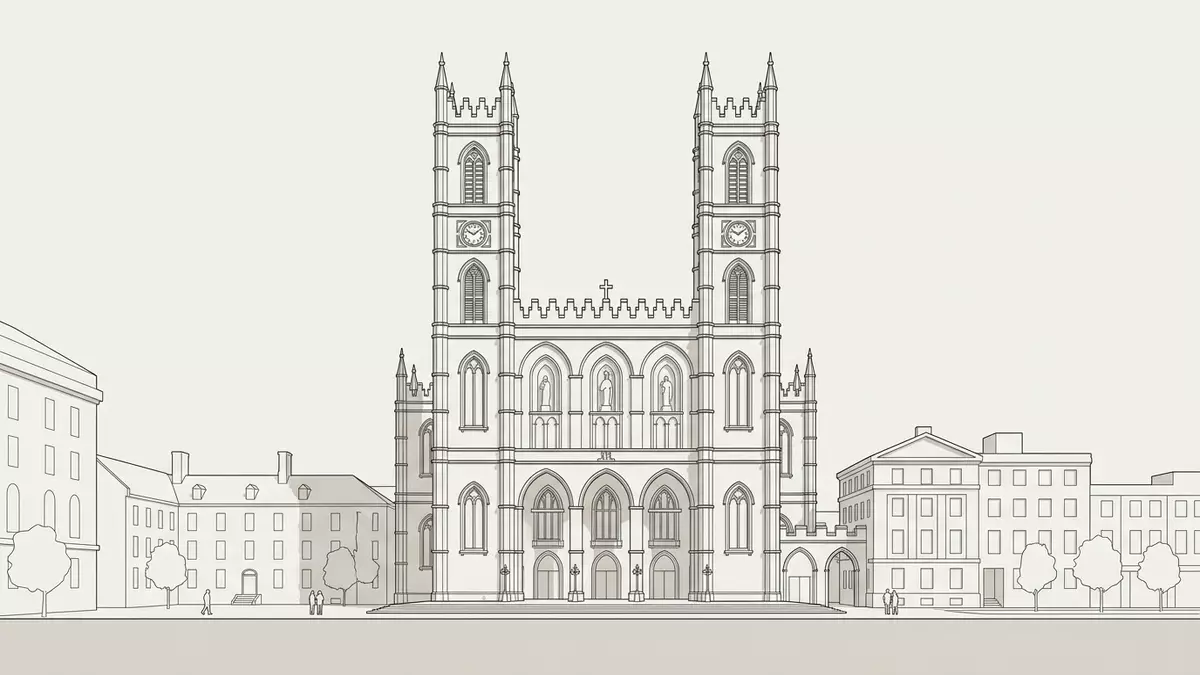
Basilique Notre-Dame de Montreal is a vast Gothic Revival church in Old Montreal whose theatrical interior turns Catholic worship into a staged visual experience on an urban scale. Dedicated in 1829 and raised to the rank of minor basilica in the 1980s, it remains one of the most striking religious buildings in Canada for its scale, its neo-Gothic structure and its richly coloured decoration.
A Gothic Revival landmark shaped by 19th-century Montreal
Basilique Notre-Dame de Montreal stands on Notre-Dame Street facing Place d’Armes, in the historic quarter that preserves some of Montreal’s earliest urban fabric.The immense stone church was constructed between 1824 and 1829 as a new parish church for a growing city. The site had carried an earlier Church of Notre-Dame from the seventeenth century, and the new building continued that role on a much larger scale.
The parish council and the Sulpician Order turned to James O’Donnell, an Irish-American architect based in New York, to design a church that could hold a congregation counted in thousands.O’Donnell chose the Gothic Revival style, drawing inspiration from churches such as Notre-Dame de Paris and Saint-Sulpice, and his work produced what is recognised as the first major Gothic Revival church in Canada.Construction began in 1824 and the church was consecrated on 15 July 1829, establishing it firmly in the early nineteenth century.
The twin-towered facade and stone massing
From Place d’Armes, Basilique Notre-Dame de Montreal presents a symmetrical stone facade dominated by twin towers and a recessed entrance framed by Gothic arches.The exterior belongs to the Romantic phase of Gothic Revival, with pointed arches, battlements and pinnacles applied to a regular, classically influenced front. The stone construction gives the building a substantial physical presence among the commercial and institutional structures of Old Montreal.
The towers rose in stages through the nineteenth century, extending the original composition upward and housing bells and clocks that mark liturgical time. The overall mass of the basilica stretches along Notre-Dame Street, and its roofline and masonry walls form a continuous backdrop to the square. The church’s designation as a National Historic Site of Canada in 1989 formally recognises its architectural significance and its role as a flagship of Gothic Revival religious architecture in the country.The building can accommodate thousands of worshippers and served as the principal parish church of Montreal in the nineteenth century.
A theatrical interior of colour, sculpture and light
Stepping inside Basilique Notre-Dame de Montreal reveals a interior very different from the sober stone exterior.The nave, chancel and galleries are lined with dark-toned woodwork, richly carved altarpieces, and stained-glass windows that depict biblical scenes and the history of the parish. The vaults and columns are painted in deep colours, and gilded motifs highlight the ribs and capitals, creating a sense of depth and drama above the congregation.
The interior decoration evolved in the later nineteenth century under the direction of Montreal architect Victor Bourgeau, who reworked O’Donnell’s original scheme.Bourgeau drew inspiration from the Sainte-Chapelle in Paris, using colour and gold-leaf ornament on the vaults and columns, and coordinated sculpture and painting to create a unified Gothic Revival decor. The result is a layered interior where altar, pulpit, organ case and side chapels form a continuous visual composition along the nave.
Visiting Basilique Notre-Dame de Montreal: what travellers from Western Europe should know
- Basilique Notre-Dame de Montreal stands on Notre-Dame Street opposite Place d’Armes in Old Montreal, a central district that is reached by city public transport and allows arrivals on foot from nearby streets.
- The basilica’s main nave is approached by external steps rising from the square and inside the church there are aisles and galleries connected by staircases, with distances on foot that reflect the building’s considerable length.
- The official language in Montreal is French and the currency is the Canadian dollar.
- Entry requirements depend on your nationality; UK travellers can check the FCDO travel advice at gov.uk/foreign-travel-advice, Irish travellers the Department of Foreign Affairs at ireland.ie.
Searching for Basilique Notre-Dame de Montreal on social platforms
These links open searches for Basilique Notre-Dame de Montreal on each platform.Frequently asked questions about Basilique Notre-Dame de Montreal
Where is Basilique Notre-Dame de Montreal located in the city?
Basilique Notre-Dame de Montreal stands on Notre-Dame Street opposite Place d’Armes in Old Montreal, a historic district close to the St Lawrence River.
What can visitors expect inside the basilica?
Visitors encounter a large Gothic Revival nave lined with carved wooden decoration, stained-glass windows and a coloured, gilded vault, together forming a theatrical church interior.
What makes Basilique Notre-Dame de Montreal distinctive among Canadian churches?
It is recognised as the first major Gothic Revival church in Canada, with twin towers, a vast stone nave and a richly reworked interior that helped define Montreal’s religious architecture.


