
Basilique Notre-Dame de Montreal in stone and blue
Published on 09/21/2026 at 20:26 | Editorial responsibility: Rafael Müller, Editor-in-Chief AD HOC NEWS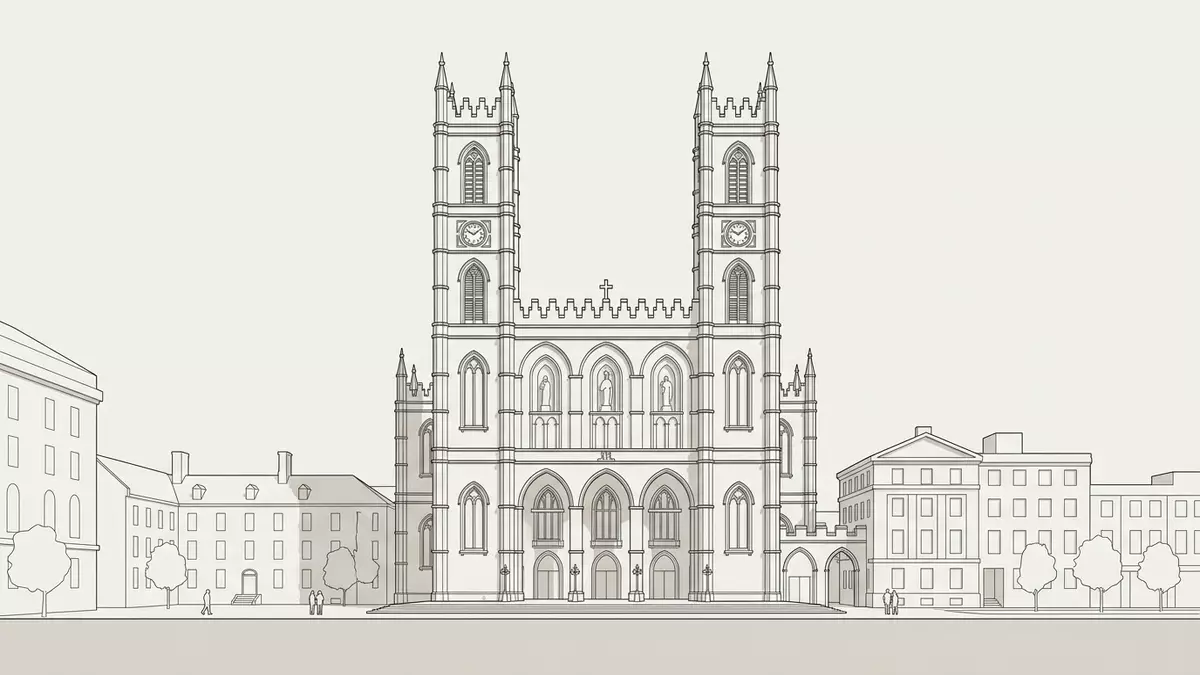
Basilique Notre-Dame de Montreal rises in Old Montreal as a stone church with a Gothic Revival profile and a long Catholic history. The building is Montréal’s mother church, and James O'Donnell is the architect most closely tied to its nineteenth-century form.
James O'Donnell and the Gothic Revival church
The present church was built between 1824 and 1829, and it marked an important early phase of Gothic Revival architecture in Canada. The Notre-Dame Basilica became the city’s principal Catholic church and remains closely linked to Montréal’s civic and religious identity.
The façade is organised around twin towers and grey Montréal limestone, while the overall mass stays symmetrical and restrained. O'Donnell, an Irish-born New York architect, gave the exterior its Gothic Revival character, drawing on European church forms without copying them mechanically.
The interior by Victor Bourgeau
The interior has a different register from the exterior, with deep colour, gilding and carved ornament. Victor Bourgeau’s decoration from the later nineteenth century transformed the space into a richly layered nave and sanctuary.
The vaults carry blue fields and gold motifs, and the decoration draws on religious symbolism rather than plain surface treatment. Six paintings from the earlier church were kept and added to the present ensemble, which gives the interior a visible link to what came before.
The chapel of Notre-Dame-du-Sacré-Cœur
A separate chapel, Notre-Dame-du-Sacré-Cœur, belongs to the basilica complex and introduces a more modern note. It was opened in 1891 and rebuilt after fire damaged it in 1978, with a bronze altarpiece by Charles Daudelin now forming its visual centre.
The chapel sits alongside the main church rather than repeating its nineteenth-century Gothic language. Its lighter treatment and newer materials make the basilica ensemble feel layered, with different periods visible in adjacent spaces.
Visiting Basilique Notre-Dame de Montreal: what travellers from Western Europe should know
- It stands at Place d'Armes in Old Montreal, close to the historic centre and the Métro station of the same name.
- The church interior is large and formal, with a long nave, twin towers outside and richly decorated vaults inside.
- The basilica also contains the Chapel of Notre-Dame-du-Sacré-Cœur and a Casavant organ finished in 1891.
- The official language is French and the currency is the Canadian dollar.
Searching for Basilique Notre-Dame de Montreal on social platforms
These links open searches for Basilique Notre-Dame de Montreal on each platform.
Frequently asked questions about Basilique Notre-Dame de Montreal
Where is Basilique Notre-Dame de Montreal?
It stands in Old Montreal at Place d'Armes, in the historic core of the city. The building faces one of Montréal’s most recognisable squares.
What does a visit reveal?
The visit brings together a Gothic Revival exterior, a coloured nineteenth-century interior and the chapel of Notre-Dame-du-Sacré-Cœur. The main space and the side chapel read as separate layers within one religious complex.
What makes it distinctive?
Its identity rests on the contrast between the sober stone exterior and the richly decorated interior. The basilica is also tied to James O'Donnell, Victor Bourgeau and the nineteenth-century history of Montréal.


