
Batu Caves, a limestone temple hill above Gombak
Published on 09/19/2026 at 16:33 | Editorial responsibility: Rafael Müller, Editor-in-Chief AD HOC NEWS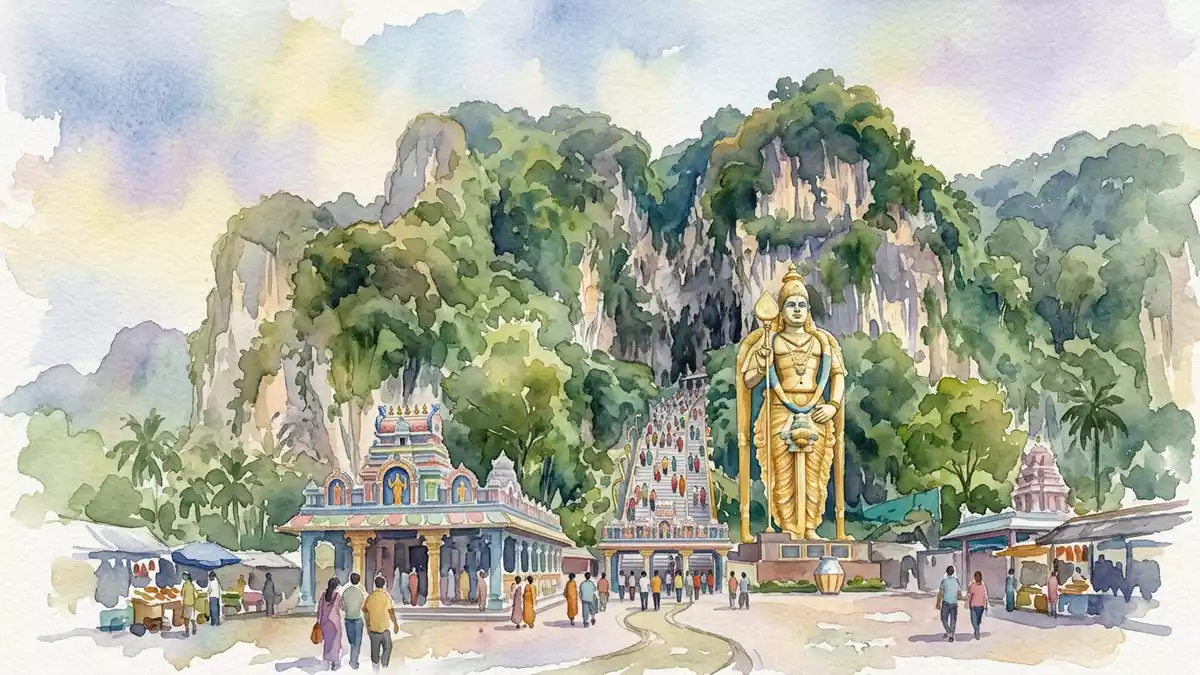
Batu Caves in Gombak near Kuala Lumpur is a limestone hill where natural caverns have been turned into Hindu temple spaces approached by a long staircase. The complex took shape as a major Tamil Hindu pilgrimage site in the late nineteenth century, when worship of Murugan was established inside the largest cave and annual Thaipusam processions began to culminate there.
A limestone hill shaped into a temple complex
Batu Caves is a limestone hill on the northern edge of Gombak in Selangor, just north of Malaysia’s capital Kuala Lumpur, with several caves that have been fitted out as Hindu temple and shrine spaces within the rock.a limestone hill on the northern edge of Gombak Geological studies describe the hill’s limestone as having formed hundreds of millions of years ago, long before human settlement in the area.rock formed more than 400 million years ago
The largest chamber within the hill is Temple Cave, also known as Cathedral Cave, a high vaulted cavern whose floor has been levelled and lined with shrines and temple structures dedicated mainly to Murugan.Temple Cave, also known as Cathedral Cave Other caves in the complex include smaller temple spaces and caverns retaining more of their natural formations, with stalactites, pillars and columns recorded in speleological surveys of the hill.stalactites, pillars and columns
Nineteenth-century worship and the rise of Thaipusam
The devotional character of Batu Caves in its present form is closely tied to the late nineteenth century, when Tamil trader K. Thamboosamy Pillai promoted the hill as a site for Hindu worship.Tamil trader K. Thamboosamy Pillai In 1888 he placed a vel, the spear associated with Murugan, inside the main cave, marking the beginning of regular worship at the site.a vel inside the main cave in 1888
A temple dedicated to Murugan inside the cave, known as the Sri Subramaniar Swamy Temple, was completed by 1891, establishing Batu Caves as a significant Hindu shrine in colonial Malaya.temple completed in 1891 The Thaipusam festival began to be celebrated there from 1892, with processions culminating at the cave temples and the staircase becoming a route for offerings carried to Murugan’s sanctuary inside the hill.Thaipusam observances since 1892
The Murugan statue and the climb up the hill
At the foot of the staircase on the limestone slope stands a golden statue of Murugan, which has become a visual marker of Batu Caves and a prominent feature beside the temple entrance.golden statue of Murugan at the foot of the steps The statue rises to around 42.7 m (140 ft) and was unveiled in 2006, adding a contemporary monumental element to the historic cave complex.42.7 m statue unveiled in 2006
The staircase itself climbs from the temple compound on the valley floor up the limestone face towards the entrance of Temple Cave, with shrines positioned at different levels and views out across Gombak and towards Kuala Lumpur between landings. Inside the main cavern, temple halls occupy the flatter parts of the floor, while further openings in the rock lead to upper chambers that form additional worship spaces open to daylight.
Visiting Batu Caves: what travellers from Western Europe should know
- Batu Caves stands in the Gombak district of Selangor, on the northern side of Kuala Lumpur, and is reached by road and rail services from the city.
- The approach to Temple Cave involves a long staircase up the limestone hillside, with many steps and landings between the temple compound below and the cave entrance.
- Within the hill, some caves retain uneven rock floors and dark interiors, and visitors encounter limestone formations alongside built temple structures.
- The official language is Malay and the currency is the Malaysian ringgit.
- Entry requirements depend on your nationality; UK travellers can check the FCDO travel advice at gov.uk/foreign-travel-advice, Irish travellers the Department of Foreign Affairs at ireland.ie.
Searching for Batu Caves on social platforms
These links open searches for Batu Caves on each platform.
Frequently asked questions about Batu Caves
Where is Batu Caves located?
Batu Caves is a limestone hill with cave temples in the Gombak district of Selangor, just north of Kuala Lumpur in Malaysia.
What can visitors expect on a visit?
Visitors encounter a temple compound, a long staircase ascending the limestone slope, the golden statue of Murugan and cave interiors fitted out as Hindu temple halls.
What makes Batu Caves distinctive among temple sites?
The combination of a limestone hill formed hundreds of millions of years ago, large caverns shaped into temple spaces and the prominent Murugan statue at the foot of the steps gives Batu Caves a character closely tied to both geology and Tamil Hindu devotion.


