Batu Caves and the rainbow climb into Malaysia’s limestone heart
Published on 09/03/2026 at 08:35 | Editorial responsibility: Rafael Müller, Editor-in-Chief AD HOC NEWS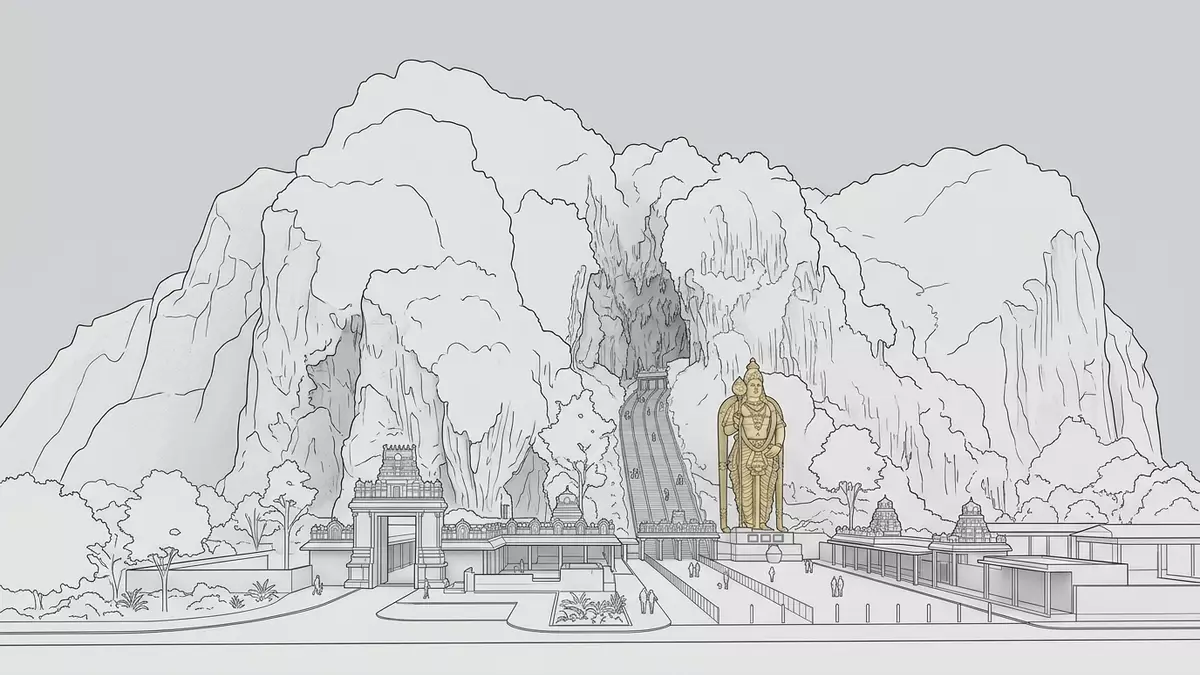
Batu Caves, on the outskirts of Gombak in Selangor, rises as a limestone hill whose caverns shelter one of Malaysia’s most important Hindu temple complexes. Carved in rock that geological studies place at more than 400 million years old, the site blends ancient stone, steep painted steps and a colossal statue of the deity Murugan into a single vertical journey from roadside level to a high temple cave.Limestone caves in Gombak
Limestone hill and temple caves above Gombak
The hill that carries Batu Caves rises to more than 300 m (around 1,000 ft), its cliffs and ledges breaking away from the surrounding lowland north of Kuala Lumpur.A limestone mogote north of Kuala Lumpur The mass is made of limestone laid down in a tropical sea and shaped into caverns and shafts over hundreds of millions of years, long before any human settlement in the area.Over 400 million years old limestone
The present temple complex occupies a cluster of caves within this hill, with the best known known as Temple Cave or Cathedral Cave, high above the approach road. Below it, at the base of the cliff, a lower cave known as Ramayana Cave contains sculptural tableaux illustrating episodes from the Ramayana epic, while other smaller caves around the base hold shrines or commercial uses.
Murugan, K. Thamboosamy Pillai and a nineteenth-century shrine
Although the limestone itself is ancient, Batu Caves entered the historical record in 1878, when American naturalist William Hornaday described the site during his travels in the Malay Peninsula.William Hornaday in 1878 In the late nineteenth century the caves became associated with Tamil Hindu worship when the trader K. Thamboosamy Pillai dedicated Temple Cave to Lord Murugan, installing a shrine that drew Indian communities from Kuala Lumpur and beyond.K. Thamboosamy Pillai’s dedication in 1890
The annual festival of Thaipusam, linked to Murugan, has been celebrated at Batu Caves since the 1890s and has turned the hill into a major Tamil Hindu pilgrimage centre in Southeast Asia.Thaipusam focal point in Malaysia On ordinary days the same stairways and shrines that fill with festival processions serve temple devotees from the Kuala Lumpur region, alongside visitors drawn by the combination of faith, geology and bright colour.
The golden Murugan statue and the rainbow stairway
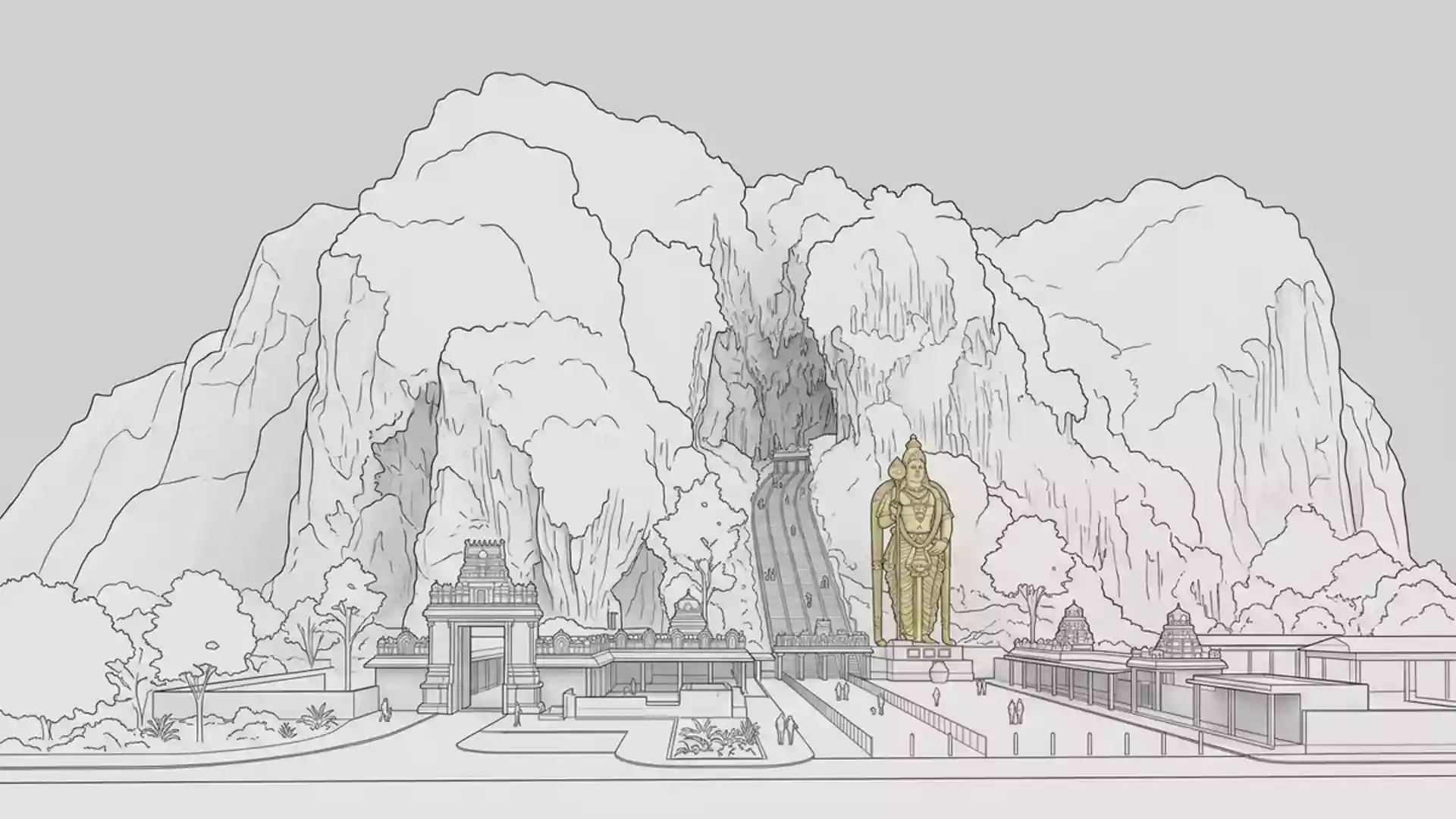
At the base of the main staircase stands a gilded statue of Lord Murugan, facing out from the cliffs and the temple entrance to the approach road. Standing 42.7 m (140 ft) high, it is recorded as the tallest statue of Murugan in Malaysia and one of the tallest statues of a Hindu deity anywhere in the world.42.7 m Murugan statue unveiled in 2006 The statue was completed and unveiled in January 2006, and has since become the defining modern landmark of the complex, photographed against the cliff behind it and the stairway beside it.Tallest Murugan statue in Malaysia
Beside the statue rises the long flight of concrete steps that leads up to Temple Cave, painted in strong bands of colour that turn the climb into a visual spectacle. Public information sources describe 272 individual steps on this main stairway, a figure that has become part of the site’s identity as strongly as the Murugan statue or the cliff itself.Colourful staircase with 272 steps From the base, the perspective carries the eye upward through the painted steps, shrine roofs and cave entrance to the limestone formations that frame the upper opening.
Visiting Batu Caves: what travellers from Western Europe should know
- The hill lies in the district of Gombak in the state of Selangor, north of Kuala Lumpur, and is reached by suburban rail services that terminate at Batu Caves station on the KTM Komuter network.
- The approach to Temple Cave involves climbing a long, steep concrete staircase of 272 steps beside the Murugan statue, with no mechanical alternative for the upper section.
- The temple complex stands on and within a natural limestone hill, so surfaces can be uneven in places and interior sections of the caves are dim compared with the exterior approach.
- The official language is Malay and the currency is the Malaysian ringgit; English is widely used in tourism and transport settings around Kuala Lumpur.
- Entry requirements depend on your nationality; UK travellers can check the FCDO travel advice at gov.uk/foreign-travel-advice, Irish travellers the Department of Foreign Affairs at ireland.ie.
Searching for Batu Caves on social platforms
These links open searches for Batu Caves on each platform.
Frequently asked questions about Batu Caves
Where are Batu Caves and what kind of place is this?
Batu Caves is a limestone hill and Hindu temple complex in the Gombak district of Selangor in Malaysia, north of Kuala Lumpur.Gombak, Selangor location
What should visitors expect during a visit?
Visitors encounter a towering golden statue of Murugan, a long painted staircase of 272 steps, and temples and shrines set inside high limestone caverns.
What makes Batu Caves distinctive among Malaysian landmarks?
The combination of very old limestone geology, an active Murugan temple complex established in the late nineteenth century, and the 42.7 m Murugan statue gives Batu Caves a character unlike other Malaysian sites.Height and date of Murugan statue