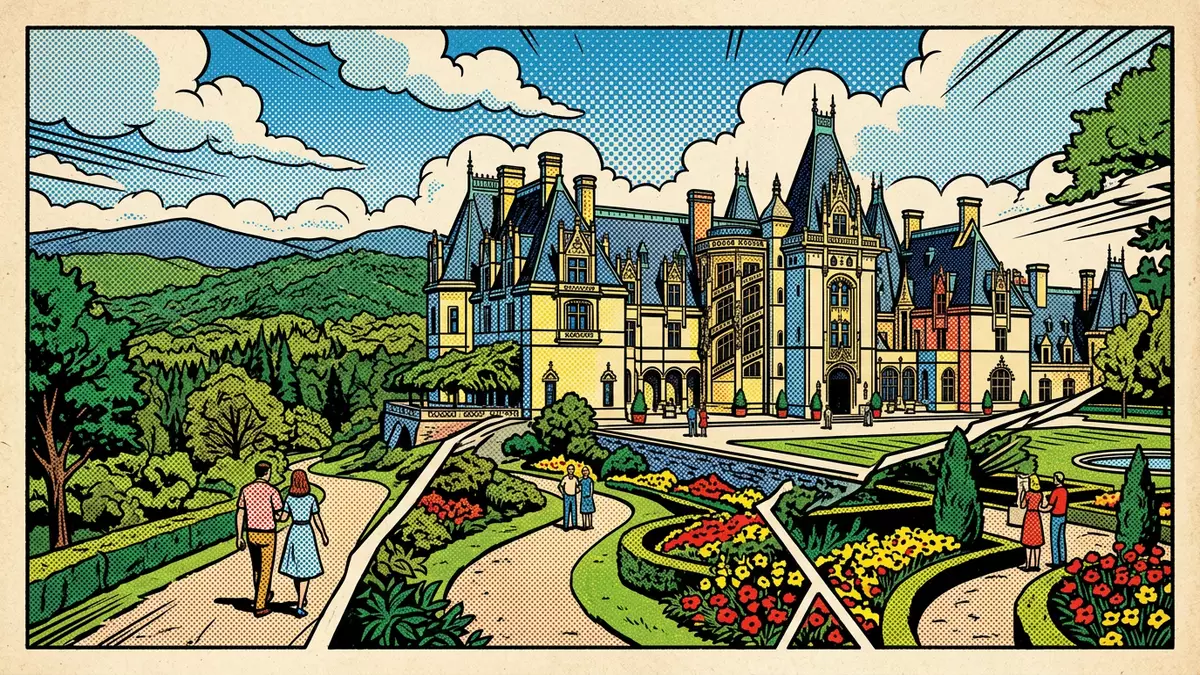
Biltmore Estate, a Gilded Age château above Asheville
Published on 08/12/2026 at 13:49 | Editorial responsibility: Rafael Müller, Editor-in-Chief AD HOC NEWS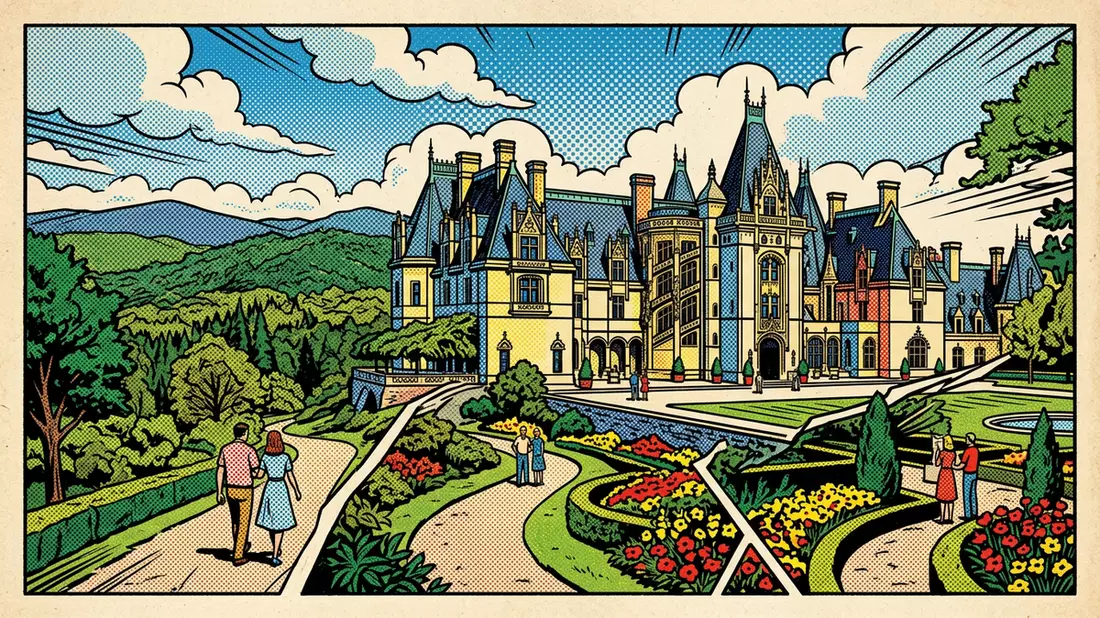
Biltmore Estate in Asheville, North Carolina, is a vast country domain built in the late nineteenth century by George Washington Vanderbilt II as a French-inspired mountain retreat. Rising above the wooded hills near the French Broad River, the mansion and its landscaped grounds form a self-contained world that captures the scale and style of Gilded Age America.
A French Renaissance château in the Blue Ridge Mountains
The centrepiece of Biltmore Estate is Biltmore House, a stone mansion designed by architect Richard Morris Hunt for George Washington Vanderbilt II and completed in 1895.Châteauesque-style mansion Hunt drew on French Renaissance and medieval precedents, adapting elements from Loire Valley châteaux such as Blois, Chenonceau and Chambord into an American country house.French Renaissance chateau The result is a multi-level façade with steeply pitched roofs, prominent towers, sculpted stonework and extensive ornament, giving the building a castle-like presence against the mountain backdrop.
The house contains hundreds of rooms arranged over several floors, including grand reception spaces, family suites and service areas that together make it one of the largest private residences ever built in the United States.largest privately owned residence Inside, the architecture is expressed through tall halls, a sweeping main staircase and extensive use of stone, wood panelling and decorative plaster. The building reads as a single coherent composition, from the formal entrance front to the terraces that look out over the surrounding hills.
George Vanderbilt’s estate and its designed landscape
George Washington Vanderbilt II began assembling the land for Biltmore Estate in the late 1880s after visiting the Asheville area and deciding to create a country retreat there.estate near Asheville At its greatest extent the estate covered around 120,000 to 125,000 acres of Appalachian forest and farmland, before being reduced to a smaller core holding of several thousand acres.estate acreage Vanderbilt engaged Frederick Law Olmsted, a leading landscape architect of the nineteenth century, to shape the grounds, gardens and approach roads.
Olmsted designed formal gardens close to the house and more pastoral landscapes further out, combining terraces, flowerbeds and conservatories with parkland and wooded drives.formal gardens and pastoral landscape Beyond the ornamental core, he planned an arboretum and managed forest areas, and his work at Biltmore became associated with early American forestry initiatives through collaboration with figures such as Gifford Pinchot.Olmsted designed estate Fields, woodlands and farm buildings form part of the wider estate, reinforcing the impression of a complete rural domain structured around the house.
From private residence to historic house museum
Biltmore House was constructed between 1889 and 1895 and opened to Vanderbilt’s family and guests on 24 December 1895, placing it squarely in the Gilded Age.opened on Christmas Eve 1895 George Vanderbilt lived there with his wife Edith Stuyvesant Dresser and their daughter, using the house as a principal residence and mountain retreat until his death in 1914.occupied by the Vanderbilt family The estate remained in family hands, and over the twentieth century it evolved from private home into a property opened more widely to visitors.
By the mid-twentieth century Biltmore House had become a historic house museum, while the estate diversified to include accommodation and a winery alongside the original mansion and gardens.house open as a museum The building is recognised as a National Historic Landmark and continues to be associated with its status as an exceptionally large country house from the period.National Historic Landmark Visitors encounter both the preserved interiors and the surrounding landscape that formed part of George Vanderbilt’s original vision.
Visiting Biltmore Estate: what travellers from Western Europe should know
- Biltmore Estate lies south of central Asheville in western North Carolina, reached by road from the city and signposted towards the estate entrance.
- The grounds include extensive paths and garden walks, with changes in gradient and distances on foot between the house, gardens and other parts of the estate.
- The surrounding landscape is part of the Blue Ridge Mountains region, so views from the terraces and open areas take in wooded hills and the French Broad River valley.
- The official language is English and the currency is the United States dollar.
- Entry requirements depend on your nationality; UK travellers can check the FCDO travel advice at gov.uk/foreign-travel-advice, Irish travellers the Department of Foreign Affairs at ireland.ie.
Searching for Biltmore Estate on social platforms
These links open searches for Biltmore Estate on each platform.
Frequently asked questions about Biltmore Estate
Where is Biltmore Estate located?
Biltmore Estate is in Asheville in western North Carolina, just south of the city and close to the French Broad River in the Blue Ridge Mountains.
What can visitors expect on a visit?
Visitors encounter a late nineteenth-century French-style mansion, extensive formal gardens, parkland and estate buildings arranged across a large, designed landscape.
What makes Biltmore Estate distinctive?
Its combination of a Châteauesque house by Richard Morris Hunt, landscaped grounds by Frederick Law Olmsted and its scale as a Gilded Age country estate make it distinctive.