
Biltmore Estate, a grand château in the Blue Ridge hills
Published on 08/25/2026 at 15:27 | Editorial responsibility: Rafael Müller, Editor-in-Chief AD HOC NEWS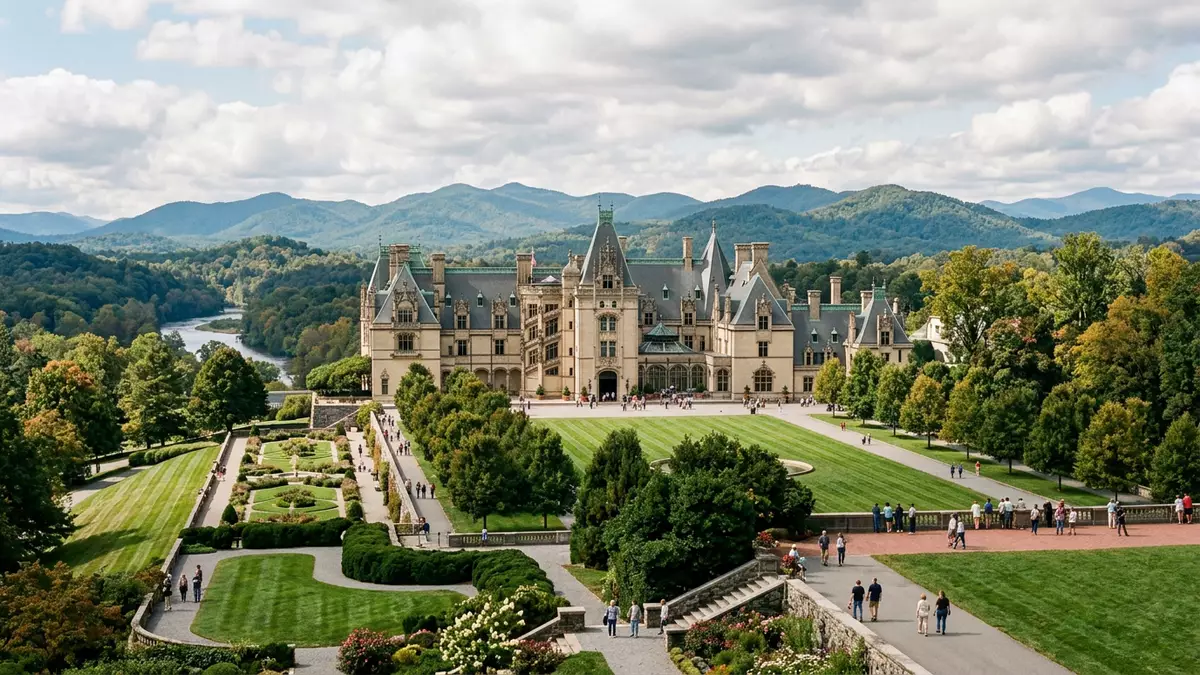
Biltmore Estate near Asheville in North Carolina is dominated by a vast French Renaissance mansion set in rolling Blue Ridge terrain, a country house on an almost palatial scale. Completed in 1895 for George Washington Vanderbilt II, it brings the language of European château architecture into an American landscape shaped by Frederick Law Olmsted.
A French château overlooking the Blue Ridge
The centrepiece of Biltmore Estate is Biltmore House, commissioned by George Washington Vanderbilt II in 1889 as a country retreat in the hills south of Asheville. Construction on the château-style mansion began around 1890 and continued for roughly six years before Vanderbilt welcomed his first guests at Christmas in 1895.Construction on Biltmore House The house is associated with the Gilded Age, a period when industrial fortunes were translated into large private residences.
Architect Richard Morris Hunt designed the main house in a Châteauesque style, drawing on French Medieval and Renaissance precedents from the Loire Valley. The building is organised around a prominent entrance front with turrets, steeply pitched roofs and elaborate stonework, clearly separated from the service court and outbuildings behind.Château–style mansion with French Gothic details Inside, the floor area extends across about 4 acres (around 1.6 hectares), with some 250 rooms ranging from grand reception spaces to bedrooms and service quarters.a 250-room residence with a floor area of some 4 acres
Inside America’s largest private house
Biltmore House has been described as the largest privately owned residence in the United States, reflecting both its footprint and the scale of its interiors.largest privately owned residence The arrangement includes dozens of bedrooms, numerous bathrooms and fireplaces, and a sequence of formal rooms that run along the main façade. A library with around 10,000 volumes, a Banquet Hall and indoor leisure spaces such as a swimming pool and bowling alley sit within the same shell.10,000-volume library and indoor pool
The house incorporates technologies that were advanced at the time of completion, including an electric lift, central heating and a call-bell system linking the principal rooms to service areas.electric Otis elevator, forced-air heating, centrally controlled clocks, fire alarms and a call bell system These sit alongside decorative programmes of carved stone, wood panelling and imported artworks. The building’s fabric mixes masonry walls with timber elements in roofs and interiors, all set out on a plan large enough to contain extensive circulation routes, staircases and corridors.
Landscape architecture and managed forest
Beyond the house, Biltmore Estate stretches across thousands of acres, a landscape assembled by Vanderbilt through land purchases in the late nineteenth century. The estate originally reached around 120,000 to 125,000 acres in the Blue Ridge Mountains, though its present size is closer to 8,000 acres after land was sold for the creation of Pisgah National Forest.eventually obtaining some 125,000 acresestablished on 125,000 acres during George W. Vanderbilt's lifetime but now covers nearly 8,000 acres Frederick Law Olmsted, a leading figure in American landscape architecture, laid out formal gardens, woodland drives and what has been described as the first large-scale managed forest in the United States.America’s first large scale managed forest
The grounds today include formal and informal gardens close to the house, a Conservatory and extensive nature trails reaching towards the French Broad River and estate features such as Deer Park, a lagoon, farm buildings and woodland belts.8,000 acres include six formal and informal gardens, a Conservatory, and 20+ miles of nature trails The approach drive from the lodge to the mansion runs through curated plantings, including stands of bamboo mentioned in contemporary descriptions, and offers views over the surrounding hills.
Visiting Biltmore Estate: what travellers from Western Europe should know
- Biltmore Estate stands in the hills south of Asheville in western North Carolina, reached by road from the city and signposted along local highways.
- The terrain around the house and gardens includes sloping paths, formal staircases and longer walking routes on estate trails, so visits involve periods on foot over varied ground.
- The wider estate lies near the French Broad River and the Blue Ridge Mountains, making it part of a broader landscape of wooded hills and river valleys in this region of the United States.
- The official language in North Carolina is English and the currency is the United States dollar.
- Entry requirements depend on your nationality; UK travellers can check the FCDO travel advice at gov.uk/foreign-travel-advice, Irish travellers the Department of Foreign Affairs at ireland.ie.
Searching for Biltmore Estate on social platforms
These links open searches for Biltmore Estate on each platform.
Frequently asked questions about Biltmore Estate
Where is Biltmore Estate located?
Biltmore Estate is near Asheville in western North Carolina, in the United States, on land that reaches towards the French Broad River.
What can visitors expect on a visit?
A visit centres on Biltmore House, a large château-style mansion with historic interiors, and landscaped grounds that extend into gardens, trails and woodland.
What makes Biltmore Estate distinctive?
Biltmore Estate combines a Gilded Age mansion by Richard Morris Hunt, completed in 1895 for George Washington Vanderbilt II, with grounds laid out by Frederick Law Olmsted.


