
Biomuseo turns Panama’s biodiversity into architecture
Published on 09/23/2026 at 22:34 | Editorial responsibility: Rafael Müller, Editor-in-Chief AD HOC NEWS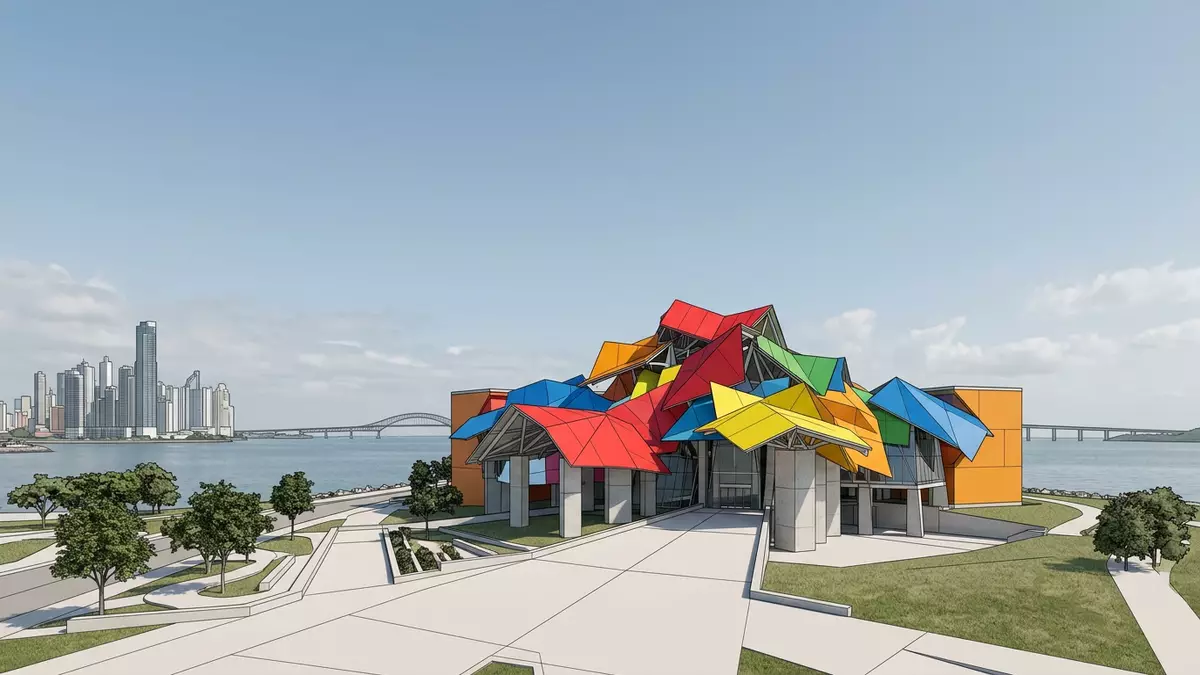
Biomuseo rises on Panama-Stadt’s Amador Causeway beneath a canopy of brightly coloured metal forms. Frank Gehry’s 2014 museum combines sculptural architecture with galleries about Panama’s biodiversity, geology and cultural history.
Frank Gehry’s colourful building beside the canal
Biomuseo stands at the Pacific entrance to the Panama Canal, with the city skyline, Casco Antiguo, Ancon Hill and the Bridge of the Americas visible from the site. Its open-air public atrium sits beneath irregular canopies in vivid colours. Biomuseo’s architectural setting links the building with Panama’s tropical landscape without separating exhibition space from the surrounding climate.
Frank Gehry designed Biomuseo as his first work in Latin America. The building uses unconventional forms, coloured metal roofs and open spaces, giving the museum a strongly sculptural character. Gehry is also associated with the Guggenheim Museum Bilbao and Walt Disney Concert Hall in Los Angeles.
Eight galleries tracing an isthmus across continents
The permanent exhibition begins with the Showcase of Biodiversity, which introduces the variety of life on Earth. Panamarama uses a ten-screen projection room for an audiovisual presentation of Panama’s ecosystems. Building the Bridge presents the geological forces associated with the isthmus through tactile displays. The permanent exhibition galleries give the museum a sequence that moves between geology, ecology and human history.
Worlds Collide contains sculptures representing 72 species that crossed the isthmus three million years ago. The Human Path uses sixteen columns to present the relationship between people and Panama’s natural environment. Oceans Divided contains aquariums showing differences between Pacific and Caribbean ecosystems. The Living Web is a 15-metre sculpture combining plants, animals, insects and microorganisms.
Panama as a meeting place of land and sea
Biomuseo’s central subject is the Isthmus of Panama. Its galleries connect the rise of the land bridge with the movement of species between North and South America, while also examining the separation of the Pacific and Caribbean marine environments.
Panama is The Museum extends the subject through touch screens, projectors and motion sensors. Birds without Borders uses panels and outdoor murals to examine migratory birds and Panama’s position within their continental journeys. The museum therefore places biological diversity beside cultural diversity, with the building itself forming part of the presentation.
The museum opened on 2 October 2014. Its combination of a Gehry-designed structure, coloured canopies, large-scale installations and scientific displays makes Biomuseo a distinct cultural landmark on the Amador Causeway.
Visiting Biomuseo: what travellers from Western Europe should know
- Biomuseo is on the Amador Causeway at the Pacific entrance to the Panama Canal. Panama-Stadt’s skyline, Casco Antiguo and Ancon Hill are visible from the site.
- The museum includes an open-air atrium, outdoor murals and exhibition spaces with aquariums, projections, touch screens and motion sensors.
- The official language is Spanish and the currency is the Panamanian balboa and the United States dollar.
- Entry requirements depend on your nationality; UK travellers can check the FCDO travel advice at gov.uk/foreign-travel-advice, Irish travellers the Department of Foreign Affairs at ireland.ie.
Searching for Biomuseo on social platforms
These links open searches for Biomuseo on each platform.Frequently asked questions about Biomuseo
Where is Biomuseo?
Biomuseo is located on the Amador Causeway in Panama-Stadt, at the Pacific entrance to the Panama Canal.
What can visitors see inside?
The galleries cover biodiversity, geology, human history and marine ecosystems through projections, aquariums, sculptures, touch screens and outdoor displays.
What distinguishes Biomuseo?
Frank Gehry designed the building, which combines vivid metal canopies and an open atrium with exhibitions about the Isthmus of Panama.


