
Biserica Neagra and the dark stone of Brasov
Published on 09/22/2026 at 21:41 | Editorial responsibility: Rafael Müller, Editor-in-Chief AD HOC NEWS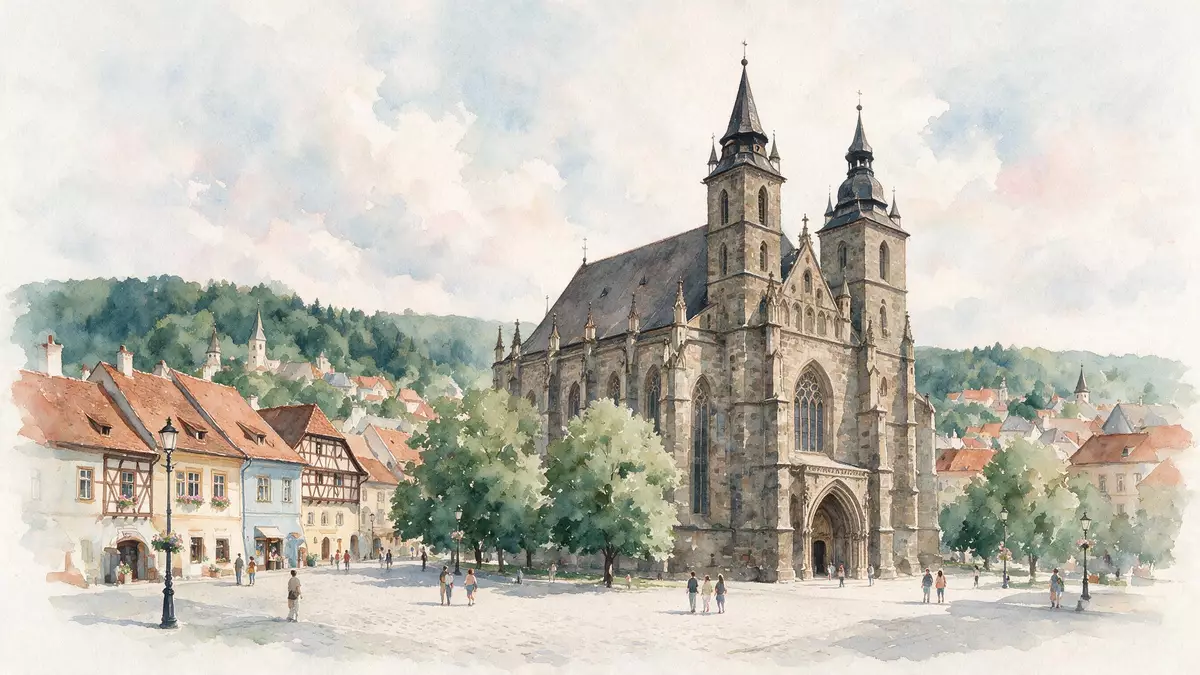
Biserica Neagra rises in the centre of Brasov as a vast Gothic church of darkened masonry. Its long stone walls, tall tower and broad interior belong to a building begun in 1383 and completed in 1477. The church’s colour gives the place its familiar name, while its scale preserves the medieval presence of the Transylvanian Saxon community.
Biserica Neagra: a Gothic church in darkened stone
The building is a late Gothic hall church, with a long nave, substantial side spaces and a prominent western tower. The exterior presents a continuous mass of masonry, articulated by tall windows, buttresses, portals and rooflines. Biserica Neagra remains the principal Gothic monument of Brasov’s historic centre.
The name refers to the darkened exterior associated with the great fire of 1689. Heat and smoke damaged the church, and subsequent repairs left a visible mixture of Gothic structure and Baroque details. The stone surfaces, tower and roof form give the building a distinctive profile within Brasov’s old town. late Gothic monument
From Saint Mary’s church to Lutheran parish
Biserica Neagra began as a Roman Catholic church dedicated to Saint Mary. The German-speaking Saxon community of Brasov built the structure during the late fourteenth and fifteenth centuries, with construction recorded from 1383 and completion in 1477.
The Reformation changed the congregation’s religious identity in the sixteenth century. In 1542, the church became Lutheran and entered the tradition of the Evangelical Church of Augustan Confession in Romania. Its history therefore connects medieval Catholic worship, the Reformation in Transylvania and the continuing religious life of Brasov’s German-speaking community. history of the Black Church
Inside Brasov’s medieval urban landmark
The interior is organised around the scale of a Lutheran parish church, with a wide central space, high masonry and furnishings accumulated across several centuries. Gothic elements remain visible in the building’s proportions and stonework, while Baroque features belong to the repairs carried out after the fire.
A major organ forms part of the church’s musical heritage, and the building contains historic liturgical furnishings associated with Transylvania’s Saxon communities. The church’s interior is not a single-period room. Medieval construction, sixteenth-century confessional change, the fire of 1689 and later restoration all appear in its fabric. medieval church in Brasov
The church belongs to the central fabric of Brasov, where its dark stone mass faces the public spaces and streets of the old town. Its relationship with the surrounding historic buildings is architectural rather than decorative: the church is a large medieval volume set within a compact urban landscape.
Visiting Biserica Neagra: what travellers from Western Europe should know
- Biserica Neagra stands in central Brasov, within the historic old town. Brasov is connected by rail and road with Bucharest, Sibiu and other Transylvanian cities.
- The approach is urban, with paved streets and public squares around the church. The interior contains steps and hard stone surfaces, while the building’s scale requires movement through a large historic space.
- The official language is Romanian and the currency is the Romanian leu.
- Brasov lies in the Carpathian region, with the church surrounded by the city’s medieval streets, civic buildings and fortified-town heritage.
Searching for Biserica Neagra on social platforms
These links open searches for Biserica Neagra on each platform.
Frequently asked questions about Biserica Neagra
Where is Biserica Neagra?
Biserica Neagra stands in the historic centre of Brasov, Romania. It is part of the city’s medieval urban fabric and Lutheran religious heritage.
What can visitors expect inside?
The interior contains a broad Gothic church space, historic furnishings, Baroque details and a major organ. Stone surfaces, high masonry and tall proportions define the building.
What makes Biserica Neagra distinctive?
Its darkened exterior, late Gothic form and history as a Lutheran church give Biserica Neagra a clear identity. The building also preserves the effects of the 1689 fire and its subsequent repairs.


