
Biserica Neagra and the dark stone of Brasov
Published on 09/23/2026 at 20:11 | Editorial responsibility: Rafael Müller, Editor-in-Chief AD HOC NEWS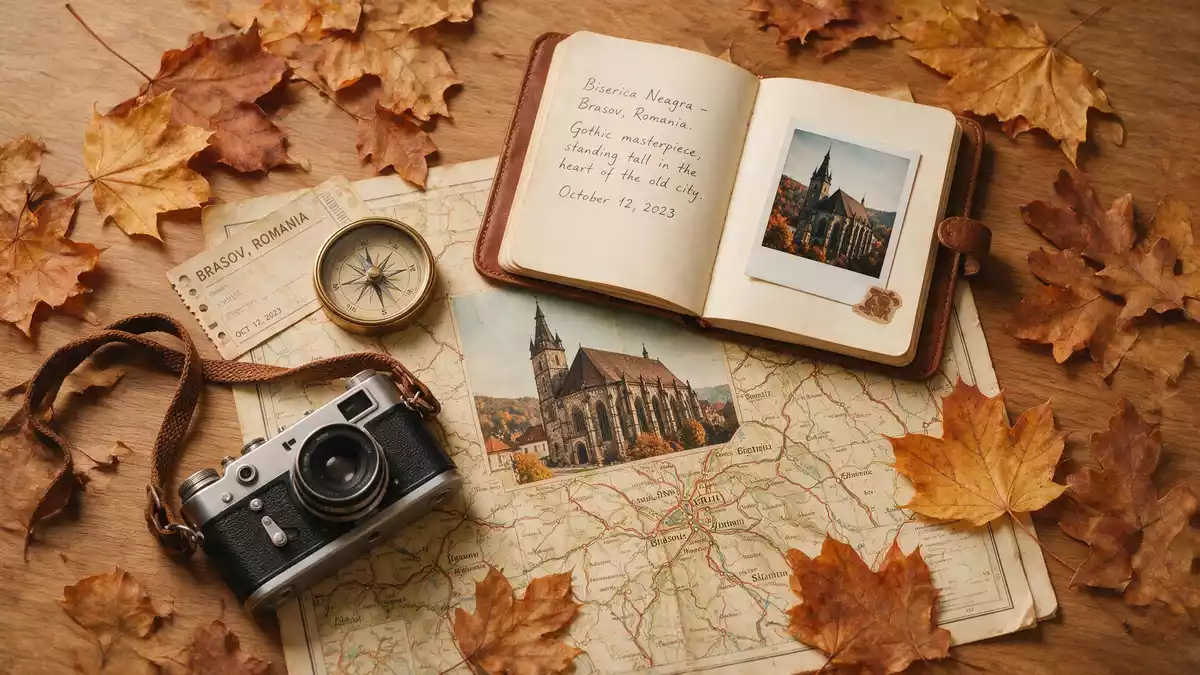
Biserica Neagra rises beside Brasov’s old centre as a Gothic hall church of darkened stone. Its walls, tower and vaulted interior carry the visible marks of a building shaped across the late fourteenth and fifteenth centuries.
Biserica Neagra: a Gothic church in darkened stone
Construction began in 1383, and the church was inaugurated in 1477. Its original dedication was to Saint Mary, reflecting the Roman Catholic character of Brasov’s Saxon community during the medieval period. The church’s Gothic history remains visible in its scale, pointed forms and long interior.
The building measures about 89 metres in length and 38 metres in width. Its surviving tower reaches about 65 metres, while the church’s broad walls and high roof give the structure a strong presence within the old town. Biserica Neagra is a hall church, with the principal spaces gathered beneath a unified architectural volume.
From Saint Mary’s Church to Biserica Neagra
The sixteenth-century Reformation changed the church’s confession. In 1542, the congregation adopted Lutheran teaching associated with Johannes Honterus, the Brasov humanist and reformer who helped introduce Protestant ideas among Transylvania’s Saxon communities.
A fire damaged Brasov in April 1689 and blackened the church’s exterior stone. The name Biserica Neagra, meaning Black Church, belongs to this appearance. Reconstruction brought Baroque elements into the Gothic building, including parts of the vaulting and interior furnishings. The result combines medieval structure with the traces of eighteenth-century repair.
Inside the church: organ, rugs and historic objects
The interior contains a large mechanical organ built by Carl August Buchholz between 1836 and 1839. It has 3,993 pipes, four keyboards and a pedalboard. The instrument remains a defining object within the church’s musical and architectural setting.
Ottoman and Anatolian rugs hang and rest within the church, linking Brasov’s medieval trade with its Lutheran religious interior. A bronze baptismal font dates from 1472, while the pulpit was crafted in 1665. The church also preserves fragments of medieval mural painting and objects connected with six centuries of worship.
Visiting Biserica Neagra: what travellers from Western Europe should know
- Biserica Neagra stands at Curtea Johannes Honterus 2 in central Brasov, close to the old town’s historic streets. Brasov is in Romania’s Transylvania region.
- Rail travellers arrive in Brasov by train, then continue towards the old centre on foot or by local city transport. The church’s position is marked by its tall Gothic tower.
- The interior includes broad stone spaces, vaulted ceilings, historic pews, a 1472 baptismal font and the Buchholz organ. Visitors encounter architecture, music and ecclesiastical objects in the same building.
- The official language is Romanian and the currency is the Romanian leu.
Searching for Biserica Neagra on social platforms
These links open searches for Biserica Neagra on each platform.
Frequently asked questions about Biserica Neagra
Where is Biserica Neagra?
Biserica Neagra stands in central Brasov, within the city’s historic old centre. Its address is Curtea Johannes Honterus 2.
What can visitors see inside?
The interior contains Gothic and Baroque elements, the Buchholz mechanical organ, Anatolian rugs, a 1472 baptismal font and historic church furnishings.
Why is it called the Black Church?
A fire in 1689 blackened parts of the church’s exterior stone. The Romanian name Biserica Neagra refers to this darkened appearance.


