
Blue Nile Falls and the river that becomes a wall of water
Published on 09/24/2026 at 03:44 | Editorial responsibility: Rafael Müller, Editor-in-Chief AD HOC NEWS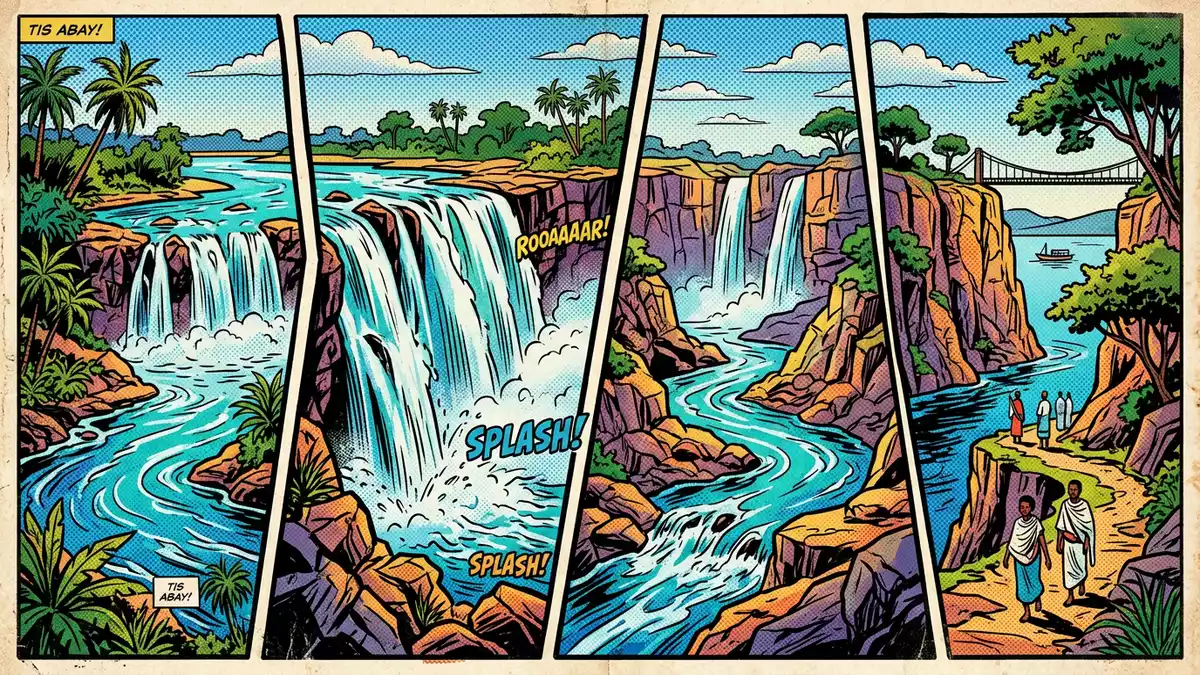
Blue Nile Falls is where the upper Blue Nile changes abruptly from a broad river into a high cascade near Bahir Dar, Ethiopia. Known in Amharic as Tis Issat, meaning “Water that Smokes”, the waterfall crosses a basalt gorge in a succession of falling streams.
Blue Nile Falls: from Lake Tana to the gorge
The waterfall lies on the Blue Nile south of Bahir Dar, downstream from Lake Tana. Ethiopia’s historical-place information places it about 30 kilometres downstream from the city, while the river continues through a landscape of fields, papyrus and volcanic rock before reaching the falls.
Ethiopia’s historical-place information identifies the falls as Tis Abay and describes their position on the upper course of the Blue Nile. The name Tis Issat refers to the spray rising from the plunge, a description tied to the waterfall’s visible form rather than to a legend.
Basalt, spray and the shape of the falls
Blue Nile Falls drops over a cliff formed by lava rock. The height is commonly given as about 40 metres, with descriptions placing the full vertical fall within a range of roughly 37 to 45 metres.
The width changes with the river’s flow. In the rainy season, several streams can merge across a broad span of the cliff, while reduced flow leaves narrower channels. The Lake Tana landscape record describes the falls as separate cascades formed by a barrier of lava rock crossing the river.
Spray rises above the gorge and can form rainbows beside the falling water. The river, dark basalt and green vegetation create a sharply defined scene: a moving sheet of water against a hard volcanic wall.
Tis Issat in Ethiopian history and landscape
The falls belong to the cultural landscape of the Lake Tana region, where the Blue Nile leaves Ethiopia’s largest lake and begins its long journey towards Sudan. The river is one of the principal tributaries of the Nile system, linking the Ethiopian highlands with the Nile valley farther north.
Portuguese Jesuit Pedro Páez recorded the waterfall in 1613 during his travels in Ethiopia. The Scottish traveller James Bruce also wrote about Blue Nile Falls in the eighteenth century, adding the site to European accounts of the upper Nile.
Pedro Páez’s 1613 account is part of the waterfall’s documented travel history. Its setting also connects natural history with Ethiopian religious and cultural traditions around Lake Tana and the Blue Nile.
Hydroelectric infrastructure upstream affects the amount of water reaching the falls outside periods of heavy rain. The same cliff therefore appears as a broad curtain of water in high flow and as a set of separate channels when the river is reduced.
Visiting Blue Nile Falls: what travellers from Western Europe should know
- Blue Nile Falls lies south of Bahir Dar on the upper Blue Nile. Road access leads towards the gorge, followed by a walk across rural terrain.
- The approach includes uneven ground and walking near a deep gorge. A historic footbridge known as Alata Bridge crosses part of the route.
- The falls are formed from basaltic lava rock, and the river reaches the gorge through a landscape of fields, papyrus and vegetation.
- The rainy season changes the appearance of the waterfall, with several channels joining across a wider section of the cliff.
- The official language is Amharic and the currency is the Ethiopian birr.
- Entry requirements depend on your nationality; UK travellers can check the FCDO travel advice at gov.uk/foreign-travel-advice, Irish travellers the Department of Foreign Affairs at ireland.ie.
Searching for Blue Nile Falls on social platforms
These links open searches for Blue Nile Falls on each platform.Frequently asked questions about Blue Nile Falls
Where is Blue Nile Falls?
Blue Nile Falls is on the upper Blue Nile in Ethiopia, about 30 kilometres south of Bahir Dar and downstream from Lake Tana.
What can travellers expect at the waterfall?
The route leads through rural terrain towards a basalt gorge, with a footbridge and walking sections before the waterfall viewpoint.
What makes Blue Nile Falls distinctive?
The river falls over a lava-rock cliff about 40 metres high, with its width and number of visible streams changing according to river flow.


