
Bondi Beach and the curve of Sydney’s oceanfront
Published on 09/17/2026 at 21:56 | Editorial responsibility: Rafael Müller, Editor-in-Chief AD HOC NEWS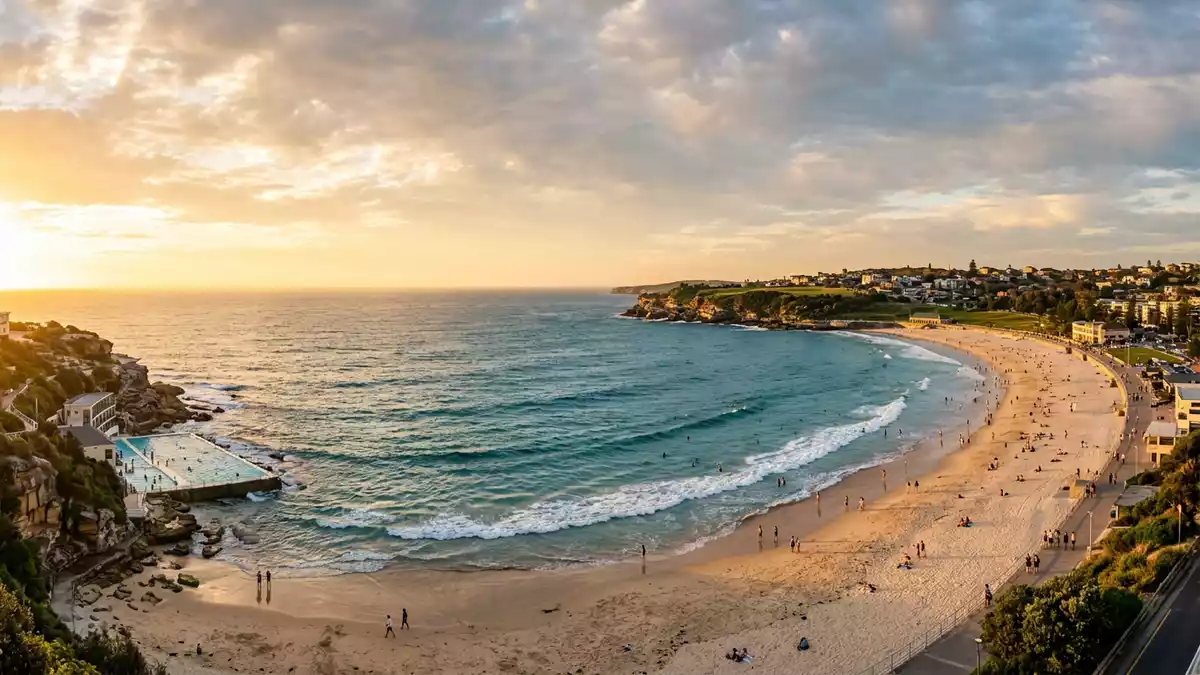
Bondi Beach on the eastern shore of Sydney is an open arc of pale sand set between sandstone headlands, a place where coastal geology and surf culture meet in a single bay. It fronts the Tasman Sea and sits within the suburb of Bondi, part of the Eastern Suburbs administered by Waverley Council, with the built streets rising behind the promenade.
The arc of sand between sandstone headlands
Bondi Beach occupies a bay cut into the sandstone coastline of the Sydney Basin, with the shoreline formed as waves sculpted a pocket of sand between more resistant headlands.sandstone coastline of the Sydney Basin The beach runs broadly north–south, with the water opening directly to the Tasman Sea, giving Bondi an exposed ocean frontage rather than a sheltered harbour setting. At the northern end the land rises into the area known as North Bondi, while the southern headland carries terraces, a coastal path and a saltwater pool built into the rock platform.the beach fronts the Tasman Sea
Behind the sand a promenade runs along the foreshore, separating the beach from the streets and lawns of the suburb.Bondi’s foreshore development The built edge includes steps down to the sand, balustrades, grassed terraces and the multi-level Bondi Pavilion, a structure that has served as a focal point for events and amenities on the landward side of the bay.Bondi Pavilion on the foreshore From the promenade the view runs across the curve of the beach to the aligned rows of buildings behind, showing how residential streets and public recreation space meet along this stretch of coast.
From private estate to public beach
The name “Bondi” traces back to an Aboriginal word associated with water breaking over rocks, a reminder that surf and stone defined the bay long before formal European records.Aboriginal term related to breaking surf The broader area around Bondi Beach lies within country connected to First Nations groups including the Bidjigal, Birrabirragal and Gadigal peoples, whose ties to Sydney’s eastern beaches are described in local histories and cultural interpretation at sites such as the Bondi Pavilion.First Peoples of Sydney’s eastern beaches
European-era landholding at Bondi can be traced to 1809, when road builder William Roberts received a grant covering much of what became the business and residential district behind the beach.1809 grant to William Roberts A significant change came in 1851, when Edward Smith Hall and Francis O’Brien purchased extensive frontage including most of the beach, a holding known as the Bondi Estate.Bondi Estate purchase in 1851 Bondi’s sands were long part of a privately owned estate where access for day visitors depended on the decisions of the owners. Government resumption of the waterfront followed, and Bondi Beach was declared a public beach in 1882, turning a previously private strip of sand into a municipal reserve for recreation.Bondi Beach declared a public beach in 1882
Surf clubs, safety and beach culture
Bondi Beach holds a central place in the development of surf bathing and surf lifesaving in Australia.Bondi Beach in Australia’s cultural history Waverley Council built early surf bathing sheds on the beach in the early twentieth century, providing facilities that matched changing attitudes to daylight ocean swimming.early surf bathing sheds at Bondi In 1907 Bondi was the site of what is regarded as Australia’s first formally recognised surf lifesaving club, the Bondi Surf Bathers’ Life Saving Club, formed after a drowning incident highlighted the need for organised patrols on the beach.foundation of surf lifesaving club in 1907
From Bondi the surf lifesaving movement spread initially along the New South Wales coast and then more widely, embedding volunteer patrols, rescue techniques and distinctive club culture into Australian beach life.Bondi as the starting point for surf lifesaving The beach has also been a focus for discussions of swimwear and public decency, with ordinances in the mid twentieth century regulating what could be worn on the sand and in the surf, before later changes relaxed those rules.heritage listing noting Bondi’s social history Alongside the lifesaving clubs, Bondi’s arc of sand is well known in surf culture, with break zones along the beach and vantage points on the headlands where boards and waves can be watched against the backdrop of the suburb.
Visiting Bondi Beach: what travellers from Western Europe should know
- Bondi Beach lies in the Eastern Suburbs of Sydney on the Tasman Sea, south-east of the city centre, reached by public transport and roads leading to the suburb of Bondi.
- The beach is a broad expanse of sand backed by a promenade and lawns, with steps down from the foreshore and a coastal path running along the headlands.
- The official language is English and the currency is the Australian dollar.
- Entry requirements depend on your nationality; UK travellers can check the FCDO travel advice at gov.uk/foreign-travel-advice, Irish travellers the Department of Foreign Affairs at ireland.ie.
Searching for Bondi Beach on social platforms
These links open searches for Bondi Beach on each platform.
Frequently asked questions about Bondi Beach
Where is Bondi Beach in relation to Sydney?
Bondi Beach lies in the suburb of Bondi in Sydney’s Eastern Suburbs, opening to the Tasman Sea south-east of the central business district.
What can visitors expect on a visit to Bondi Beach?
Visitors encounter a wide sandy bay backed by a promenade, lawns and the Bondi Pavilion, with surf zones, coastal walks on the headlands and streets of the suburb close behind.
What makes Bondi Beach distinctive among Australian beaches?
Bondi Beach combines its sandstone headland setting, the curve of its Tasman Sea frontage and its role in the early history of surf lifesaving, including the 1907 surf lifesaving club.


