
Bora Bora’s volcanic heart and luminous lagoon around Vaitape
Published on 08/14/2026 at 14:30 | Editorial responsibility: Rafael Müller, Editor-in-Chief AD HOC NEWS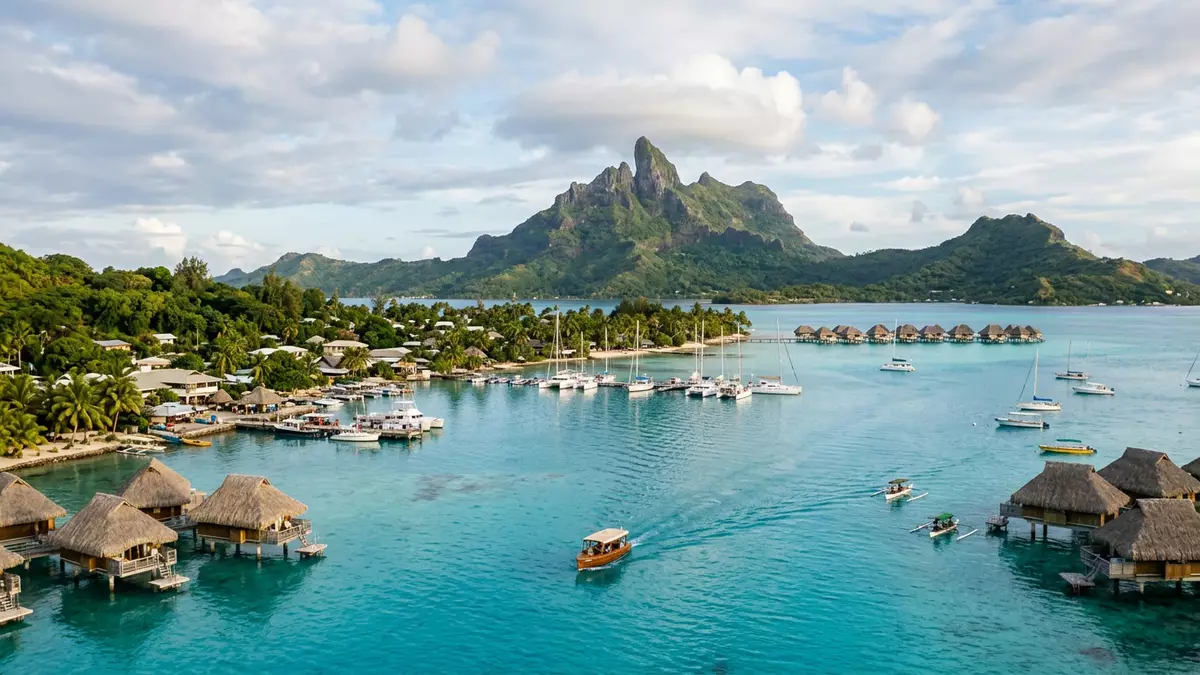
Bora Bora in French Polynesia is a compact volcanic island ringed by a luminous lagoon and coral reef, with the settlement of Vaitape facing its western waters. The island group sits in the Leeward Islands section of the Society Islands, giving this small tract of land in the South Pacific a clear geological identity and a long-settled human history dating back to Polynesian navigation across the ocean.
An extinct volcano rising above the South Pacific
Bora Bora is the remnant of an extinct volcano whose central massif still dominates the island’s skyline, rising above the lagoon in steep green slopes and dark rock. The main mountainous island is surrounded by a broader island group, with smaller motus forming a ring that marks the boundary between the shallow turquoise lagoon and the deeper Pacific waters beyond.The principal mountainous island sits about 265 km (165 miles) north-west of Tahiti, occupying a compact footprint of around 30.55 km² (12 sq mi) of land.
The island’s most visible landmarks are Mount Otemanu and Mount Pahia, two volcanic peaks that rise over the central ridge and give Bora Bora its characteristic profile from sea level. Mount Otemanu reaches an elevation of 727 m (2,385 ft), making it the highest point on the island, while Mount Pahia climbs to 658 m (2,159 ft).Mount Otemanu and Mount Pahia stand as volcanic pinnacles above the lagoon, their weathered faces and steep slopes a reminder of the island’s origins in repeated eruptions and subsequent subsidence.The island was formed after volcanic eruptions over hundreds of thousands of years.
Lagoon, reef and motus: Bora Bora’s ring of water and coral
Encircling the main island is a shallow lagoon, separated from the open ocean by a barrier of coral reefs and small islands that create a distinct inner seascape. This lagoon, protected by the reef, has clear water and a marked colour contrast with the deeper Pacific beyond, forming a sheltered environment between volcanic land and ocean swells.The lagoon and coral reefs frame the island on all sides.
The motus around Bora Bora include a series of named islets such as Motu Ahuna, Motu Tapu, Motu Mute, Motu Tevairoa, Motu Tane, Motu Toopua, Motu Sofitel, Motu Pitiaau, Motu Tufari and Motu Toopuaiti, which together form part of the wider Bora Bora island group.These adjacent smaller islands stand on the reef rim and shape the lagoon’s outline, with passages that connect the inner waters to the sea. On the western side, the Teavanui Pass forms a deep channel into the lagoon, providing a navigable entrance aligned with the largest settlement.The Teavanui passage is wide and deep enough for substantial vessels.
Vaitape and the human history of Bora Bora
Vaitape is the principal village and administrative centre on Bora Bora, located on the western coast of the main island with views across the lagoon towards the reef and motus.The administrative centre of Bora Bora has grown on this side of the island around the harbour area, with Mount Otemanu and Mount Pahia rising inland as a backdrop.Vaitape lies on the western side and sits only a few metres above sea level.
Polynesian settlers reached Bora Bora centuries ago, navigating by stars, swells and currents from other islands in the Society group.The island was inhabited by Polynesians by the early centuries of the current era, and the Tahitian name Pora Pora refers to “First Born”, echoing local traditions about its place among the islands.The name Pora Pora appears in historical accounts. In the nineteenth century a recognised Kingdom of Bora Bora existed, and in 1888 the island was formally annexed by France, later becoming part of the French Overseas Territories and, from 2004, of French Polynesia with an autonomous administration.The Kingdom of Bora Bora and subsequent annexation mark key points in its political history.
Visiting Bora Bora: what travellers from Western Europe should know
- Bora Bora forms part of French Polynesia in the South Pacific, with Vaitape on the western side of the main island facing the lagoon and the Teavanui Pass.
- The terrain on the main island is steep and mountainous, with volcanic slopes rising to 727 m (2,385 ft); paths and roads climb away from the coastal strip.
- The lagoon is shallow and sheltered by coral reefs and motus, while the main island’s shoreline combines narrow coastal land with sections of reef and small harbours.
- The official languages are French and Tahitian and the currency is the CFP franc, used across French Pacific territories.
- Entry requirements depend on your nationality; UK travellers can check the FCDO travel advice at gov.uk/foreign-travel-advice, Irish travellers the Department of Foreign Affairs at ireland.ie.
Searching for Bora Bora on social platforms
These links open searches for Bora Bora on each platform.
Frequently asked questions about Bora Bora
Where is Bora Bora and what is its setting?
Bora Bora is part of the Leeward Islands in the Society Islands of French Polynesia, a volcanic island group in the South Pacific surrounded by a lagoon and coral reef.
What should travellers expect when visiting Bora Bora and Vaitape?
Travellers encounter a mountainous central island with peaks such as Mount Otemanu, a sheltered lagoon edged by motus and a coastal settlement at Vaitape facing the main harbour channel.
What makes Bora Bora distinctive among Pacific islands?
Its combination of steep volcanic peaks, a clearly defined turquoise lagoon, encircling coral reef and named motus around Vaitape gives Bora Bora a strongly recognisable island structure.


