
Brandenburger Tor and Berlin’s neoclassical gateway
Published on 09/22/2026 at 07:50 | Editorial responsibility: Rafael Müller, Editor-in-Chief AD HOC NEWS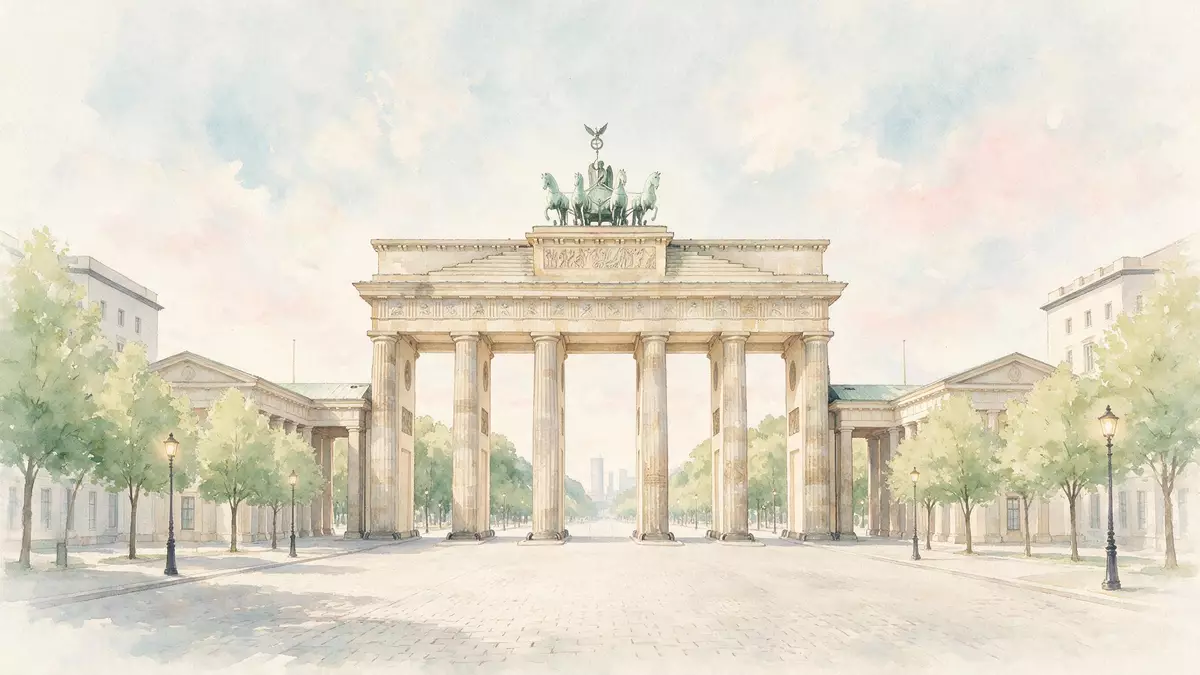
Brandenburger Tor is a sandstone gateway at the western end of Unter den Linden in Berlin. Its broad neoclassical façade, ordered by Carl Gotthard Langhans and completed in 1791, is crowned by the Quadriga, a chariot drawn by four horses.
Sandstone columns and an Athenian model
The gate belongs to the late eighteenth-century revival of Greek architectural forms. Langhans based its composition on the Propylaea, the monumental entrance to the Acropolis in Athens, translating an ancient reference into a Prussian city setting.
Its material is dressed sandstone. Doric columns divide the passageways, while the entablature and upper structure give the building the appearance of a temple-like gateway. The central sculptural group is visible above the roofline from Unter den Linden and Pariser Platz. The gate’s Athenian architectural model remains central to its identity.
From Prussian entrance to civic symbol
Frederick William II of Prussia commissioned the present structure, which replaced a simpler gate in Berlin’s former customs-wall system. Construction took place between 1788 and 1791, placing Brandenburger Tor among the earliest major works of Berlin classicism.
The gate opened on 6 August 1791. Johann Gottfried Schadow created the Quadriga, which was installed above the gateway in 1793. The sculptural ensemble shows a winged female figure guiding a four-horse chariot, with the horses facing towards the city centre.
Its political meaning changed across German history. The gate has served as a setting for royal ceremonies, military displays, state occasions and public gatherings. The surviving structure also carries the memory of Berlin’s division, because the Berlin Wall stood close to it and access around the gate was restricted during the divided-city period.
Pariser Platz, Unter den Linden and the five passages
Brandenburger Tor connects Pariser Platz with the boulevard Unter den Linden. The gate has five passageways beneath its roof, framed by the regular rhythm of its columns and the long horizontal line of its upper storey.
The central passage aligns with Unter den Linden and the route towards Berlin’s historic centre. Pariser Platz forms the open urban space immediately east of the gate, while the western side leads towards the Tiergarten and the Straße des 17. Juni.
The Quadriga adds a vertical focal point to an otherwise strongly horizontal composition. Seen from Pariser Platz, the sculptural group rises above the sandstone architecture; seen from Unter den Linden, it forms the uppermost element of the ceremonial gateway. Berlin’s listed monument record dates the structure to 1788–1791 and names Langhans among its designers.
Visiting Brandenburger Tor: what travellers from Western Europe should know
- Brandenburger Tor stands in central Berlin at Pariser Platz, beside Unter den Linden and the western edge of the historic centre.
- The gate is an open urban monument with broad paved spaces around it. Its passageways are reached at street level.
- Berlin’s official language is German and the currency is the euro.
- Nearby landmarks include the Reichstag building, the Tiergarten and the Memorial to the Murdered Jews of Europe.
Searching for Brandenburger Tor on social platforms
These links open searches for Brandenburger Tor on each platform.Frequently asked questions about Brandenburger Tor
Where is Brandenburger Tor?
Brandenburger Tor stands at Pariser Platz in central Berlin, at the eastern end of the Tiergarten and the western end of Unter den Linden.
What can visitors expect at the gate?
Visitors encounter a sandstone neoclassical monument, five passageways, Doric columns and the Quadriga above the roofline.
What makes Brandenburger Tor distinctive?
Its distinctive character comes from the combination of an Athenian-inspired gateway, Prussian history, sandstone architecture and a sculpted four-horse chariot.


