
Bryggen’s timber wharf and Hanseatic quarter in Bergen
Published on 08/18/2026 at 13:09 | Editorial responsibility: Rafael Müller, Editor-in-Chief AD HOC NEWS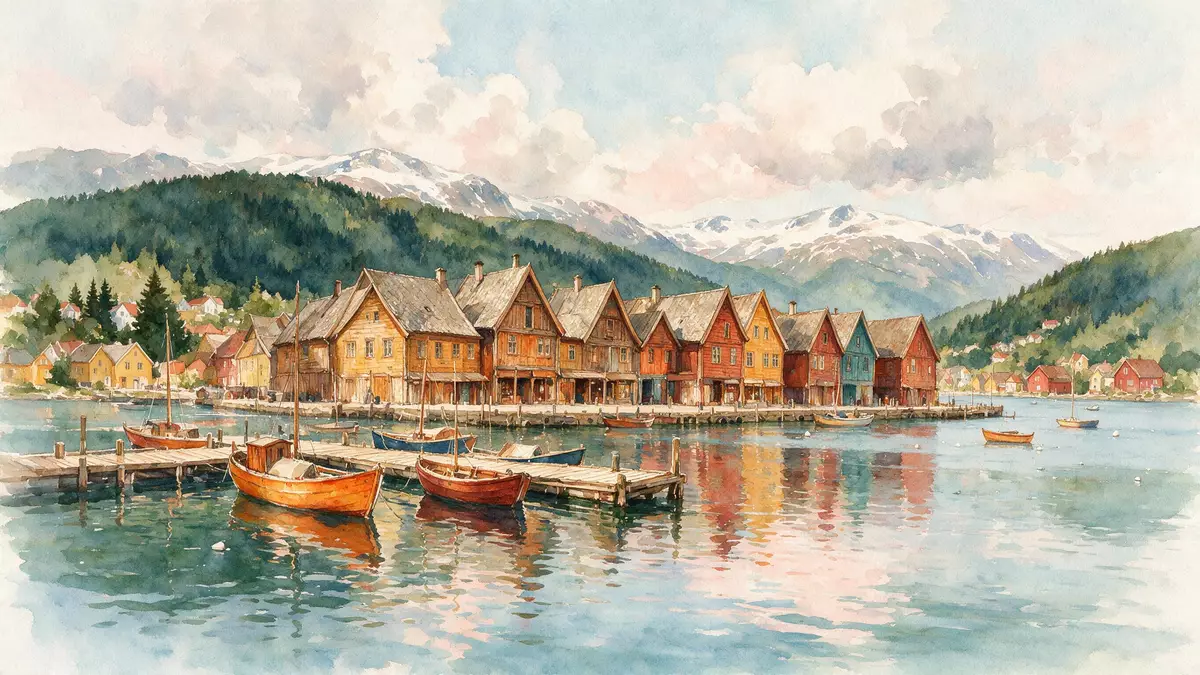
On the eastern side of Bergen’s Vågen harbour, Bryggen forms a dense run of timber buildings that still reads as a medieval trading quarter on the water’s edge. Recognised as a UNESCO World Heritage Site since 1979, it preserves the structure of a Hanseatic wharf in Norway’s second city and keeps Bergen’s long history as a North European port visible in wood and stone.
Timber rows on the Vågen harbour
Bryggen lines the sheltered inner part of Vågen, the natural harbour that helped make Bergen a trading centre by the 12th century. The front row of houses faces the water directly, with narrow gable ends and timber façades forming a continuous frontage along the quay. Behind them, further wooden buildings and warehouses extend inland, creating long rows arranged perpendicular to the harbour and divided by tight passages.
Fires have destroyed parts of Bryggen repeatedly, including a major blaze in 1702 that reshaped the quarter, yet rebuilding stuck close to earlier layouts and construction methods. The result is that the quarter retains a compact medieval urban form of timber buildings side by side, sharing roof structures and resting on timber frames and stone foundations.Bryggen’s appearance after the 1702 fire keeps this pattern visible, even where individual buildings are younger than the trading system they recall.
A Hanseatic merchant quarter in Norway
From the 14th to the mid-16th century, Bryggen formed the overseas office of the Hanseatic League in Bergen, one of four main foreign kontors that controlled the stockfish trade in Northern Europe.The Hanseatic merchants’ quarter at Bryggen was organised as a separate enclave, with its own warehouses, offices and living quarters for mainly German merchants who traded dried cod from northern Norway and imported grain and goods from Baltic and continental ports.
The World Heritage listing describes Bryggen as the only remaining part of a Hanseatic overseas office and highlights how its surviving buildings show the social organisation of that merchant community.Bryggen’s World Heritage status from 1979 rests on this layered role as both trading infrastructure and a nucleus of urban development on the Atlantic edge of Europe. Walking between the houses today means stepping through the framework of Bergen’s long engagement with maritime commerce.
Inside the narrow passages and warehouses
Seen from the quay, Bryggen’s timber façades give only a hint of how compressed the quarter is inside. Between the front houses and the rear buildings, long wooden passages run inland, tight enough that two people pass close and shaded by overhanging upper floors. The buildings are mostly constructed in softwood, with simple plank cladding and steep roofs, a building tradition that made repair and rebuilding possible after fires but also kept the risk of new blazes high.Descriptions of Bryggen’s timber construction underline how common such wooden urban structures once were across Northern Europe, and how rare it is that a quarter of this type survives in a city centre.
Today, some 62 buildings stand within the protected area, enough to demonstrate the layout of warehouses, counting houses and living quarters that defined the Hanseatic period.The surviving buildings at Bryggen include front houses along the harbour and longer rear structures stretching back towards Øvregaten. The quarter’s tight geometry and stacked timber volumes make it one of the clearest surviving examples of a medieval merchant district built largely in wood.
Visiting Bryggen: what travellers from Western Europe should know
- Bryggen stands on the eastern side of the Vågen harbour in central Bergen, within walking distance of the city’s other historic streets and the harbourfront.
- The historic wharf is compact and built on uneven timber and stone surfaces, with narrow passages and staircases that require steady footing and attention in wet weather.
- The World Heritage area includes the wharf itself, the back plots towards Øvregaten and related museum buildings, so a visit combines open-air timber streets with interior museum spaces.
- Bergen is in Norway; the official language is Norwegian and the currency is the Norwegian krone.
Searching for Bryggen on social platforms
These links open searches for Bryggen on each platform.
Frequently asked questions about Bryggen
Where is Bryggen and what kind of place is it?
Bryggen is a historic harbour district on the eastern side of the Vågen harbour in Bergen, Norway, consisting of timber wharf houses and warehouses.
What should visitors expect when walking through Bryggen?
Visitors encounter narrow wooden passages, closely spaced timber buildings and a compact layout that reflects its origins as a Hanseatic merchant quarter linked to Bergen’s maritime trade.
What makes Bryggen distinctive among historic port areas?
Bryggen is distinctive because it preserves the structure of a Hanseatic overseas office in timber, recognised as a UNESCO World Heritage Site since 1979 and retaining a rare medieval wooden urban form.


