
Bryggen’s timber wharf lanes in Bergen
Published on 09/19/2026 at 14:50 | Editorial responsibility: Rafael Müller, Editor-in-Chief AD HOC NEWS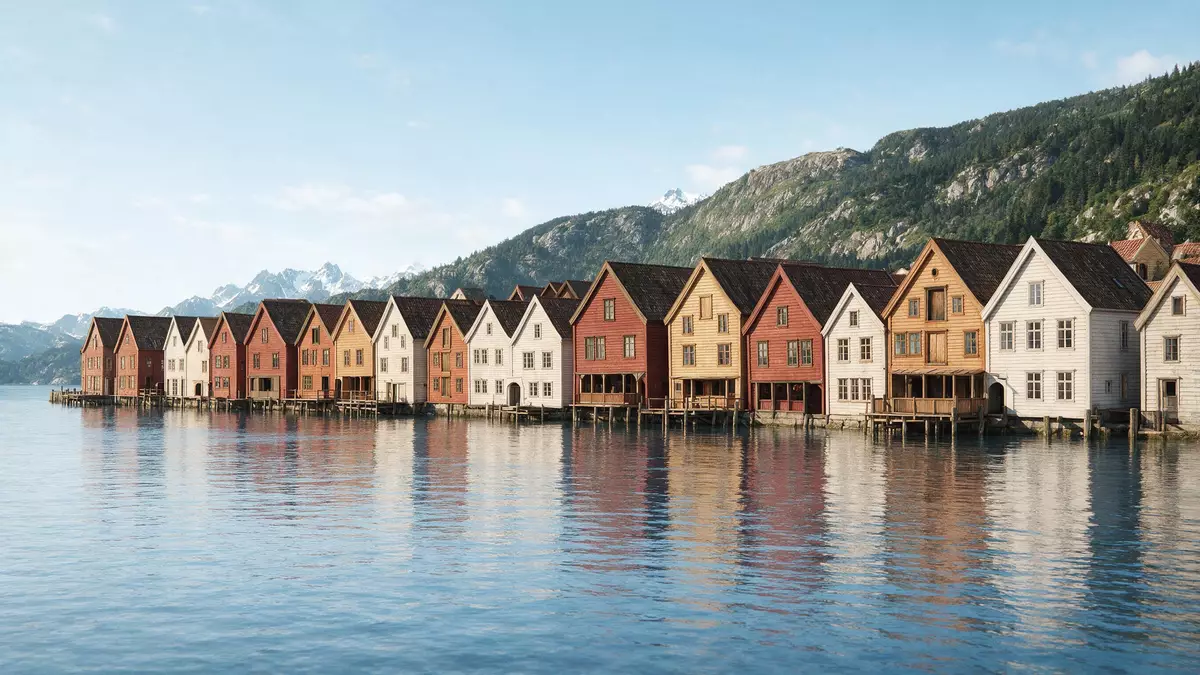
On the inner edge of Bergen’s Vågen harbour, Bryggen forms a dense timber wharf quarter where narrow lanes and tall wooden gables still reflect a medieval Hanseatic trading world. Recognised as a UNESCO World Heritage Site since 1979, it preserves a rare ensemble of historic warehouses and passages on Norway’s Atlantic coast.
Timber wharf facing the Vågen harbour
Bryggen stretches along the eastern side of the Vågen, the sheltered harbour that has long served as Bergen’s waterfront for shipping from across northern Europe.eastern side of the Vågen harbour The waterfront row is made up of tall, timber-built houses set close together, their gable ends turned towards the water and their long bodies extending inland.
Behind the waterside façades, parallel ranges of wooden buildings form a compact pattern of yards and service structures that once handled incoming cargo and outgoing goods. The protected area focuses on these wharf buildings and their immediate plot structure, including properties such as Finnegården and garden land reaching towards Øvregaten further uphill.Finnegården and the cabbage gardens at the back towards Øvregaten
Medieval trading quarter of the Hanseatic League
Bryggen is part of Bergen, one of northern Europe’s older port cities on the west coast of Norway, which was established as a centre for trade by the twelfth century.historic harbour district in Bergen In 1350 the Hanseatic League set up a formal overseas office here and gradually gained control of the wharf area.Hanseatic Office in Bergen in 1350 From the fourteenth to the mid-sixteenth century, Bergen functioned as a hub in a trading system that connected fishing grounds and coastal settlements in northern Norway with merchants and consumers across the Baltic and North Sea regions.
The Hanseatic merchants based at Bryggen dealt especially in stockfish, dried cod from northern Norway, exchanging it and other products such as cod liver oil, hides and furs for grain, malt, salt, beer, hemp, fabrics, hardware and glass.stockfish and other goods The quarter therefore combined warehouse storage with commercial offices, communal facilities and accommodation for traders linked to a wider Hanseatic network.
UNESCO World Heritage and surviving wooden structures
Bryggen was inscribed on the UNESCO World Heritage List in 1979, under cultural criterion (iii), as an exceptional testimony to a trading culture that emerged in medieval northern Europe.inscription on the World Heritage List in 1979 The listing highlights the way the quarter’s layout records social organisation and the use of space within a Hanseatic merchant community that developed from the fourteenth century onwards.criterion (iii)
Many fires have affected the wooden houses of Bryggen, with the last major blaze recorded in 1955, yet rebuilding has followed traditional patterns and methods that preserve the overall timber urban structure.fires and preserved structure The surviving wharf front and inner ranges therefore offer insight into an ancient North European type of wooden urban fabric and into the development of Bergen around its harbour.
Visiting Bryggen: what travellers from Western Europe should know
- Bryggen lines the inner harbour of Bergen on Norway’s west coast, on the eastern side of Vågen, and is reached on foot from the central parts of the city.
- The historic quarter consists of timber buildings and narrow passageways with uneven surfaces and stairways between the harbour edge and the slope towards Øvregaten.
- The official language is Norwegian and the currency is the Norwegian krone.
Searching for Bryggen on social platforms
These links open searches for Bryggen on each platform.Frequently asked questions about Bryggen
Where is Bryggen?
Bryggen is a historic timber wharf district along the eastern side of the Vågen harbour in Bergen, on the west coast of Norway.
What can visitors expect at Bryggen?
Visitors encounter closely spaced wooden warehouse fronts, narrow lanes running inland from the harbour, and a preserved plot pattern rooted in the medieval trading quarter.
What makes Bryggen distinctive among harbour districts?
Bryggen is notable as the preserved site of a Hanseatic overseas office and as a UNESCO-listed wooden urban structure whose layout dates back to the fourteenth century.


