
Bukchon Hanok Maeul and the tiled roofs between Seoul’s royal palaces
Published on 09/19/2026 at 12:52 | Editorial responsibility: Rafael Müller, Editor-in-Chief AD HOC NEWS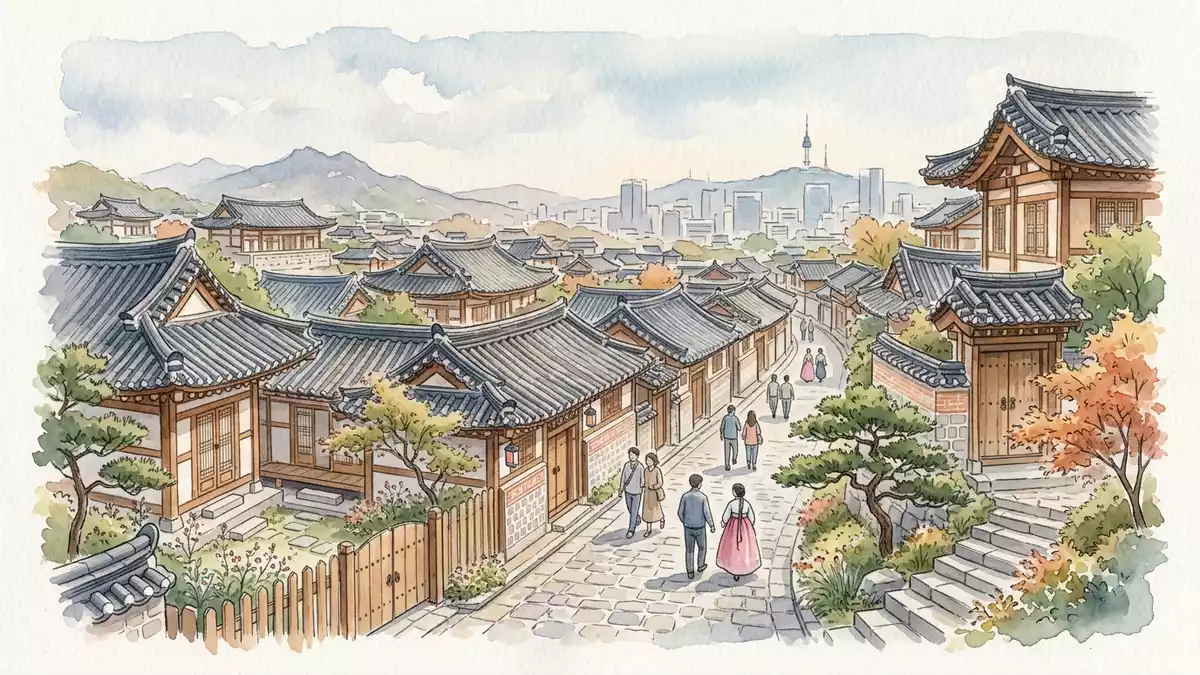
Bukchon Hanok Maeul in Seoul is a hillside neighbourhood of traditional Korean houses, known as hanok, set between the royal palaces of Gyeongbokgung and Changdeokgung. On the slopes of Jongno-gu, rows of dark tiled roofs and timber-framed homes trace patterns laid out in the Joseon dynasty, yet remain part of a working residential district.
Between palace walls and hillside streets
Bukchon Hanok Maeul lies in central Seoul’s Jongno-gu, on rising ground between Gyeongbokgung Palace to the west and Changdeokgung Palace to the east. This position places the quarter within walking distance of Jongmyo Shrine, the Confucian royal memorial complex that completes the triangle of palace and ritual sites framing the village.cluster of traditional hanok between Gyeongbokgung Palace, Changdeokgung Palace, and Jongmyo Shrine
The name Bukchon, meaning “northern village”, refers to its position north of Cheonggyecheon stream and the old Jongno axis, on slope-side land that rises towards Bugaksan mountain. Streets climb and bend between palace edges and modern buildings, creating views where low hanok rooflines sit below the higher walls and pavilions of Gyeongbokgung and Changdeokgung.north of Cheonggyecheon and Jongno on a hillside between the city’s two most important royal palaces
Hanok architecture rooted in the Joseon dynasty
Bukchon Hanok Maeul is defined by its concentration of hanok, the traditional Korean houses built around courtyards with timber frames, earthen or plastered walls and tiled roofs. Timber posts and beams rest on stone foundations, while clay walls and roof tiles form continuous horizontal lines that give the streets a low, layered skyline rare in a major capital.
The hanok in Bukchon are closely associated with the Joseon dynasty, which ruled Korea from 1392 to 1910 and established the palace complex and city structure that still shapes this part of Seoul. The area developed as a residential zone for high-ranking officials and aristocratic families connected to the royal court, leaving a pattern of lanes and plots adapted to hillside terrain and Confucian-era city planning.hanoks dating back to the Joseon Dynasty, which ruled Korea from 1392 to 1910
A dense residential cluster in the centre of Seoul
Jongno-gu records a substantial number of hanok in Bukchon, forming one of the densest surviving clusters of traditional houses in Seoul. Street after street carries roofs in dark tiles that overlap along the hillside, broken only by alleys, courtyards and the occasional modern insertion between older plots.Jongno-gu records around hundreds of such homes in Bukchon, forming one of the densest surviving clusters of hanok in the city
The neighbourhood is a lived-in residential quarter rather than a separate museum site, and many houses remain private homes. Others accommodate cultural centres, guesthouses or craft workshops, yet the core impression is of everyday life carried out within traditional architecture at the geographical centre of South Korea’s capital.originally a residential area for elite classes in the Joseon dynasty that later evolved yet kept hanok character
Visiting Bukchon Hanok Maeul: what travellers from Western Europe should know
- Bukchon Hanok Maeul lies in Jongno-gu, central Seoul, between Gyeongbokgung and Changdeokgung palaces and close to Jongmyo Shrine; Anguk Station on Line 3 of the Seoul Metro is the nearest major stop.
- The streets rise and fall across hillside terrain, and many routes involve walking up and down narrow lanes with stepped sections and uneven surfaces between clusters of hanok.
- Bukchon Hanok Maeul sits in Seoul, South Korea, where the official language is Korean and the currency is the South Korean won.
- Entry requirements depend on your nationality; UK travellers can check the FCDO travel advice at gov.uk/foreign-travel-advice, Irish travellers the Department of Foreign Affairs at ireland.ie.
Searching for Bukchon Hanok Maeul on social platforms
These links open searches for Bukchon Hanok Maeul on each platform.Frequently asked questions about Bukchon Hanok Maeul
Where is Bukchon Hanok Maeul located in Seoul?
Bukchon Hanok Maeul is in Jongno-gu, central Seoul, rising between Gyeongbokgung Palace and Changdeokgung Palace and close to Jongmyo Shrine.
What should visitors expect on a walk through Bukchon Hanok Maeul?
Visitors encounter narrow hillside streets lined with traditional hanok, a mix of private homes and cultural spaces, and views towards palace walls and modern city buildings.
What makes Bukchon Hanok Maeul distinctive among Seoul’s districts?
Its dense concentration of Joseon-era hanok on sloping terrain between major royal sites gives Bukchon a rare combination of historic architecture and present-day residential life at the centre of Seoul.


