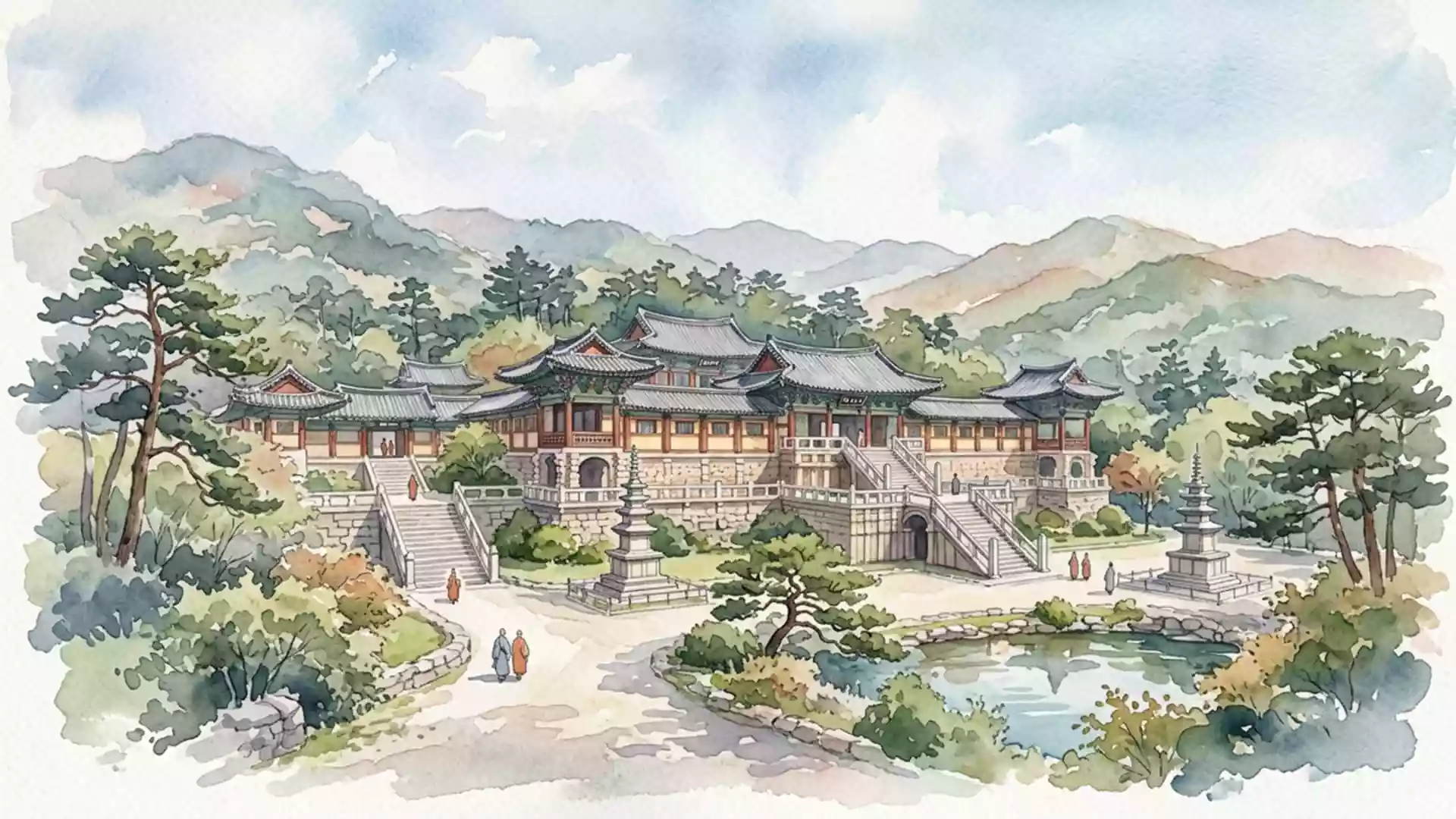
Bulguksa, a stone terrace temple above Gyeongju
Published on 09/03/2026 at 16:15 | Editorial responsibility: Rafael Müller, Editor-in-Chief AD HOC NEWS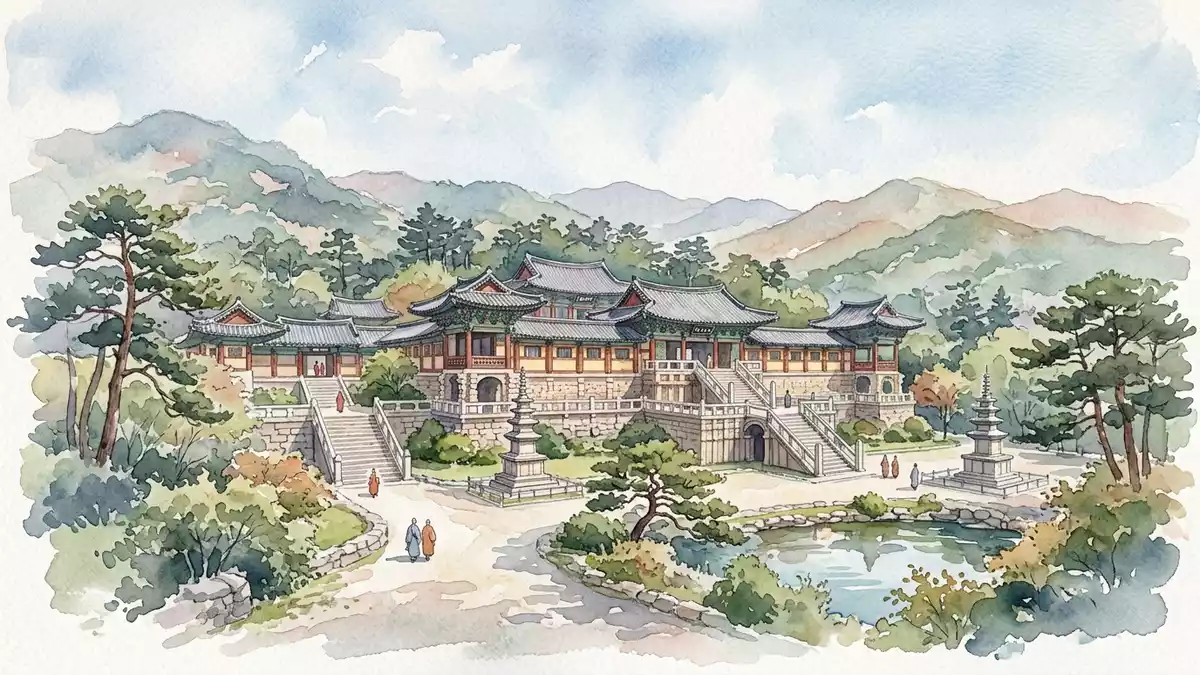
Bulguksa is a Buddhist temple complex on the slopes of Mount Tohamsan above Gyeongju in South Korea, laid out on broad stone terraces rather than a single courtyard. Built as a major temple of the Silla kingdom in the eighth century and restored in the twentieth century, it combines timber halls, granite stairways and stone pagodas in one compact hillside site.
Terraces of stone and timber halls
Bulguksa stands in Jinhyeon-dong on the western side of Mount Tohamsan, south-east of central Gyeongju, the former capital of the Silla kingdom.Buddhist temple on Tohamsan The complex rises in stepped platforms of dressed stone, with wooden halls painted in strong colours set back from the main staircases.
The present layout dates to major rebuilding that began in 751 under the Silla official Kim Daeseong and was completed in 774 under royal patronage.rebuilding began in 751 The site is recognised as a head temple of the Jogye Order of Korean Buddhism, and its sequence of courts and halls still reflects its status as a major monastic centre.head temple of the Jogye Order
National treasures in a Silla-era setting
Several of Korea’s designated National Treasures stand within Bulguksa, giving the terraces the character of an open-air stone gallery as well as a working temple.seven national treasures Two stone pagodas, Dabotap and Seokgatap, stand in front of the main hall and show contrasting interpretations of Silla stone craft, from intricate multi-tiered carving to a more restrained, balanced profile.Dabotap and Seokgatap stone pagodas
The main worship space, Daeungjeon Hall, houses an image of Sakyamuni Buddha and looks over a raised stone courtyard framed by wooden corridors.statue of Sakyamuni Buddha Nearby halls such as Geungnakjeon and Birojeon focus on Amitabha and Vairocana Buddha respectively, reflecting the complex cosmology of Silla Buddhism in their dedications and interior statues.Geungnakjeon and Birojeon areas
UNESCO landscape of temple and grotto
Bulguksa and the nearby Seokguram Grotto together form a UNESCO World Heritage Site that links a hillside temple with a mountainside Buddha shrine.Seokguram Grotto and Bulguksa Temple The inscription in 1995 highlighted the quality of Silla stone architecture and sculpture, from the granite retaining walls and staircases to the carved guardians and reliefs.World Heritage religious complex
The temple stands within wooded slopes that form part of the larger Tohamsan landscape, with views towards the Gyeongju basin and forested ridges around the site.slopes of Mt. Tohamsan Within the complex, stone bridges such as Cheongungyo and Baegungyo cross stepped approaches to the main halls, reinforcing the impression of a temple built on layered stone platforms rather than on flat ground.Cheongun-gyo stone bridge
Visiting Bulguksa: what travellers from Western Europe should know
- Bulguksa stands on the slopes of Mount Tohamsan in Jinhyeon-dong, south-east of central Gyeongju, and is reached by road from the city.location in Jinhyeon-dong, Gyeongju
- The temple complex is laid out on stone terraces connected by exterior stairways, so a visit involves repeated climbs between levels and walking on uneven stone surfaces.wooden buildings on raised stone terraces
- Bulguksa is in South Korea, where the official language is Korean and the currency is the South Korean won.
- Entry requirements depend on your nationality; UK travellers can check the FCDO travel advice at gov.uk/foreign-travel-advice, Irish travellers the Department of Foreign Affairs at ireland.ie.
Searching for Bulguksa on social platforms
These links open searches for Bulguksa on each platform.
Frequently asked questions about Bulguksa
Where is Bulguksa?
Bulguksa is a Buddhist temple complex in Jinhyeon-dong on the slopes of Mount Tohamsan, south-east of central Gyeongju in South Korea.
What can visitors expect at Bulguksa?
Visitors encounter stone terraces, wooden worship halls, Silla-era stone pagodas and bridges, all arranged in a multi-level hillside layout within a forested setting.
What makes Bulguksa distinctive?
Bulguksa is distinctive for its Silla-period stone architecture, including National Treasure pagodas and bridges, and its joint UNESCO World Heritage status with Seokguram Grotto.