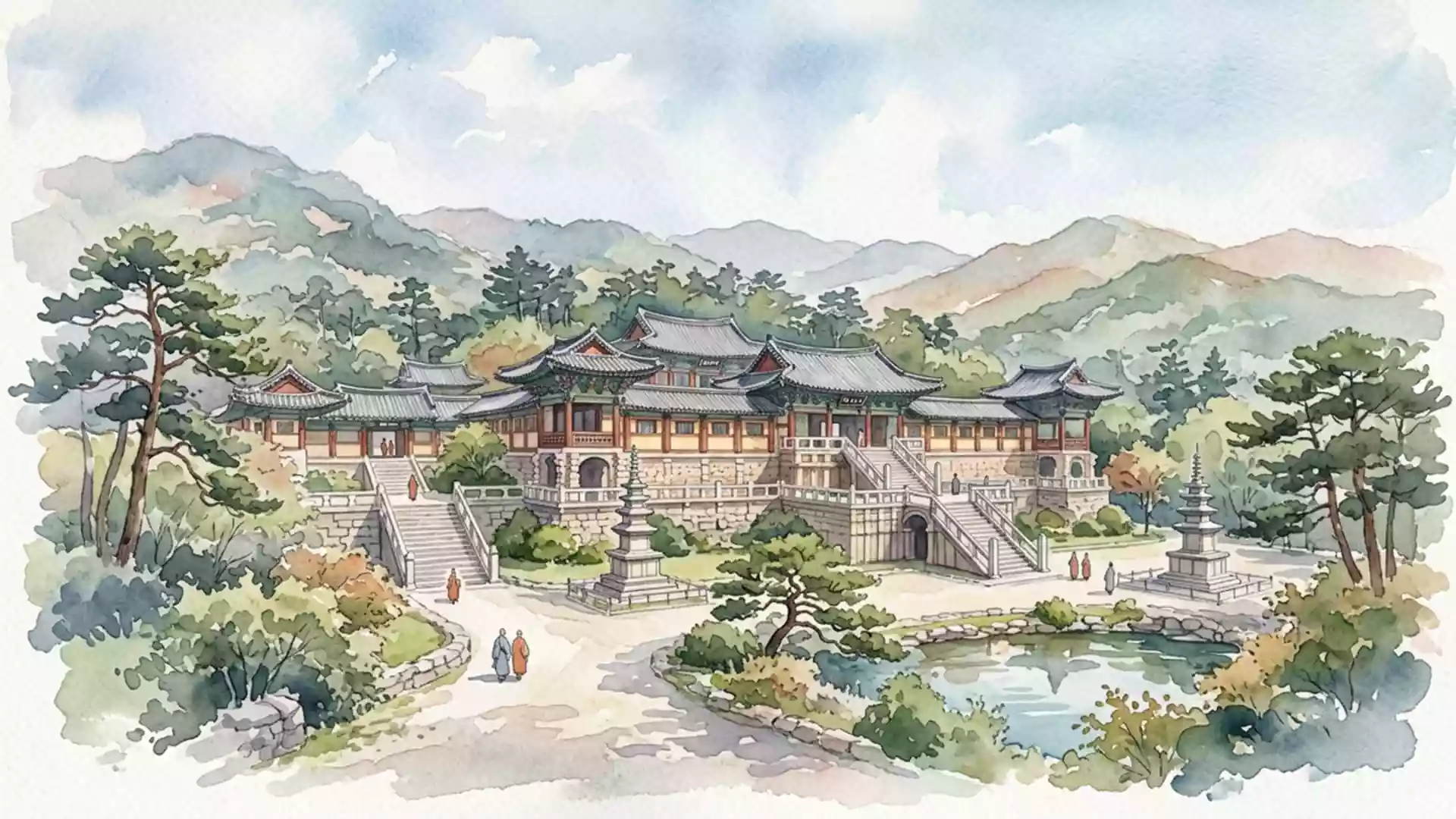
Bulguksa and the stone terraces of Buddha Land in Gyeongju
Published on 08/19/2026 at 17:37 | Editorial responsibility: Rafael Müller, Editor-in-Chief AD HOC NEWS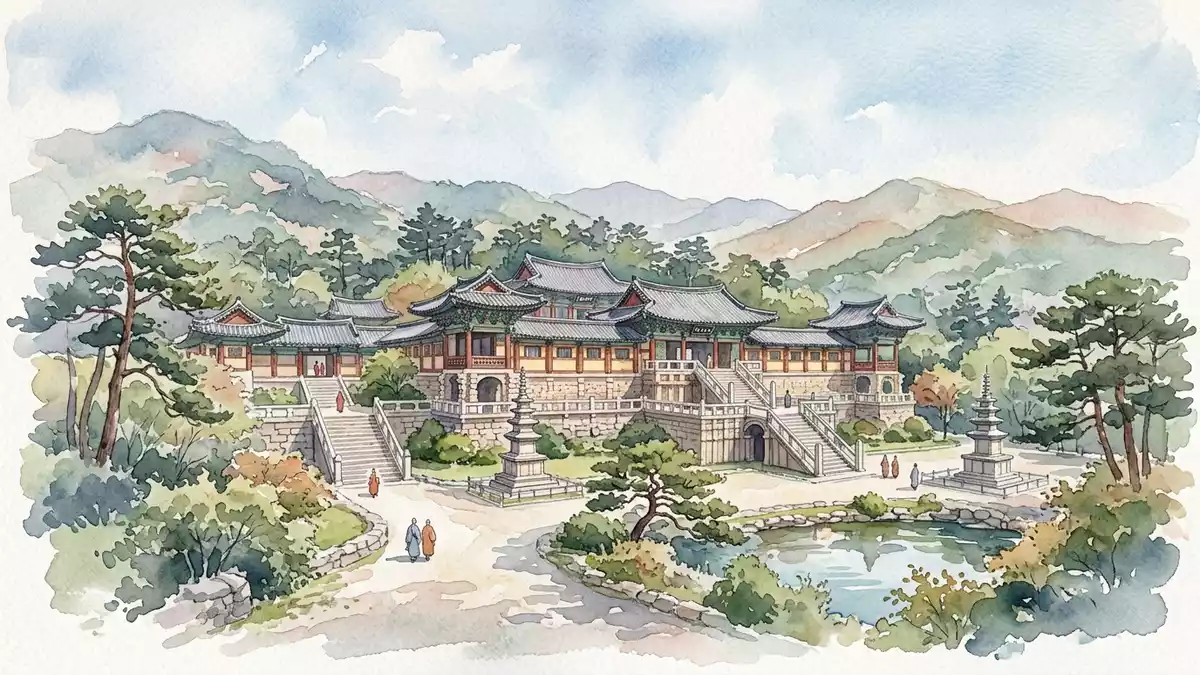
Bulguksa in Gyeongju is one of Korea’s defining Buddhist temple complexes, raised on stone terraces along the slopes of Tohamsan and rooted in the Silla kingdom’s Buddhist culture of the eighth century. Built during the Unified Silla period and completed in 774, it translates the idea of a “Buddha Land” into architecture and landscape that still structure the site.
Stone terraces and the idea of Buddha Land
Bulguksa is a Buddhist temple complex composed of wooden halls standing on carefully laid stone platforms that step up the lower slopes of Mt Tohamsan east of Gyeongju. The layout creates successive terraces and courtyards, each reached by stairways and stone bridges that organise movement through the temple grounds.Bulguksa is a Buddhist temple complex These terraces support key halls such as Daeungjeon, Geungnakjeon and Birojeon, grouped into distinct precincts within the complex.grounds of the temple were divided into five sections
The temple site has a long history in Korean Buddhism, with origins linked to Silla’s acceptance of Buddhism in the sixth century and later rebuilding in the eighth century under the minister Kim Daeseong. Over centuries the stone work, terraces and stairs were restored after periods of damage, preserving the characteristic stepped setting against the mountain.built in the eighth century on the wooded slopes of Mt Tohamsan The present complex brings together this layered history in a single sequence of platforms, pagodas and halls.
Unified Silla architecture and national treasures
Bulguksa is closely associated with the Unified Silla kingdom, which ruled much of the Korean peninsula from 668 to 935, and its architecture reflects that period’s timber construction and stone craftsmanship. The temple is traditionally linked to Kim Daeseong, a chief minister of Silla who is credited with overseeing major works, including the eighth?century rebuilding.chief architect of Bulguksa is traditionally credited as Kim Dae-seong Over time the complex became a significant Buddhist seminary, with its main halls housing statues of Vairocana, Amita and Sakyamuni Buddha.statues of Vairocana Buddha and Amita buddha
Within the temple grounds sit several structures designated as National Treasures of Korea, a reflection of their cultural and artistic importance. Among them are the paired stone pagodas Dabotap and Seokgatap, standing in front of one of the main halls, as well as stone bridges such as Cheongun?gyo. Together these monuments form a concentrated group of Silla stone architecture inside the temple compound.temple now holds seven national treasures Bulguksa is also the main temple of the eleventh district of the Jogye Order of Korean Buddhism, underlining its ongoing religious role.main temple of the 11th district of the Jogye Order
World Heritage recognition and mountain setting
Bulguksa stands on the outskirts of Gyeongju in Jinhyeon?dong, on the lower slopes of Mt Tohamsan, and forms part of a wider cultural landscape that includes the nearby Seokguram Grotto. In 1995 UNESCO inscribed “Seokguram Grotto and Bulguksa Temple” as a single World Heritage Site, recognising the ensemble as an outstanding expression of Buddhist art and architecture.Seokguram Grotto and Bulguksa Temple The approach from Gyeongju climbs into the foothills, where the temple complex spreads out over its stone platforms.
The wider Gyeongju area was the ancient capital of Silla, and Bulguksa forms part of a network of archaeological sites, burial mounds and religious monuments linked to that era. Visitors encounter not only the temple’s timber halls and pagodas but also views toward the forested slopes and the route onwards to Seokguram, a separate grotto temple in the mountain above.Gyeongju Bulguksa Temple [UNESCO World Heritage] The combination of religious precincts and mountain landscape is central to how Bulguksa is experienced.
Visiting Bulguksa: what travellers from Western Europe should know
- Bulguksa lies in Jinhyeon?dong to the south?east of central Gyeongju, on the lower slopes of Mt Tohamsan. It is reached by road and local buses from the city’s transport terminals.
- The temple complex is spread over stone terraces linked by stairways and bridges, and a visit involves walking between multiple courtyards on sloping ground.
- The wider setting includes forested hills and the path toward Seokguram Grotto higher on Tohamsan, and the area can feel more exposed to mountain weather than the built?up centre of Gyeongju.
- The official language is Korean and the currency is the South Korean won.
- Entry requirements depend on your nationality; UK travellers can check the FCDO travel advice at gov.uk/foreign-travel-advice, Irish travellers the Department of Foreign Affairs at ireland.ie.
Searching for Bulguksa on social platforms
These links open searches for Bulguksa on each platform.
Frequently asked questions about Bulguksa
Where is Bulguksa and what is its setting?
Bulguksa is on the slopes of Mt Tohamsan in Jinhyeon?dong near Gyeongju, with the temple complex spread over stone terraces against the mountain landscape.
What can visitors expect during a visit to Bulguksa?
Visitors walk through multiple courtyards and halls on raised stone platforms, seeing Silla?era pagodas, bridges and timber buildings arranged along the hillside.
What makes Bulguksa distinctive among Korean temples?
Its combination of Unified Silla architecture, designated National Treasures and shared World Heritage inscription with Seokguram Grotto give Bulguksa a particular status in Korean Buddhism.