
Bulguksa and the stone terraces of Gyeongju
Published on 09/22/2026 at 07:59 | Editorial responsibility: Rafael Müller, Editor-in-Chief AD HOC NEWS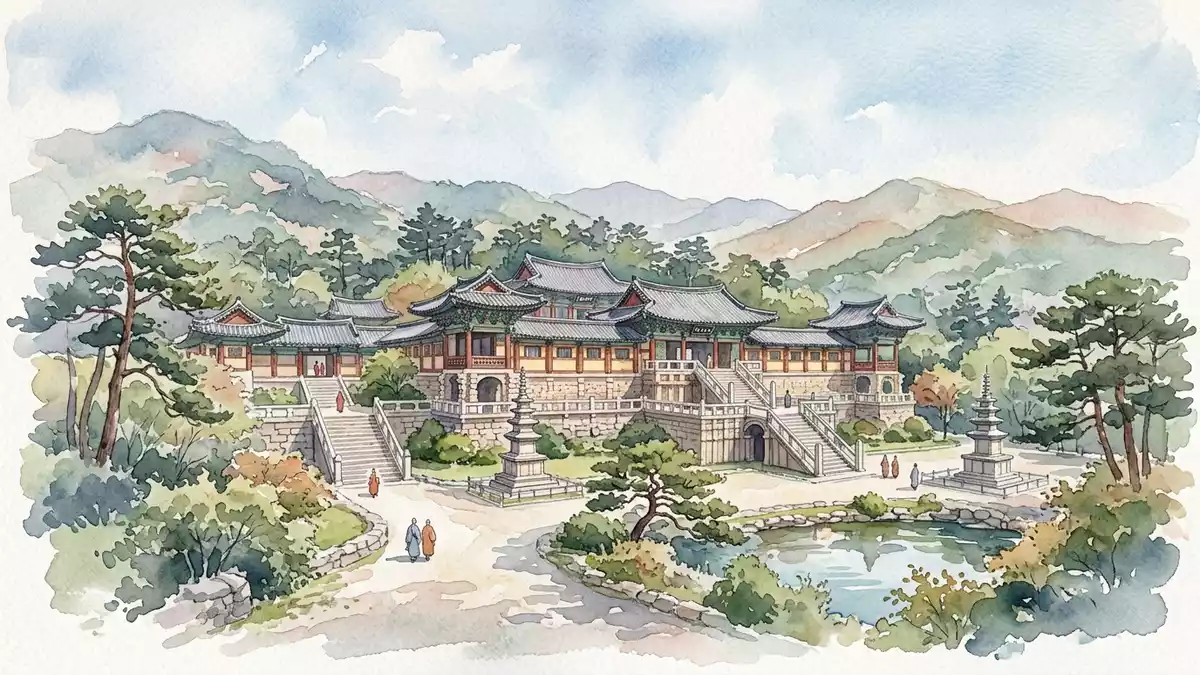
Bulguksa presents Korean Buddhist architecture as a carefully layered landscape of stone terraces, stairways, bridges and timber halls. The temple stands in Gyeongju, the historic capital of the Silla kingdom, and its principal buildings combine carved masonry with painted wood.
Bulguksa: a temple arranged in stone
The approach to Bulguksa leads through a sequence of raised platforms and stairways. Granite blocks form the terraces, retaining walls and bridges, while timber structures occupy the higher ground. The arrangement gives the complex a strong vertical character without reducing it to a single building.
Cheongungyo and Baegungyo are among the best-known stone features. Their names mean Blue Cloud Bridge and White Cloud Bridge. Together with Yeonhwagyo and Chilbogyo, they connect the lower and upper parts of the temple precinct. The stairways are historic architectural elements, not ordinary routes through the complex.
Silla history in Gyeongju
Bulguksa is associated with the Silla kingdom, which ruled much of the Korean Peninsula before the establishment of the Goryeo dynasty. The temple’s history reaches back to the eighth century, during the reign of King Gyeongdeok. Bulguksa and Seokguram form part of Gyeongju’s Buddhist heritage.
The complex has undergone rebuilding and repair across different historical periods. Its identity rests on the relationship between Silla-era religious culture, later timber architecture and the surviving stonework. The temple is also linked with Seokguram, a Buddhist grotto on Mount Tohamsan.
Dabotap, Seokgatap and the temple’s visual language
Two stone pagodas give the main precinct much of its visual character. Dabotap has an elaborate profile with multiple carved levels, while Seokgatap presents a more restrained arrangement of stacked stone forms. Both are associated with the Silla period.
The pagodas stand near the main hall, alongside other recognised elements of the temple compound. Bulguksa also contains wooden halls, Buddhist images, stone railings and ornamental details. Korean heritage records place the temple within the country’s protected cultural landscape.
Colours, rooflines and carved stone create a sequence of changing surfaces across the site. The painted timber follows Korean Buddhist architectural traditions, while the masonry gives the terraces their durable geometric outline. The contrast is visible throughout the upper precinct.
Visiting Bulguksa: what travellers from Western Europe should know
- Bulguksa lies east of central Gyeongju on the slopes of Mount Tohamsan. Local buses and taxis connect the temple with Gyeongju, while Bulguksa railway station serves the surrounding area.
- The grounds include historic stairways, raised terraces and uneven stone surfaces. The principal bridges are architectural monuments, and access around the complex involves changes in level.
- Seokguram is located on Mount Tohamsan and belongs to the same cultural heritage setting. The grotto is reached separately from the main Bulguksa precinct.
- The official language is Korean and the currency is the South Korean won.
- Entry requirements depend on your nationality; UK travellers can check the FCDO travel advice at gov.uk/foreign-travel-advice, Irish travellers the Department of Foreign Affairs at ireland.ie.
Searching for Bulguksa on social platforms
These links open searches for Bulguksa on each platform.
Frequently asked questions about Bulguksa
Where is Bulguksa?
Bulguksa is in Gyeongju, in South Korea’s North Gyeongsang Province. The temple stands on the slopes of Mount Tohamsan, east of the historic city centre.
What can visitors see at Bulguksa?
The complex contains stone terraces, historic bridges, timber halls, Buddhist images and the Dabotap and Seokgatap pagodas. Its layout combines elevated masonry platforms with traditional Korean temple buildings.
What makes Bulguksa distinctive?
Bulguksa brings Silla-period stonework and Korean Buddhist timber architecture into one temple precinct. Its association with Seokguram adds a second major Buddhist monument within the Gyeongju heritage landscape.


