
Bulguksa in Gyeongju, a stone-built vision of Silla Buddhism
Published on 09/18/2026 at 13:34 | Editorial responsibility: Rafael Müller, Editor-in-Chief AD HOC NEWS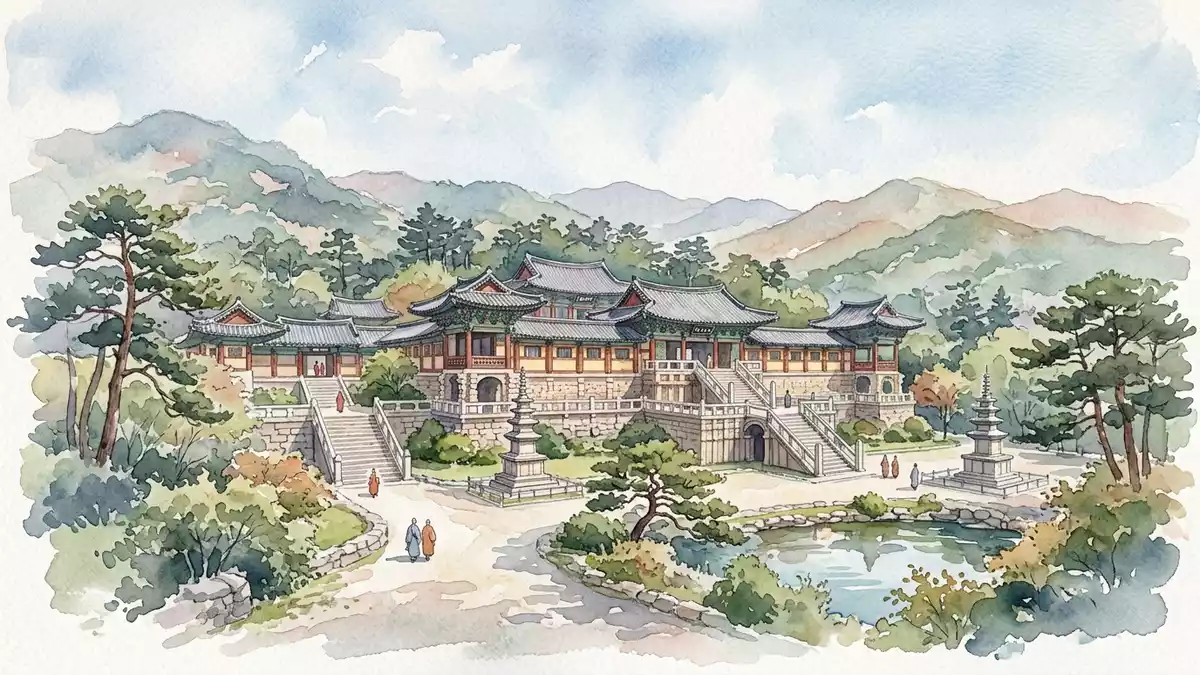
Bulguksa in Gyeongju is a Buddhist temple complex where stone terraces, timber halls and stone pagodas rise together on the lower slopes of Mount Tohamsan. Built under the Silla dynasty and completed in 774, it sets sacred architecture into a stepped landscape rather than a single courtyard.Silla dynasty complex
Silla stone terraces and timber halls
Bulguksa was first founded during the Silla Kingdom in the sixth century, in the reign of King Beopheung, when Buddhism gained official acceptance at court.Foundation under King Beopheung The temple was later rebuilt in the eighth century under Prime Minister Kim Dae-seong and completed in 774, when it received the name Bulguksa, “Temple of the Buddha Land”.Completion and naming in 774
The complex stands on a sequence of broad stone platforms, each carrying wooden halls with tiled roofs and ornamental brackets. Visitors move up flighted stairways built in stone, emerging on terraces that hold halls such as Daeungjeon, devoted to Shakyamuni Buddha, and other shrines of the Jogye Order of Korean Buddhism.Jogye Order main temple Timber structures sit on precisely laid masonry, giving the temple its layered profile against the hillside.
Stone pagodas and national treasures
Bulguksa is renowned for its stone pagodas, which stand on the upper terrace in front of the main hall and are counted among Korea’s National Treasures.Seven National Treasures Two of them, Dabotap and Seokgatap, date to the eighth century, with inscriptions placing their construction around 751.Dabotap and Seokgatap pagodas Dabotap has a highly articulated profile with multiple platforms and balustrades, while Seokgatap presents a simpler, more restrained form.
Beyond these pagodas, Bulguksa preserves stone staircases, bridges and lanterns designated as cultural properties by South Korea’s heritage authorities.National treasures at Bulguksa Together they turn the ascent from the lower gate buildings to the main terrace into a progression through carved stone elements, with wooden halls set back above them.
World Heritage landscape above Gyeongju
The temple forms part of a wider religious landscape that includes the Seokguram Grotto higher on Mount Tohamsan. Bulguksa and Seokguram were inscribed together on the UNESCO World Heritage List in 1995 as “Seokguram Grotto and Bulguksa Temple”, recognising the ensemble as an outstanding example of Silla Buddhist architecture.UNESCO inscription in 1995 From the temple terraces the wooded slopes rise further towards the grotto, linking carved stone, timber halls and a hermitage cave into one sacred topography.
Bulguksa lies south-east of central Gyeongju, in North Gyeongsang Province, and has long served as an important temple of the Jogye Order, the largest school of Korean Buddhism.Jogye Order temple history The complex has been repaired and restored on several occasions, including major works in the twentieth century that reinstated halls lost to fire in the late sixteenth century.Restoration after Imjin War
Visiting Bulguksa: what travellers from Western Europe should know
- Bulguksa stands on the lower slopes of Mount Tohamsan, south-east of central Gyeongju; buses run from Gyeongju bus terminal to a stop near the temple entrance.
- The temple complex is built on ascending stone terraces linked by stairways, so a visit involves walking up and down steps between the gate area and the main halls.
- The surrounding hills carry woodland and further religious sites, including Seokguram Grotto higher on Mount Tohamsan, which is reached separately from Bulguksa.
- The official language is Korean and the currency is the South Korean won.
- Entry requirements depend on your nationality; UK travellers can check the FCDO travel advice at gov.uk/foreign-travel-advice, Irish travellers the Department of Foreign Affairs at ireland.ie.
Searching for Bulguksa on social platforms
These links open searches for Bulguksa on each platform.Frequently asked questions about Bulguksa
Where is Bulguksa located?
Bulguksa is on the lower slopes of Mount Tohamsan to the south-east of Gyeongju, in North Gyeongsang Province, South Korea.
What should visitors expect at Bulguksa?
Visitors encounter layered stone terraces, timber halls and stone pagodas arranged on the hillside, with stairways linking different levels of the temple complex.
What makes Bulguksa distinctive among Korean temples?
Bulguksa combines eighth-century stone pagodas such as Dabotap and Seokgatap with Silla-period halls, and forms part of a UNESCO World Heritage ensemble with Seokguram Grotto.


