
Burano’s kaleidoscope of colour and lace
Published on 09/17/2026 at 15:59 | Editorial responsibility: Rafael Müller, Editor-in-Chief AD HOC NEWS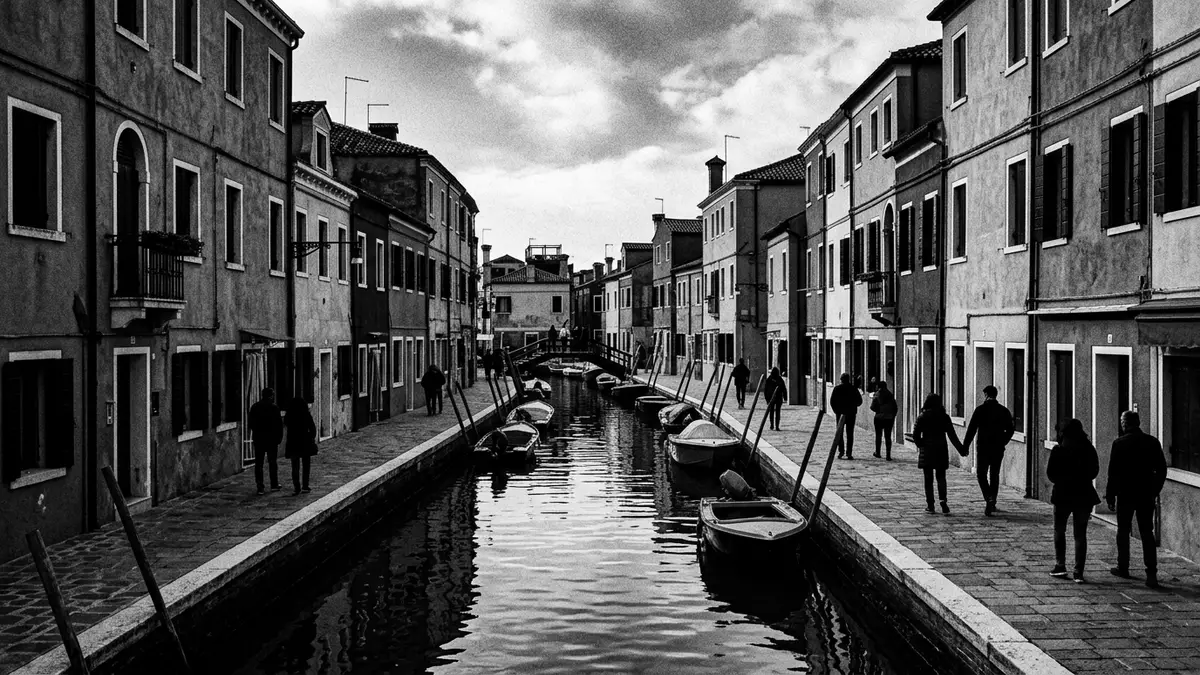
Burano is a small island in the northern Venetian Lagoon, part of Venedig in Italy, where brightly painted fishermen’s houses and a long tradition of needle lace share the same narrow canals. The island is known both as an ancient fishing village and as a centre of lace production from the sixteenth century, giving it a dual character that is visible in its streets and workshops.
Colour-washed houses along quiet canals
At first glance Burano is defined by its houses, modest in scale but painted in strong colours that run in bands along the canals and lanes. Simple façades stand shoulder to shoulder on low foundations, with washing lines, small balconies and window boxes adding their own details to the paintwork. This patchwork of colour has become the island’s most recognisable feature, drawing attention to buildings that were originally constructed as fishermen’s homes.painted in all colours
The coloured houses are closely associated with Burano’s fishing past, when small boats moved between the lagoon and the island’s moorings and simple dwellings lined the water’s edge.coloured fishermen’s houses Canals cross the island in several directions, bridged by short stone spans that connect one terrace to the next, and the water lies close to doorsteps and wharves. Burano’s houses are protected as part of a regulated streetscape, and repainting them follows rules set by the municipal authorities, preserving the impression of a continuous colour field.coloured houses are protected by law
Lacemaking traditions and the Museo del Merletto
Alongside fishing, lacemaking has shaped Burano’s identity since at least the sixteenth century, when women on the island developed a distinctive form of needle lace known as punto in aria.traditional needle lace This technique uses only needle and thread without a fabric backing, creating patterns that seem to float on open space. Burano lace became highly valued across Europe, and its intricate motifs still appear in collars, table linens and decorative pieces that connect present-day workshops with centuries of craft history.
The Museo del Merletto, housed in former lacemaking school rooms on Piazza Baldassarre Galuppi, presents historic and contemporary examples of this work, along with documentation of techniques and tools.Museum of Lace Making Displays trace how lacemaking flourished, declined and was revived in the nineteenth century, when a school was founded to preserve local skills.school for lacemaking was established In the streets around the square, small shops sell pieces made with traditional methods, and it is common to see lacemakers working with fine thread at tables, continuing a practice that has been sustained over generations.
Church, campanile and small-town layout
Burano’s compact townscape is organised around its main square, Piazza Baldassarre Galuppi, where the parish church of San Martino and its campanile form a prominent landmark. The bell tower rises above the surrounding roofs and is visibly out of alignment, giving it a slight lean that is particularly noticeable from the nearby canals.leaning bell tower of the Chiesa San Martino Around the square, low houses and civic buildings create enclosed edges, making this area both a meeting point and a reference for orientation on the island.
Beyond the central square, Burano’s streets follow the pattern of the canals, with short axes leading to waterside landings and wider paths aligning with the main channels. Many of the houses are traditional fishermen’s dwellings, set in rows with repeated forms and details, and there are few grand palazzi, giving the island a consistent, village-like scale.inhabited mainly by poor fishermen Together, the coloured façades, the leaning tower and the lace museum create a series of focal points that can be reached on foot within a short circuit, making Burano a place that reveals itself through walking rather than through large individual monuments.
Visiting Burano: what travellers from Western Europe should know
- Burano lies in the northern part of the Venetian Lagoon, north-east of the historic centre of Venedig, and is reached by boat services that connect the city to the lagoon islands.
These routes also link Burano with neighbouring Murano and Torcello. - The island is flat and compact, with canals crossed by short bridges and streets laid out in a close-knit grid.
Moving around the centre involves frequent short walks on level paving and occasional steps on bridge ramps. - Burano is in Italy, where the official language is Italian and the currency is the euro.
English is widely understood in the main visitor areas of Venedig and its lagoon.
Searching for Burano on social platforms
These links open searches for Burano on each platform.
Frequently asked questions about Burano
Where is Burano and how is it related to Venedig?
Burano is an island in the northern Venetian Lagoon in Italy, lying north-east of central Venedig and forming part of the wider lagoon settlement.
What can visitors expect when walking through Burano?
Visitors encounter narrow canals lined with colour-washed fishermen’s houses, short bridges, paved lanes and a central square with the church of San Martino and its leaning bell tower.
What makes Burano distinctive among the lagoon islands?
Burano is distinctive for its combination of brightly painted houses and a centuries-old tradition of needle lace, presented in workshops and in the Museo del Merletto on Piazza Baldassarre Galuppi.


