
Bwindi Impenetrable National Park’s ancient rainforest world
Published on 09/19/2026 at 06:29 | Editorial responsibility: Rafael Müller, Editor-in-Chief AD HOC NEWS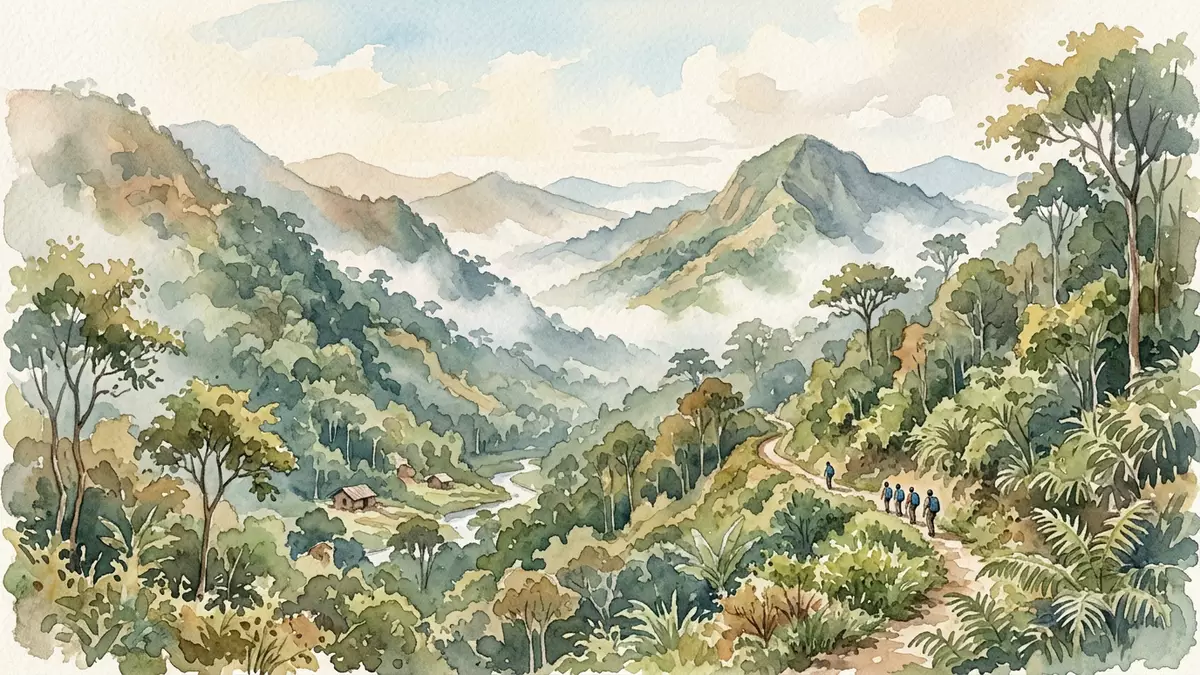
In the south-western highlands of Uganda, Bwindi Impenetrable National Park preserves an ancient block of montane rainforest where dense vegetation, steep slopes and deep valleys create one of Africa’s richest ecological refuges. Established as a national park in 1991 and recognised as a natural UNESCO World Heritage Site in 1994, it is a place where conservation history, biodiversity and challenging terrain come together in a single landscape.
Ancient forest on the edge of the Albertine Rift
Bwindi Impenetrable National Park lies in the Kigezi Highlands near Kabale, on the eastern edge of the Albertine Rift Valley in south-western Uganda, close to the border with the Democratic Republic of the Congo.south-western Uganda near the rift The protected area forms part of the Bwindi-Sarambwe forest system and occupies rugged hills cut by numerous streams, with elevations that rise from the lower slopes towards misty ridgelines.
The national park covers just over 320 km² (124 sq mi) of both lowland and montane forest, making it one of the largest remaining blocks of Afromontane forest in East Africa.321 km² of lowland and montane forest Within this compact area, more than 160 tree species and over 100 fern species have been recorded, alongside an abundance of epiphytes and understorey plants that create the dense structure that gave the forest its “impenetrable” reputation.exceptional biodiversity of trees and ferns The forest is regarded as a long-term refugium for tropical species, with parts of it surviving climatic changes over tens of thousands of years.
A World Heritage landscape of biodiversity
In recognition of its outstanding ecological value, Bwindi Impenetrable National Park was inscribed as a natural World Heritage Site on the UNESCO List in 1994.World Heritage inscription in 1994 The inscription highlights both its exceptional scenic qualities and its importance for conserving rare species and intact montane forest. As a World Heritage property, Bwindi sits alongside the Rwenzori Mountains and the Kasubi Tombs as one of Uganda’s internationally recognised heritage sites.one of Uganda’s three World Heritage sites
The forest’s biodiversity extends across plants, birds, mammals and invertebrates. The park protects endangered mountain gorillas and other primates, as well as many forest antelope species and a long list of forest birds and butterflies.endangered species including mountain gorilla Conservation organisations have long regarded Bwindi as a “living laboratory” for evolutionary and ecological research because of the variety of species and habitats packed into its steep hillsides.living laboratory for evolutionary studies For travellers, this diversity is visible in the rapid changes from dense valley forest to more open areas with towering trees, and in the presence of wildlife signs along established paths.
Mountain gorillas and conservation history
Bwindi Impenetrable National Park is closely associated with the conservation of mountain gorillas, a subspecies of gorilla that lives only in a few high-altitude forest blocks in the Albertine Rift region.a key refuge for mountain gorillas The park holds a significant proportion of the global mountain gorilla population, making it one of the central areas for field research and carefully managed gorilla tourism.
The forest was first protected as a reserve in the mid-twentieth century and later upgraded to national park status in 1991, a change that shifted its management towards strict conservation.national park designation in 1991 During the early 1990s, selected gorilla groups such as the Mubare group near Buhoma were gradually habituated to the presence of humans, allowing structured visits under close monitoring.habituation of groups near Buhoma Over subsequent decades, conservation programmes, veterinary interventions and cooperation between authorities and local communities have contributed to an increase in the number of gorillas recorded within the wider Bwindi–Virunga area.growth in the regional gorilla population
Visiting Bwindi Impenetrable National Park: what travellers from Western Europe should know
- Bwindi Impenetrable National Park lies in south-western Uganda, with access by road from towns such as Kabale, Kanungu, Kihihi and Kisoro; regional flights serve nearby airstrips.
- The terrain within the park is steep and uneven, with forest paths that can be muddy and slippery and approaches that may involve sustained walking on hillsides.
- The forest occupies highland terrain where rainfall is frequent; waterproof layers and sturdy footwear are important for moving through the vegetation in changing conditions.
- The official language of Uganda is English and the national currency is the Ugandan shilling.
- Entry requirements depend on your nationality; UK travellers can check the FCDO travel advice at gov.uk/foreign-travel-advice, Irish travellers the Department of Foreign Affairs at ireland.ie.
Searching for Bwindi Impenetrable National Park on social platforms
These links open searches for Bwindi Impenetrable National Park on each platform.
Frequently asked questions about Bwindi Impenetrable National Park
Where is Bwindi Impenetrable National Park?
Bwindi Impenetrable National Park is in south-western Uganda, in the Kigezi Highlands near Kabale and close to the border with the Democratic Republic of the Congo.
What should visitors expect on a visit?
Visitors can expect steep forest terrain, established walking paths through dense vegetation, frequent rainfall and organised activities that focus on wildlife and rainforest observation.
What makes Bwindi Impenetrable National Park distinctive?
The park is distinctive for its ancient montane rainforest, its role in conserving mountain gorillas and its recognised status as a natural UNESCO World Heritage Site.


