
Caislean na Blarnan and its limestone tower above Blarney
Published on 09/22/2026 at 15:06 | Editorial responsibility: Rafael Müller, Editor-in-Chief AD HOC NEWS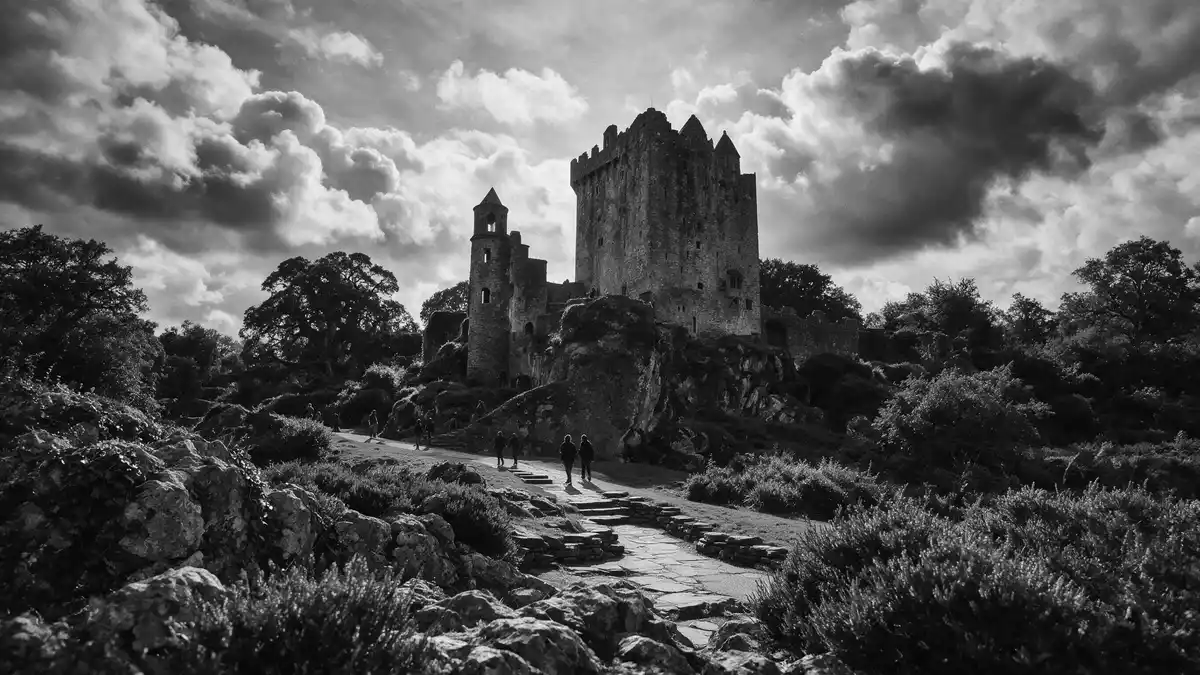
Caislean na Blarnan rises above the gardens of Blarney as a substantial limestone tower house from 1446. Its battlements contain the Blarney Stone, while thick masonry, vaulted chambers and narrow stairways preserve the character of a late medieval stronghold.
Caislean na Blarnan: a tower house in limestone
The surviving castle is a tower house, a fortified building associated with Gaelic lords and Anglo-Irish families between the fifteenth and seventeenth centuries. It belongs to the MacCarthy of Muskerry dynasty, a branch of the MacCarthy kings of Desmond.
The present structure dates to 1446 and is linked with Cormac Láidir MacCarthy, Lord of Muskerry. Its walls are built from limestone, with the masonry becoming less massive as the tower rises. The lower walls reach about 5.5 m (18 ft) in thickness, giving the building a powerful, weighty profile above the grounds. the limestone tower house remains the defining feature of the estate.
The medieval rooms inside the MacCarthy stronghold
Inside, the castle is arranged through chambers connected by stairways and passages. The Great Hall occupies a vaulted room with a seventeenth-century fireplace, while the kitchen lies above the room known as the Priest’s Room.
The castle also contains guards’ quarters, a dungeon, a chapel area, a banqueting hall and family rooms. These names preserve the building’s changing domestic and defensive functions without turning the interior into a single-purpose monument. The older tower contains a spiral staircase leading towards the Young Ladies’ Bedroom and the Priest’s Room.
The walls and bawn formed a defended enclosure around the tower. The bawn covered about 8 acres and provided space associated with the castle’s household and livestock. The building’s rooms, stairs and masonry remain legible as parts of a fortified residence rather than as separate museum galleries.
The Blarney Stone and the castle gardens
The Blarney Stone is set into the upper masonry beneath the battlements. Its story connects Caislean na Blarnan with the wider traditions of Munster, Robert the Bruce and the Stone of Scone. The stone’s reputed gift is eloquence, a tradition attached to the castle for generations.
The gardens extend across more than 60 acres of parkland around the tower. Their named features include the Druid’s Cave, the Wishing Steps and the Witch’s Kitchen, while mature trees, streams and planted areas surround the medieval walls.
A separate house on the estate adds a nineteenth-century architectural contrast. Blarney House was built in 1874 by the architect John Lanyon, using Scots baronial forms with neoclassical and Jacobean details. Its stepped gables, turrets and chimneys create a different silhouette from the rough limestone keep. the 1874 Blarney House belongs to the later history of the estate.
Visiting Caislean na Blarnan: what travellers from Western Europe should know
- Caislean na Blarnan stands in Blarney, County Cork, north-west of Cork city. Road connections and local bus services link Blarney with Cork and the surrounding region.
- The castle interior includes narrow stairways, vaulted rooms and uneven historic masonry. Reaching the upper battlements involves climbing inside the tower.
- The estate combines the medieval tower with parkland, named garden features, streams and Blarney House. The grounds therefore contain several distinct architectural and landscape settings.
- The official language is English and Irish, and the currency is the euro.
Searching for Caislean na Blarnan on social platforms
These links open searches for Caislean na Blarnan on each platform.Frequently asked questions about Caislean na Blarnan
Where is Caislean na Blarnan?
Caislean na Blarnan is in Blarney, County Cork, Ireland, north-west of Cork city. The castle forms part of an estate containing gardens and Blarney House.
What can visitors expect to see?
The visit includes a medieval tower house with vaulted rooms, defensive masonry, stairways and battlements. The surrounding grounds contain mature planting and named features including the Druid’s Cave and Wishing Steps.
What makes the castle distinctive?
The limestone tower combines a fifteenth-century stronghold with the Blarney Stone in its upper masonry. The nearby nineteenth-century Blarney House adds a contrasting Scots baronial building.


