
Caislean na Blarnan and its tower rising over Blarney
Published on 09/21/2026 at 08:14 | Editorial responsibility: Rafael Müller, Editor-in-Chief AD HOC NEWS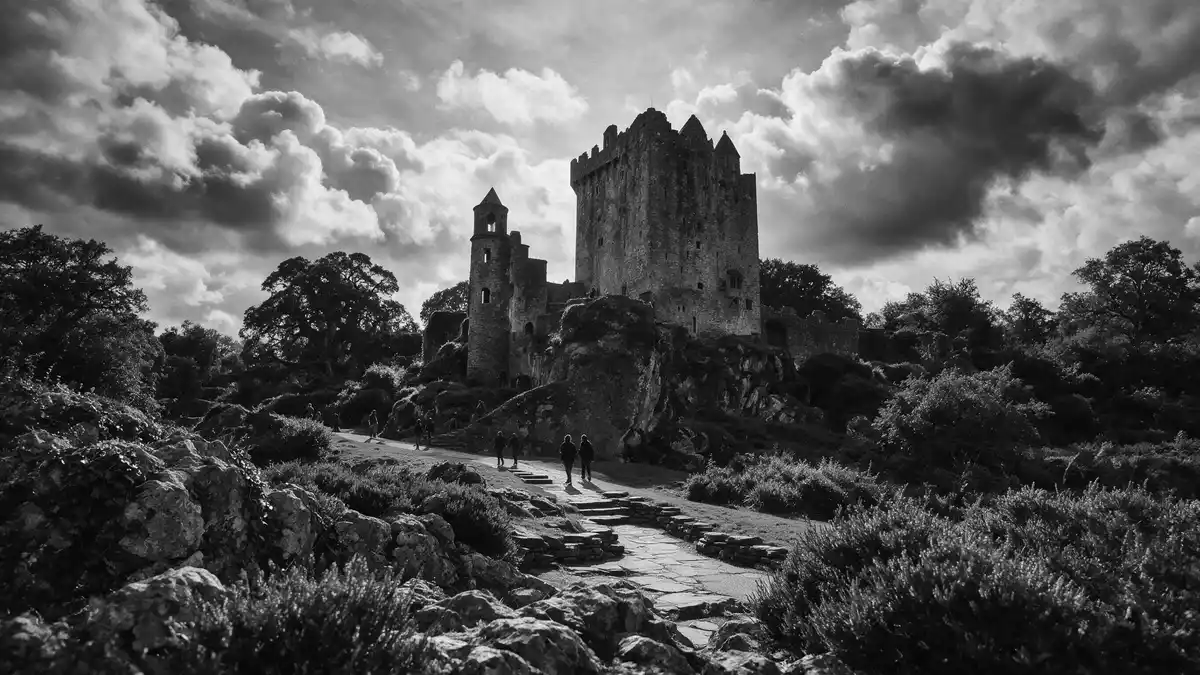
Caislean na Blarnan in Blarney, Ireland is a medieval stone tower house rising above parkland and water, known worldwide for the stone set into its battlements. The castle’s present form dates to the fifteenth century, when the MacCarthy dynasty reshaped earlier fortifications into the tall keep that still stands over the River Martin and the village below.
A fifteenth-century stronghold on older foundations
The site of Caislean na Blarnan carries a layered history of fortification, with traces of earlier wooden and stone structures giving way to the tower house that survives. The stronghold visible today is understood to be the third major castle on the site, following an early timber structure and a stone building erected around 1210.the third castle to have been erected on this site In 1446 Dermot McCarthy, King of Munster, rebuilt the fortification into the substantial stone keep that now dominates the landscape.built in 1446 by the McCarthys of Muskerry
The tower house forms the heart of a wider defensive complex, reflecting the power of the MacCarthy lords in late medieval Munster. As a residence and stronghold of the MacCarthys of Muskerry, a cadet branch of the Kings of Desmond, it stood within a network of castles that included Kilcrea and Carrignamuck in County Cork.MacCarthy of Muskerry dynasty, a cadet branch of the Kings of Desmond In the seventeenth century the castle passed from MacCarthy control after the Williamite War, its lands confiscated and eventually sold to Sir James St John Jefferyes, Governor of Cork, whose family later added a mansion and formal gardens nearby.purchased by Sir James St. John Jefferyes
The tower house and the stone in the battlements
The core of Caislean na Blarnan is a tall stone tower house with thick walls and multiple floors, characteristic of fifteenth-century Irish fortified residences. The oldest part of the tower is a rectangular block rising several storeys, later extended by an L-shaped addition that enlarged its footprint and provided more accommodation.medieval construction in two distinct phases Inside, a narrow spiral staircase in the north-east corner links the levels, opening through pointed-arch doorways onto chambers and guard rooms with splayed window embrasures overlooking the surrounding countryside.
High at the top of this tower lies the feature that has made Caislean na Blarnan so widely known: a block of stone set into the battlements, reached by visitors who lean back over a drop with assistance. Legends connect this stone to earlier royal sites and to the Stone of Scone, woven into stories of alliances between Cormac McCarthy, King of Munster, and Robert the Bruce after the Battle of Bannockburn in 1314.the stone eventually became known as the Blarney Stone Whatever its exact origin, the stone has become inseparable from the castle’s upper battlements and from the experience of visiting the keep itself.
Gardens, water and the surrounding estate
Caislean na Blarnan stands within a wider estate that combines defensive remnants, landscaped gardens and watercourses. The castle rises above the wooded banks of the River Martin, a small river in County Cork that curves through the grounds and provides a natural boundary to parts of the parkland.Blarney Castle in County Cork In the eighteenth century, the Jefferyes family laid out formal gardens and built a house close to the tower, creating a setting in which the medieval keep and later landscaping stand side by side.built a Georgian gothic house near the castle and laid out a fantastic landscape garden
Walks around the estate reveal contrasts between the vertical mass of the tower and the softer lines of lawns, rock features and tree-lined paths. The grounds include areas of formal planting near the mansion and more naturalistic sections with outcrops, steps and viewpoints aligned on the castle. From many points the stone keep remains the focal feature, its walls rising above foliage and water, with the upper battlements clearly visible against the sky.
Visiting Caislean na Blarnan: what travellers from Western Europe should know
- Caislean na Blarnan stands in the village of Blarney in County Cork, south-west Ireland, a short distance north-west of Cork city, and can be reached by road from the city and its transport hubs.
- The approach to the tower house involves walking through the estate and climbing a series of internal stone staircases, including a narrow spiral staircase with many steps to reach the upper battlements.
- The castle grounds extend over undulating terrain beside the River Martin, with paths crossing lawns, rock features and wooded sections that may involve short, uneven stretches underfoot.
- The official language is Irish and English and the currency is the euro.
Searching for Caislean na Blarnan on social platforms
These links open searches for Caislean na Blarnan on each platform.
Frequently asked questions about Caislean na Blarnan
Where is Caislean na Blarnan located?
Caislean na Blarnan stands in the village of Blarney in County Cork in the south of Ireland, a short distance north-west of the city of Cork.
What should visitors expect on a visit to the castle?
Visitors encounter a tall medieval stone tower house with internal staircases, an upper battlement containing the celebrated stone, and extensive estate grounds with lawns, trees and water.
What makes Caislean na Blarnan distinctive among Irish castles?
The combination of a fifteenth-century MacCarthy tower house, its well-known stone in the battlements and the surrounding landscaped estate beside the River Martin gives the site a character recognised far beyond County Cork.


