
Canyon de Chelly and its red sandstone walls
Published on 09/24/2026 at 00:49 | Editorial responsibility: Rafael Müller, Editor-in-Chief AD HOC NEWS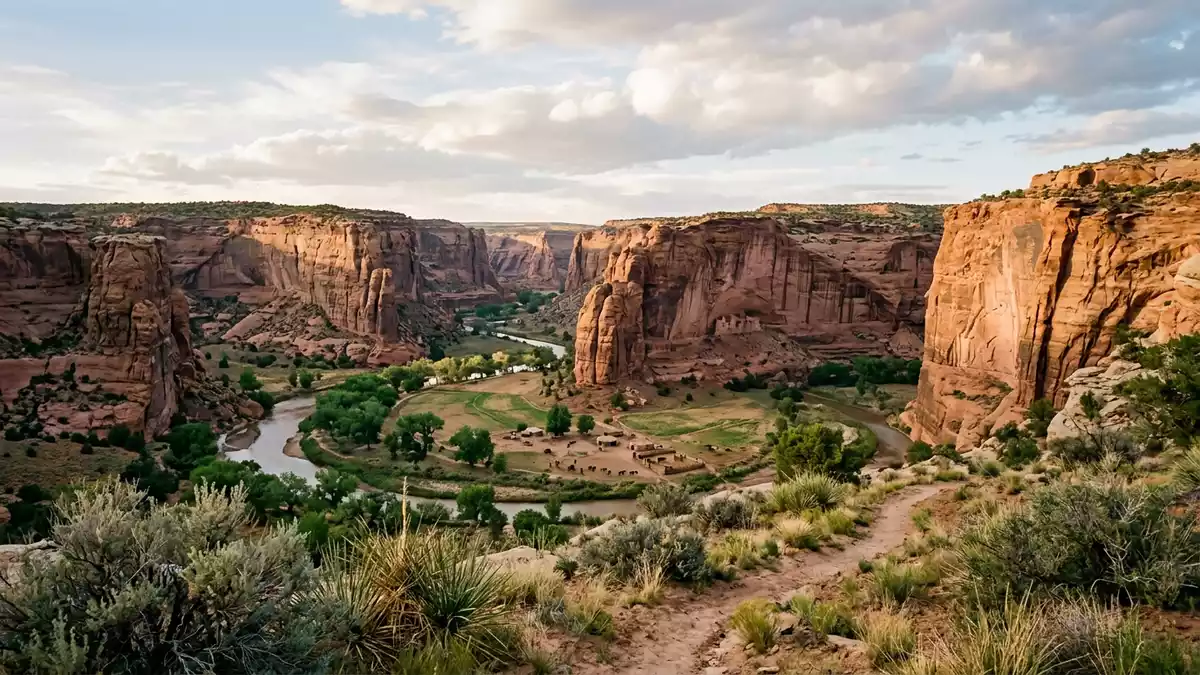
Canyon de Chelly is a canyon landscape of red sandstone walls, narrow side canyons and cultivated ground near Chinle in north-eastern Arizona. The cliffs rise as high as 366 metres (1,200 ft), while homes, farms and archaeological sites occupy the canyon system below.
Canyon de Chelly: a landscape cut through red sandstone
The monument lies within the Colorado Plateaus Physiographic Province, where uplift and stream erosion exposed layers of sedimentary rock. De Chelly Sandstone forms the principal red cliff faces, alongside the Supai Formation, the Cutler Group and the Triassic Chinle Formation.
The canyon system includes Canyon de Chelly, Canyon del Muerto and tributary canyons. Its walls contain alcoves, terraces and vertical faces, while resistant sandstone and caprock form isolated features such as Spider Rock and Face Rock. The geology reaches back through hundreds of millions of years, visible in bands of colour and changing textures along the cliffs. red sandstone cliff walls describe the monument’s most recognisable physical setting.
Five thousand years of homes, farms and memory
People have lived in these canyons for nearly 5,000 years. Archaeological remains include pit houses, cliff dwellings, pictographs, petroglyphs and villages associated with Ancestral Puebloan communities.
White House Ruin is the best-known named dwelling. Its buildings were constructed and occupied between 1060 and 1275, within an alcove beneath a sandstone cliff. The upper structure has a long wall covered with white plaster, giving the ruin its English name. Other named sites include Antelope House and Mummy Cave.
Hopi traditions remain connected with ancestral places in the canyon. Navajo families also live, farm and raise livestock within the monument, which lies entirely on Navajo Nation land. The Navajo name Tseyi’ refers to the place within the rocks, while the National Park Service and Navajo Nation share management responsibilities. the place called Tseyi’ links the landscape’s name with its continuing cultural life.
Spider Rock, White House and the canyon rims
Spider Rock rises from the canyon floor as a tall sandstone spire at the junction of Canyon de Chelly and Monument Canyon. From the rim, it appears as an isolated column against the surrounding cliffs. In Diné tradition, Spider Woman is associated with Spider Rock and with the teaching of weaving.
Two rim roads provide viewpoints over the main canyons. The North Rim looks towards Canyon del Muerto and sites including Antelope House, while the South Rim reaches views of White House and Spider Rock. The overlooks show the relationship between the narrow canyon floor, red walls and broad plateau above.
The monument was established on 14 February 1931 under President Herbert Hoover. It covers approximately 33,929 hectares (83,840 acres) and protects archaeological resources alongside a living community. the 1931 designation placed this inhabited landscape within the National Park System.
Visiting Canyon de Chelly: what travellers from Western Europe should know
- Canyon de Chelly lies beside Chinle in north-eastern Arizona. By car, the usual approach follows U.S. Highway 191 through Chinle, then Indian Route 7 towards the monument.
- The canyon floor contains farms, homes, archaeological sites and narrow washes. Rim viewpoints are reached by road, while the White House route descends by foot from the South Rim.
- Access beyond the public rim viewpoints is connected with Navajo cultural authority. Guided canyon excursions use authorised Navajo guides and travel through a living landscape.
- The official language is English and the currency is the US dollar.
- Entry requirements depend on your nationality; UK travellers can check the FCDO travel advice at gov.uk/foreign-travel-advice, Irish travellers the Department of Foreign Affairs at ireland.ie.
Searching for Canyon de Chelly on social platforms
These links open searches for Canyon de Chelly on each platform.
Frequently asked questions about Canyon de Chelly
Where is Canyon de Chelly?
Canyon de Chelly is beside Chinle in Apache County, north-eastern Arizona. The monument lies entirely within Navajo Nation land in the Four Corners region.
What can visitors expect to see?
Rim roads and overlooks show red sandstone cliffs, Spider Rock, White House Ruin and farms on the canyon floor. Walking and guided excursions offer different views of the canyon landscape.
What makes Canyon de Chelly distinctive?
Its archaeological record spans nearly 5,000 years, while Navajo families continue to live and work within the canyon. Red cliffs, ancestral dwellings and present-day agriculture share the same protected landscape.


