
Cape Coast Castle in Ghana’s Cape Coast: a stone fortress on the Atlantic edge
Published on 09/17/2026 at 22:38 | Editorial responsibility: Rafael Müller, Editor-in-Chief AD HOC NEWS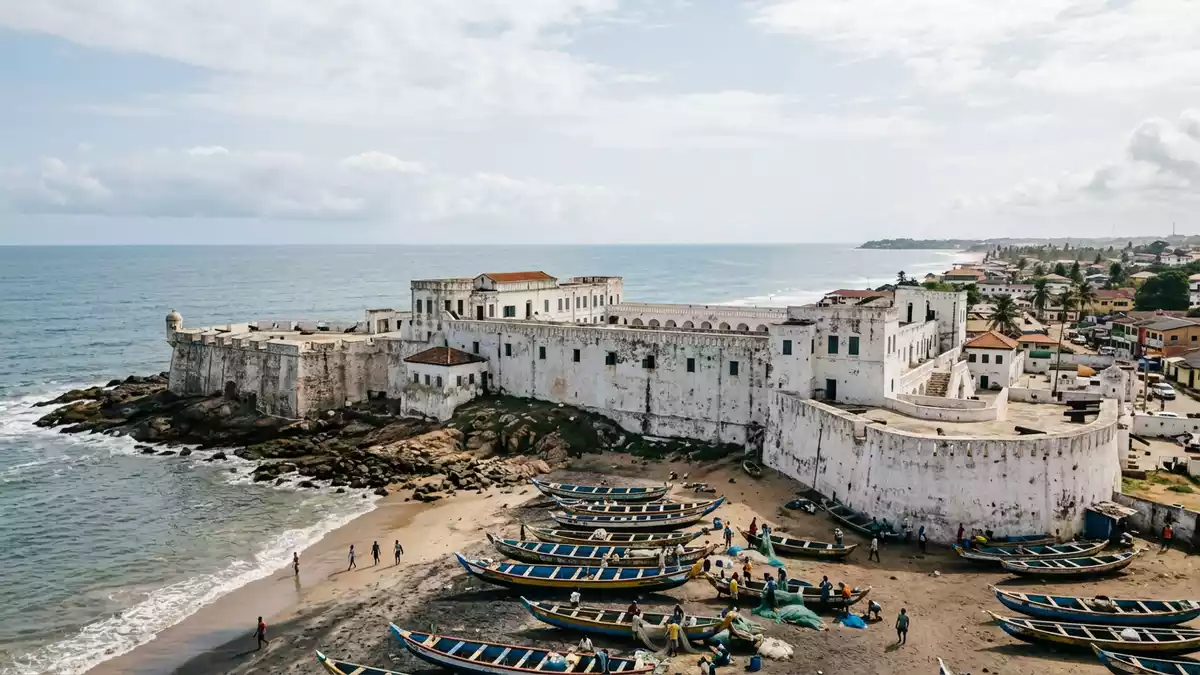
Cape Coast Castle on Ghana’s central shoreline is a stone fortress pressed between the Atlantic surf and the streets of Cape Coast, a place where massive walls, inner courtyards and sea-facing battlements remain in use as a museum of West African and transatlantic history. The site grew from a Portuguese trading post in 1555 into a fortified stronghold reshaped by Swedish, Dutch and British power, and since 1974 it has been open as a historical museum inside the former colonial headquarters.
A European-built fortress on Ghana’s central coast
Cape Coast Castle occupies a rocky stretch of the Gulf of Guinea at Cape Coast, a harbour town in southern Ghana whose shoreline carries a line of fishing boats, low buildings and coastal forts. The castle itself developed from a Portuguese trading post called Cabo Corso, established in 1555 as a “short cape” on the West African coast, into a timber fort built for the Swedish Africa Company in 1653 and named Carolusborg after Charles X Gustav of Sweden.Portuguese trading post Cabo Corso Control of the fort soon shifted among European powers, with Danes and Dutch occupying the site before British forces under Captain Holmes captured it in the 1660s and began turning the fort into a larger stone castle.
By about 1700 the British had upgraded Cape Coast Castle into a full stone-built fortress with thick sea walls, towers such as Dalzel Tower and heavy cannon batteries facing the ocean, and it later served as the headquarters of the British colonial governor on the Gold Coast.upgraded into a castle by 1700 From 1821 it acted as the seat of government for the British colony before that role moved to Accra in 1877, leaving the fortress to take on new administrative, educational and military uses under colonial rule.headquarters of British colonial administration
Architecture of stone walls, courtyards and dungeons
The architectural character of Cape Coast Castle is defined by its heavy masonry, stepped terraces and enclosed courtyards arranged around a central open space. Early Swedish and British building campaigns created thick stone ramparts and bastions that face the sea, with cannon and mortars positioned along the parapets to control access to the harbour.Dalzel Tower, cannons and mortars Behind these outer defences, ranges of whitewashed buildings frame internal courtyards, with arched passageways connecting administrative rooms, storage spaces and the governor’s quarters.
Beneath the main courtyard and sea-facing walls lie the stone-vaulted dungeons that once held large numbers of captive Africans before departure on slave ships across the Atlantic.Cape Coast Castle dungeons These underground chambers form some of the most striking spaces in the castle, with low ceilings, narrow doorways and limited light contrasting with the open air of the upper terraces. The complex also houses the West African Historical Museum, whose exhibits cover the arrival of Europeans, coastal culture and the Atlantic slave trade, and whose galleries occupy former administrative rooms around the courtyard.West African Historical Museum
From trading post and slave fort to museum and World Heritage site
In its early centuries Cape Coast Castle functioned as a hub for timber, gold and textile trade along the Gold Coast, with merchants using its warehouses and secure harbour-side position to store and ship goods towards Europe.trade in gold, wood and textiles During the eighteenth century the fort became one of the principal centres of the British transatlantic slave trade in West Africa, with its dungeons and courtyards serving as holding areas for enslaved Africans taken from inland regions and coastal settlements before embarkation towards the Caribbean and the Americas.principal shipping point for enslaved people
Britain’s legal abolition of the slave trade in 1807 did not immediately end enslavement in the region, but the role of the castle shifted towards education, administration and military use under colonial authorities.educational and administrative centre After Ghana’s independence in 1957, the Ghana Museums and Monuments Board took over responsibility for the building, which was restored in the 1920s and again in the early 1990s and opened as a museum in 1974.opened as a museum in 1974 Cape Coast Castle forms part of the Forts and Castles, Volta, Greater Accra, Central and Western Regions inscription on the UNESCO World Heritage List, recognising the chain of coastal forts built and occupied at different times by traders from Portugal, Sweden, Denmark, Holland, Germany and Britain.UNESCO World Heritage listing
Visiting Cape Coast Castle: what travellers from Western Europe should know
- Cape Coast Castle stands beside the Atlantic Ocean in Cape Coast in southern Ghana, along the country’s central coastline, and is reached by road from other coastal towns and from Accra.
- Within the castle, movement involves stone steps, uneven masonry floors and staircases between levels, including access down to the dungeons and up to the sea-facing ramparts.
- The official language is English and the currency is the Ghanaian cedi.
- Entry requirements depend on your nationality; UK travellers can check the FCDO travel advice at gov.uk/foreign-travel-advice, Irish travellers the Department of Foreign Affairs at ireland.ie.
Searching for Cape Coast Castle on social platforms
These links open searches for Cape Coast Castle on each platform.Frequently asked questions about Cape Coast Castle
Where is Cape Coast Castle?
Cape Coast Castle stands on the Atlantic coast in the town of Cape Coast in southern Ghana, on the country’s central shoreline.
What can visitors expect inside Cape Coast Castle?
Visitors encounter stone ramparts, inner courtyards, underground dungeons and museum galleries presenting the history of trade, colonial rule and the transatlantic slave trade.
What makes Cape Coast Castle distinctive among coastal forts?
The castle combines a long history as a European-built trading and slave fort, a period as British colonial headquarters and its current role as a museum within a UNESCO-listed chain of coastal forts.


