
Capilano Suspension Bridge and the forest canyon of North Vancouver
Published on 09/04/2026 at 15:38 | Editorial responsibility: Rafael Müller, Editor-in-Chief AD HOC NEWS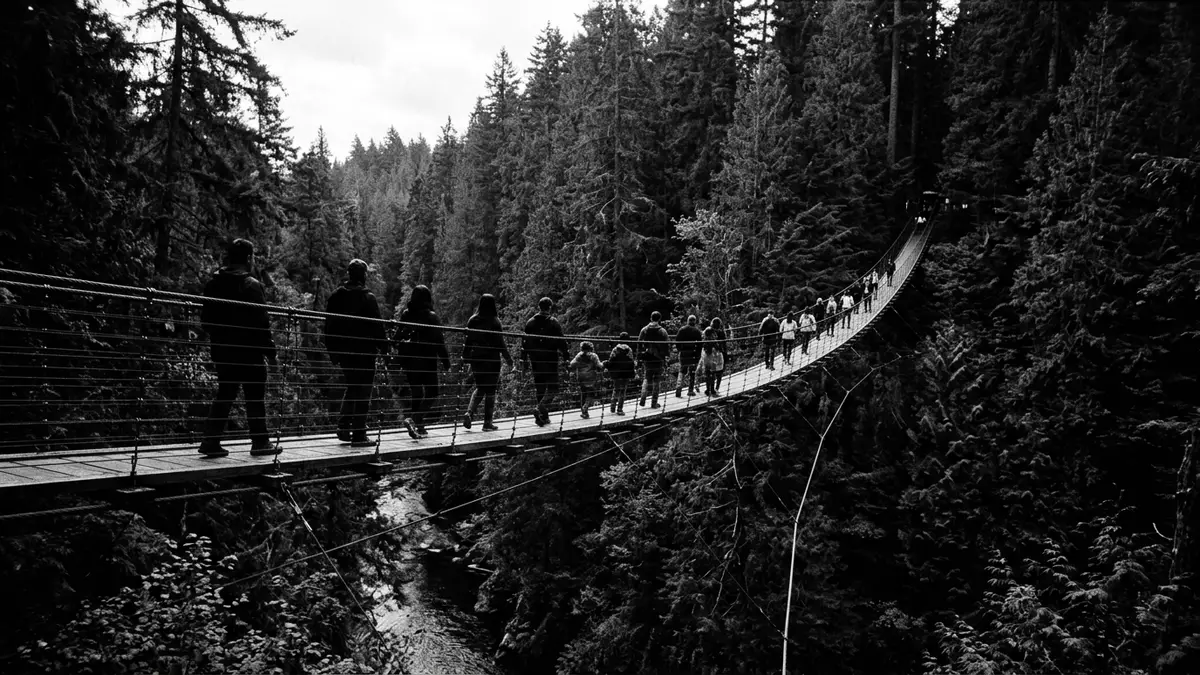
Capilano Suspension Bridge in North Vancouver is a long pedestrian suspension bridge that spans a steep canyon above the Capilano River, combining nineteenth-century origins with a modern forest park of walkways and viewing platforms. First completed in 1889 for Scottish civil engineer George Grant Mackay, it has evolved into a timber-decked steel suspension structure surrounded by trails, treetop bridges and cliffside paths in the coastal rainforest of British Columbia.
A historic crossing high above the Capilano River
The history of Capilano Suspension Bridge begins with George Grant Mackay, a Scottish civil engineer who established a cliffside cabin above the Capilano River in the late 1880s. To reach land on the opposite side of the canyon he commissioned a simple suspension crossing made of hemp ropes and cedar planks, which was in place by 1889 and provided the first direct route over the gorge.built in 1889
Early versions of the bridge were progressively replaced by stronger constructions as visitor interest grew. A wire cable bridge was built in 1903, giving the span a more robust form with steel cables and timber decking anchored into the canyon rim.wire cable bridge in 1903 The present Capilano Suspension Bridge dates from 1956 and continues the line of the earlier crossings in a single suspended walkway of steel cables and timber that carries pedestrians across the canyon.present bridge built in 1956
Dimensions, structure and the canyon setting
The span of Capilano Suspension Bridge is about 137 m (450 ft) from bank to bank, forming a narrow deck that hangs above the Capilano River and aligns with the curves of the canyon.450 ft long, 137 m The walkway rises roughly 70 m (230 ft) above the water, with handrails and vertical supports framing views up and down the forested gorge.70 m above the river At each end of the bridge, the main cables are anchored into the rock near the top of the canyon walls, and the timber deck runs as a single suspended line between these points.
Surrounding the bridge is a dense stand of coastal rainforest typical of the lower slopes of the North Shore mountains. Mature Douglas firs and other conifers rise from the canyon rim and valley floor, and the river cuts a winding course below the deck before turning through the forest beyond. Wooden steps and pathways lead from the landward side of the park down towards viewpoints and up to higher terraces, giving different angles on the bridge and on the river in its gorge.rainforest setting
A forest park of walkways, totem poles and treetop bridges
Capilano Suspension Bridge Park extends beyond the main crossing into a wider attraction built among the trees on both sides of the canyon. On one side, visitors find nature trails, interpretive displays about the forest and a collection of poles and carvings that reflect First Nations culture, particularly of the Squamish people whose territory includes the Capilano area.history and culture exhibits The presence of carved poles and life-sized figures gives the park a distinct character among regional attractions.
Further into the trees, the park includes elevated experiences such as Treetops Adventure, where a series of smaller suspension bridges link platforms high in the canopy of large Douglas firs.Treetops Adventure bridges Along the canyon wall, Cliffwalk carries a narrow path of cantilevered walkways that follow the rock face above the river. Together with the central span, these elements make Capilano Suspension Bridge Park a place where the canyon, forest and structures are closely intertwined, from ground-level trails to high-level crossings.
Visiting Capilano Suspension Bridge: what travellers from Western Europe should know
- Capilano Suspension Bridge Park lies in North Vancouver, on the north side of Burrard Inlet opposite central Vancouver, and is reached by road along Capilano Road from the city.
- The bridge crosses a deep canyon, and access within the park involves wooden stairways, sloped paths and elevated walkways that include steps and changes of level.
- The Capilano River flows beneath the bridge in a forested gorge, and viewpoints on both sides of the canyon give sightlines to the water and the surrounding trees.
- The official language is English and the currency is the Canadian dollar.
- Entry requirements depend on your nationality; UK travellers can check the FCDO travel advice at gov.uk/foreign-travel-advice, Irish travellers the Department of Foreign Affairs at ireland.ie.
Searching for Capilano Suspension Bridge on social platforms
These links open searches for Capilano Suspension Bridge on each platform.
Frequently asked questions about Capilano Suspension Bridge
Where is Capilano Suspension Bridge located?
Capilano Suspension Bridge spans the Capilano River in North Vancouver, British Columbia, on the forested slopes north of Burrard Inlet.
What can visitors expect when crossing the bridge?
Visitors walk along a timber deck that hangs from steel cables high above a canyon, with views of the river, forest and surrounding cliffs on either side.
What makes Capilano Suspension Bridge distinctive among Vancouver attractions?
Capilano Suspension Bridge combines a historic suspension crossing dating from 1889 with treetop bridges, cliffside walkways and cultural exhibits set in dense coastal rainforest.


